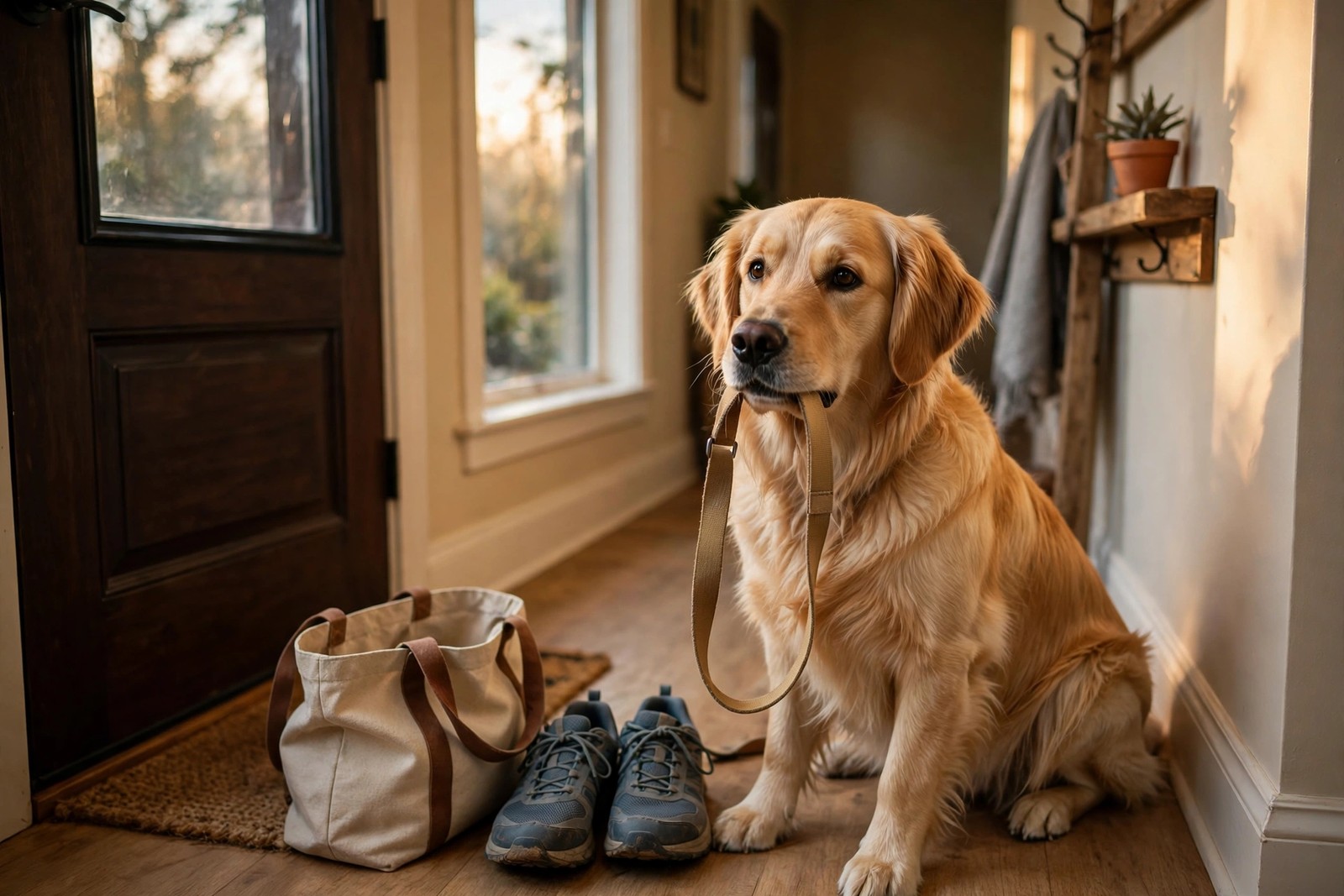
Your dog is not confused about the time; your dog is early on purpose. A walk that happens at a regular hour becomes a highly predictable event in a dog's day, and dogs read the approach of that hour through several channels at once: the angle and quality of the light, the sounds of the household shifting gear, hunger and toilet rhythms, and an internal body clock that tracks daily routines closely. An hour out, anticipation switches on, and your dog starts preparing in the only way available — by gathering the equipment.
Why the Equipment, and Why the Door?
The lead, shoes, and bags are the objects your dog has watched you collect, in roughly the same order, hundreds of times. Dogs learn chains by association: shoes appear, then the lead comes off its hook, then the door opens. Carrying those items to the door is your dog running the opening steps of the chain, partly as rehearsal and partly as communication. There is also a learning history behind it. If even once or twice a delivered lead produced an earlier walk, a laugh, or a fuss, the ferrying was rewarded, and rewarded behaviour gets repeated and refined. Some dogs extend their service over time, graduating from the lead to shoes, then to any bag associated with outings.
Harmless Anticipation or Building Anxiety?
Enjoy the behaviour while your dog's body stays loose: soft tail sweeps, play bows, pauses to sniff or settle between deliveries, and the ability to nap during the waiting hour all say this is happy expectation. The picture changes if the hour fills with pacing between door and owner, panting with a wide and tense mouth, whining that builds rather than fades, or scratching at the door itself. That is anticipation tipping into frustration, and it is worth reshaping rather than laughing off, because a dog who rehearses an hour of arousal before every walk often arrives at the park already wound up and harder to settle.
Keeping the Waiting Hour Calm
- Hold the departure time steady, because a walk that sometimes comes early teaches your dog that ferrying and pestering genuinely work.
- Reward the pauses, not the deliveries — praise, and occasionally treat, your dog for lying down during the waiting hour, so calmness becomes part of the chain.
- Give the build-up somewhere to go: a long-lasting chew, a snuffle mat, or treats scattered in the grass occupies anticipation without feeding the door vigil.
- Vary tiny, non-essential elements, such as a different jacket or keys picked up at a different point, so no single cue carries the whole charge.
- If you must delay a walk, offer a garden toilet break rather than letting your dog watch you almost-prepare for half an hour.
When the Household Clock Changes
If work shifts or the seasons move your walk by an hour, expect the ferrying to move too, usually within a week or two of the new routine settling, as your dog re-anchors to the new pattern of light and household rhythm. Helping means keeping the new time boring in its consistency, whoever in the house does the walking. A dog whose anticipation suddenly appears at odd hours, paired with appetite or sleep changes, is giving you health information rather than a training puzzle, and a vet conversation is the right next step. Recording who walks your dog and at what time in KinsLe's Care Teams, where each completed walk is marked with a timestamp, keeps the schedule identical across the whole household — and a schedule your dog can trust is what keeps that early gathering at the door a party trick instead of a pressure valve.