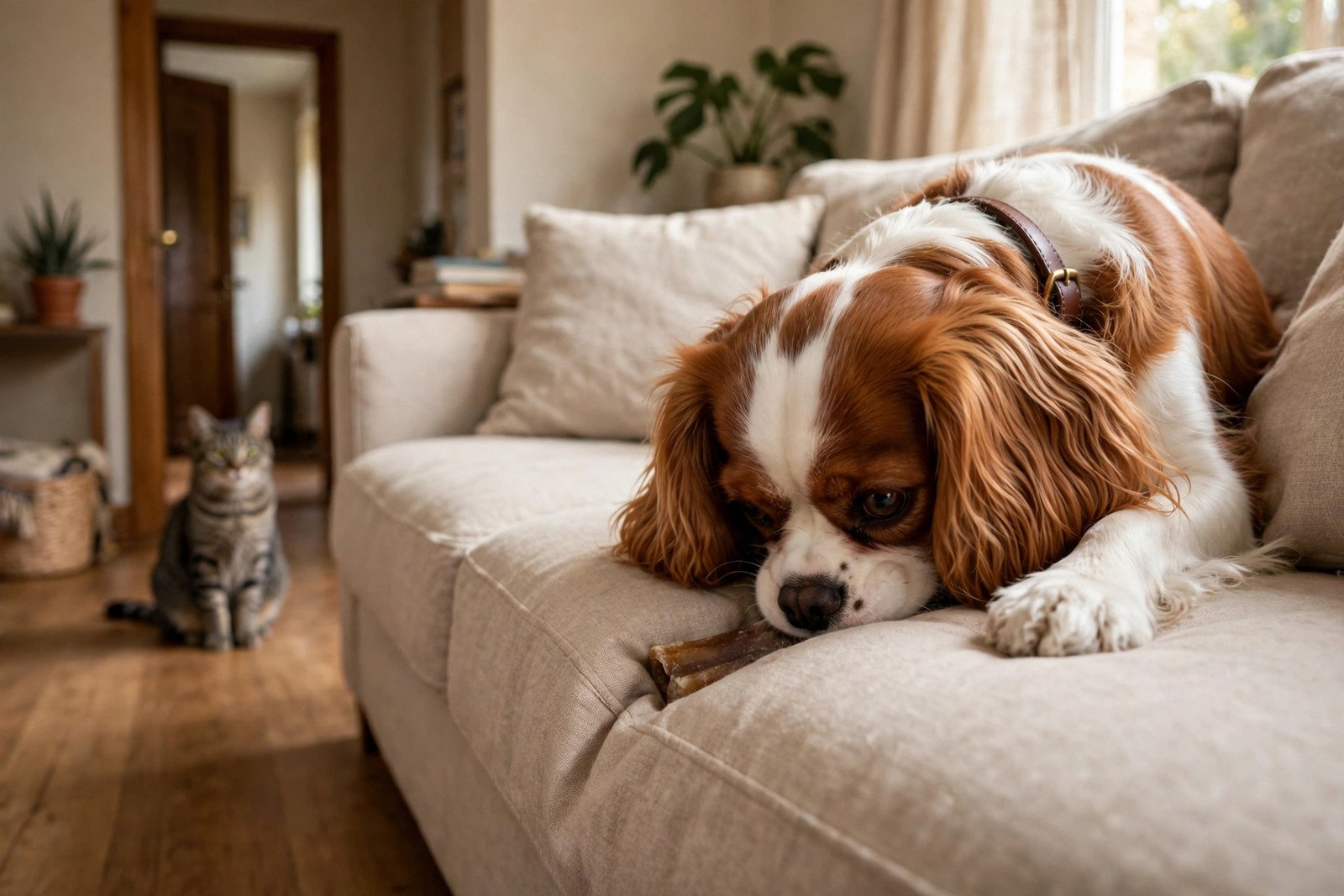
Caching is one of the oldest strategies your dog owns. A dog handed a bone or a long-lasting chew worth more than one sitting faces an ancient problem: eat it all now and lose the surplus, or store it somewhere rivals will not find it. Wild canids solve this by burying food in earth, and your dog solves it with the materials available indoors. Sofa cushions push apart like soil, hold scent, and sit in a room your dog treats as home territory. The nose-push movements against the fabric, the patting down, and the satisfied survey of the finished job are the full burying sequence, performed on upholstery.
Why the Cat Gets Guarded Off
A cache is only a store if it stays undisturbed, so guarding the spot is not a separate behaviour — it is the completion of the same one. The cat is, from your dog's perspective, the most plausible thief in the house: mobile, curious, and historically interested in anything the dog values. Expect the warning ladder to be subtle at first. A dog who goes still over the cushion, positions its body between the cat and the hiding place, tracks the cat with hard eyes, or gives a low growl is communicating clearly and early. Those signals deserve respect rather than correction, because a dog punished for growling learns to skip the warning, not to feel safer about the cache.
Making Chew Time Safe and Sofa-Friendly
- Move the whole event. Give bones and long-lasting chews in one confined, washable area — a kitchen corner, a pen, or a crate your dog already likes — so caching never starts on the furniture.
- Size the chew to the session. A chew your dog can finish in one sitting leaves nothing to store; oversized chews are the ones that get buried.
- Trade up at the end. When the session finishes, exchange the remnant for something small and tasty, then put the remnant away yourself; a dog who knows leftovers get collected calmly has less reason to hide them.
- Keep the cat out of the chew area entirely while a bone is in play, using a door or gate rather than relying on either animal's restraint.
- Wash cushion covers after clearing a cache out; the lingering smell of a buried bone keeps a spot marked as a pantry in your dog's mind.
When Guarding Outgrows the Cache
Caching with mild guarding of one spot from one cat is manageable with the routine above. Take it more seriously if the guarding spreads: your dog begins guarding resting places, ordinary toys, the water bowl, empty floor space where a chew once lay, or people. Guarding that generalises, guarding directed at children, or any snap or bite means the conversation moves to your vet and a qualified behaviourist, and unsupervised chews go on hold meanwhile. Puppies who cache are not automatically future guarders, but teaching a puppy early that hands approaching during chew time predict extra food arriving, not theft, is time well spent.
One Household Rule, Applied by Everyone
This behaviour unravels when one person hands over bones on the sofa, another takes them away without a trade, and a third lets the cat wander through chew time. The fix is unglamorous and effective: one chew location, one end-of-session trade, one rule about the cat. Writing that routine into KinsLe's Care Teams, where chew-time supervision and clear-up can be assigned and ticked off by whoever is home, keeps your dog's lessons identical every day — and a cache-guarding dog who can predict exactly how chew time works is a dog with far less to guard.