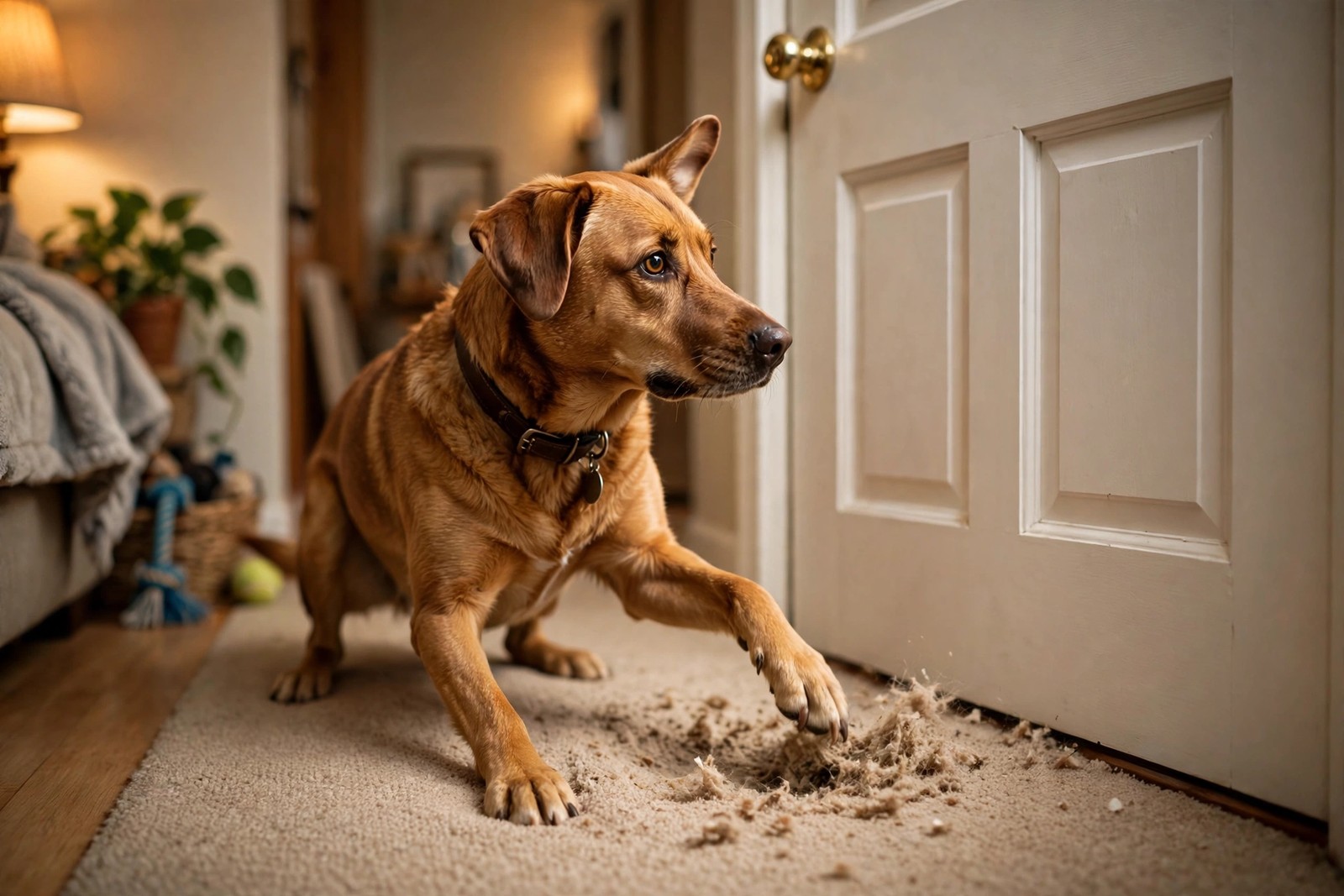
Your dog knows exactly where the visitors are. Sound, scent, and laughter all travel under and around a closed door, and the gap at the bottom is where that information is strongest — which is precisely where the digging lands. Digging is a dog's barrier tool: outdoors it moves earth, indoors it becomes a rapid pawing at carpet pile, underlay, and the draught excluder, aimed at widening the one weak point in the barrier. The behaviour is goal-directed, not random destruction, and the goal is access to the social event on the other side.
Frustration, Anxiety, or Simple FOMO?
Three drivers produce the same digging, and they need slightly different handling. The sociable frustrated dog digs in bursts, whines in a rising, demanding tone, listens at the door between efforts, and would explode joyfully into the room if the door opened; this dog is barred from a party it fully expected to attend. The anxious dog digs more frantically and less rhythmically, pants and drools, cannot settle on a bed or chew even in a quiet room, and is unsettled by strangers in the house rather than eager to join them. The habitual dog has simply learned that digging at that door has worked before — a door opened "just to check" is a full reward — and digs promptly and almost cheerfully on that basis.
The Setup Owners Often Miss
Being shut in the room nearest the gathering is the hardest seat in the house: close enough to hear every laugh and smell every snack, with no way to participate. If your dog must be separated during visits, distance is kinder than proximity. Settle the dog before visitors arrive, in a room at the far end of the house that already has restful associations, with a long-lasting chew, a familiar bed, and ordinary background sound. Arriving guests should not be audible as a doorstep performance the dog is locked away from mid-flow; the settling happens first, while the house is still calm, and the dog misses nothing because the event has not started yet.
The Managed-Join Alternative
Many door-diggers do perfectly well at the visit itself, given structure. Let the dog join once guests are seated, on a lead at first, with a mat to settle on and a chew for the boring stretches; reward calm behaviour, and remove the dog briefly — without drama — if mugging guests for food or attention escalates. Visiting children, guests who fear dogs, or a dog who guards the household change the calculation entirely, and separation with distance is the right call for those visits. What does not work is the halfway pattern: dog shut nearby, released when the digging peaks, shut away again when the excitement peaks. That sequence pays the digging, punishes the release, and trains both behaviours at once.
Protecting Carpet and Calming the Habit
A clear mat or board over the digging spot protects the floor while you change the setup, and it is worth fitting one the same day, because ingrained digging at a frayed patch gets easier for the dog each time the carpet gives a little. Practise the visitor routine on ordinary days: door closed, dog settled with a chew on the far side of the house, people moving and talking in the other room, then quiet praise for a dog who stays settled. Two or three calm rehearsals teach the shape of the event far better than corrections delivered mid-visit. Giving one household member the settle-the-dog task through KinsLe's Care Teams, set up before each visit and marked done when the dog is settled, means the routine starts before the doorbell rather than being improvised around it — and a dog settled early, far from the action, is a dog with nothing to dig toward.