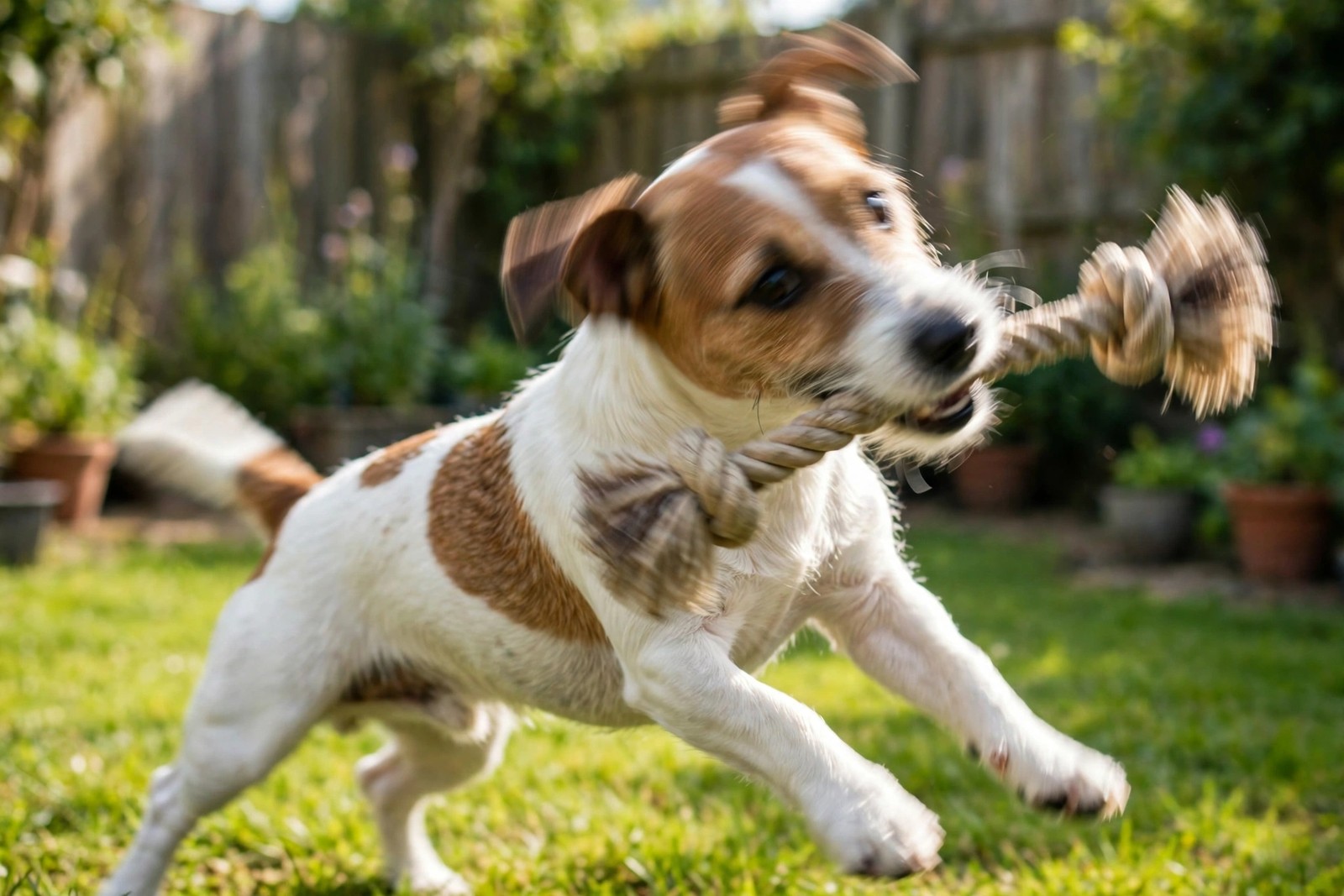
Grab, clamp, and shake until the toy's seams give up: it can look alarming, but your dog is performing one of the oldest moves in the canine repertoire. Toy shaking is the rehearsal of a hunting step, played out on a plush pheasant or a rope toy in your living room, and for many dogs it is a deeply satisfying form of play.
The predatory sequence, played out on a toy
Wild canids catch food through a sequence: search, stalk, chase, grab, shake, and then eat. The shake — a rapid side-to-side whip of the head with prey held in the jaws — is the step that stuns or breaks the neck of small prey. Breeds were shaped by which steps humans emphasised: terriers were developed to pursue and dispatch rats and other vermin, so their grab-and-shake step is particularly strong and gleeful. Your dog is not frustrated, angry, or imagining anything sinister; she is running an inherited motor pattern that feels intrinsically rewarding, which is why she will shake a toy with nobody watching and nothing to gain.
Why it is play, not aggression
Context separates play shaking from anything concerning. A playing dog has a loose, wiggly body, takes breaks, drops the toy to invite another round, and happily trades it for a treat or a different game. Shaking during play is aimed at the toy, punctuated by play bows, bounces, and pauses. Behaviour that deserves a calmer response looks different: a dog who stiffens over a toy, guards it with a hard stare or growl when approached, or redirects snapping toward hands or other dogs. That is resource guarding or over-arousal, not ordinary play, and it is best worked on with a qualified trainer using reward-based methods.
Making shake play safe
A determined shaker dismantles weak toys fast, and swallowed stuffing, squeakers, and fabric strips are genuine hazards. Choose toys built for vigorous play, sized so your dog cannot fit the whole toy in her mouth, and inspect them regularly for split seams and loosening parts. Supervise shake sessions, put damaged toys straight in the bin rather than back in the basket, and teach a reliable drop-and-trade: offer a high-value treat, let her release the toy willingly, and return it when it is safe, so giving things up never feels like losing.
Giving the drive a proper outlet
Dogs who love the shake usually adore structured games that use the same sequence. A flirt pole — a lure on a rope that she can chase, grab, and shake under your control — rehearses the whole pattern in a few energetic minutes. Short tug games with clear start and stop cues, and scatter-feeding or hide-and-seek games that use the search step, round out the outlet. Ending play while she is still engaged, rather than exhausted, keeps these games something she looks forward to.
Reading the shake itself
Not every shake carries the same enthusiasm, and the details are informative. A dog shaking a soft toy gently while trotting about is amusing herself; a dog who locks on, stills, and then shakes with full neck power is deep in the predatory pattern and will be slower to respond to her name in that moment, because the sequence is absorbing rather than disobedient. Interrupt by trading, not by grabbing the toy from her jaws mid-shake, which can turn a game into a contest. Breeds and individuals differ hugely: many retrievers carry toys tenderly for years, while a terrier may dismantle the same toy in an afternoon, and neither dog is behaving better — they are expressing different slices of the same inherited sequence.
In a shared household, the safety habits only work if everyone follows them. KinsLe's Care Teams lets you assign toy checks and play duties to each family member with completed tasks timestamped, so the toy with the split seam is thrown away once and noted, rather than quietly returning to the basket.