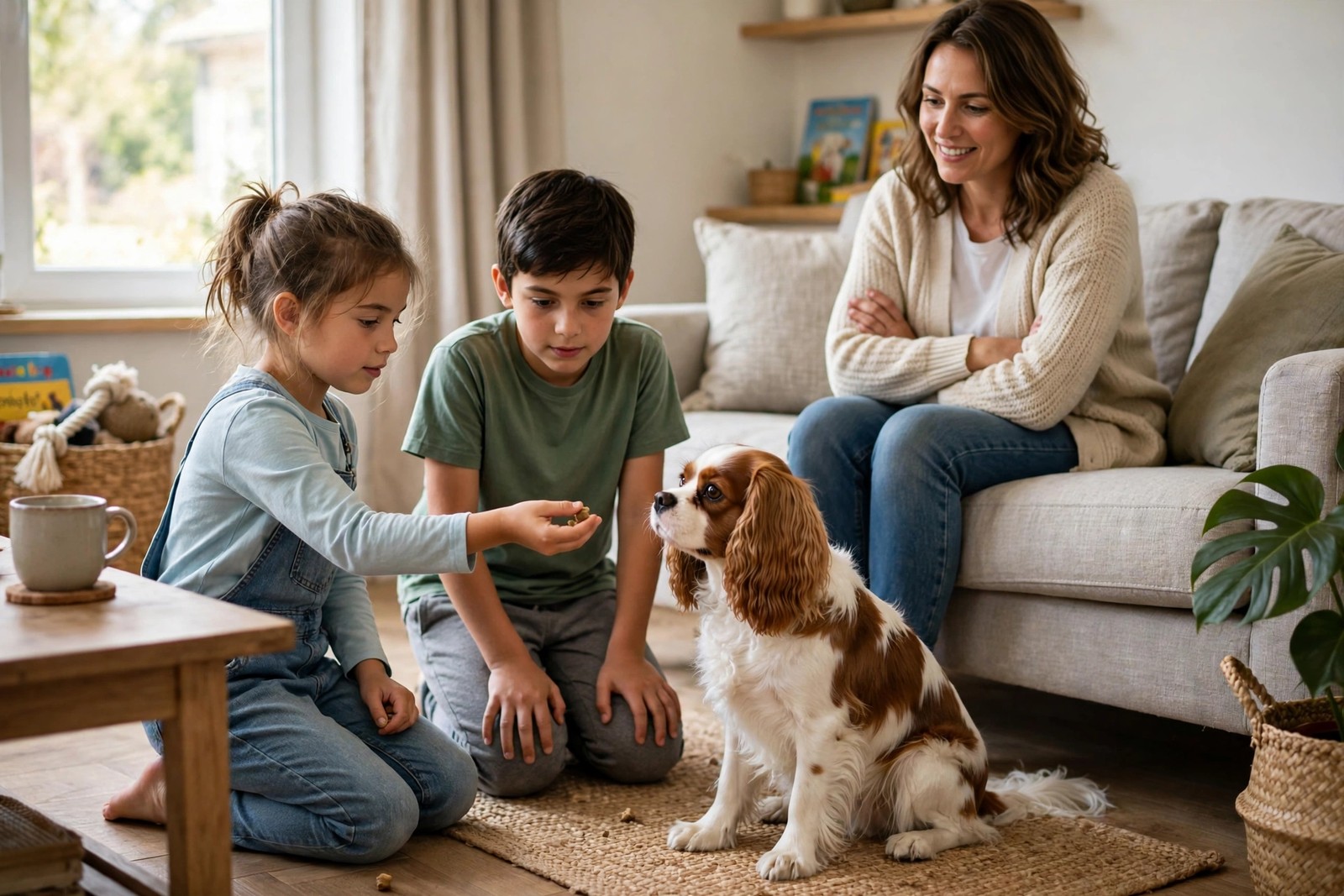
Consistency usually fails at the cue, not at the dog. One child says "sit down," another says "sit" while pointing at the floor, and a third repeats "sit, sit, sit" until the dog guesses. The dog is not being stubborn; each person is teaching a slightly different behaviour. The fix is to make the children trainers inside one shared system: one word, one hand signal, one reward, delivered the same way by everyone.
Build One Shared Cue Chart
Start with the cues the dog already knows best, usually sit, down, come, wait and leave it. For each one, agree a single word and a single clear hand signal, then write both on a chart at child height near the treats. Sit might be an open palm lifted upward; come might be both arms opened wide. Beside each cue, note what the dog earns: a small treat from the flat of the hand, a tossed treat to chase, or a favourite toy thrown once. Nobody invents a new word mid-session, nobody repeats a cue more than once, and nobody issues a cue they cannot pay for. If a child asks for a behaviour and has no reward ready, an adult quietly supplies one, so the dog still gets paid and the rule stays intact.
Give Each Child a Job They Can Do Well
Match jobs to age and confidence rather than handing every child every cue. Younger children shine at games where the dog comes to them: hide-and-seek recall around the sofa, scattering treats in the grass for a find-it, or holding the treat pot while an adult handles the lead. Older children can run short sit, down and wait sequences, or teach a simple trick such as a paw or a spin, using the chart's words and signals. Set two safety rules that never bend: an adult is always present during practice, and training stops if anyone feels frustrated, because raised voices and grabbed collars teach the dog that children are unpredictable. Children also learn what not to practise: no cueing the dog away from food, no rehearsing greetings at the front door until the dog is calm with adults first.
Run Short Family Practice Rounds
Practise for five minutes, twice a day, and end while the dog still wants more. In each round, one child works the dog while the others watch for the exact moment the reward should land, which teaches timing faster than any lecture. Rotate who trains, who watches and who restocks the treat pot, so every child learns every role. Keep a simple score on the chart: which cues the dog answers first time from each child. A cue that works from adults but not from the youngest child usually needs a clearer signal or a better-paid reward, not more repetitions aimed at the dog.
Fix Drift Without Blaming the Child
Drift is normal: within a fortnight someone will be saying "stay" instead of "wait," or paying a down with praise alone while everyone else pays with food. Hold a five-minute family reset once a week, run each cue once per person, and correct the chart or the habit on the spot, kindly and briefly. If the dog starts ignoring one person in particular, watch that person's rounds first: signals get smaller, treats arrive late, or cues get repeated. Coaching the human fixes it far faster than drilling the dog, and it keeps children feeling like trusted trainers rather than the weak link.
In KinsLe, Care Teams turns that chart into shared duties: assign the morning and evening practice rounds to named children, and each finished round is logged with a timestamp, so you can see at a glance that the dog heard the same cues, the same way, from everyone today.