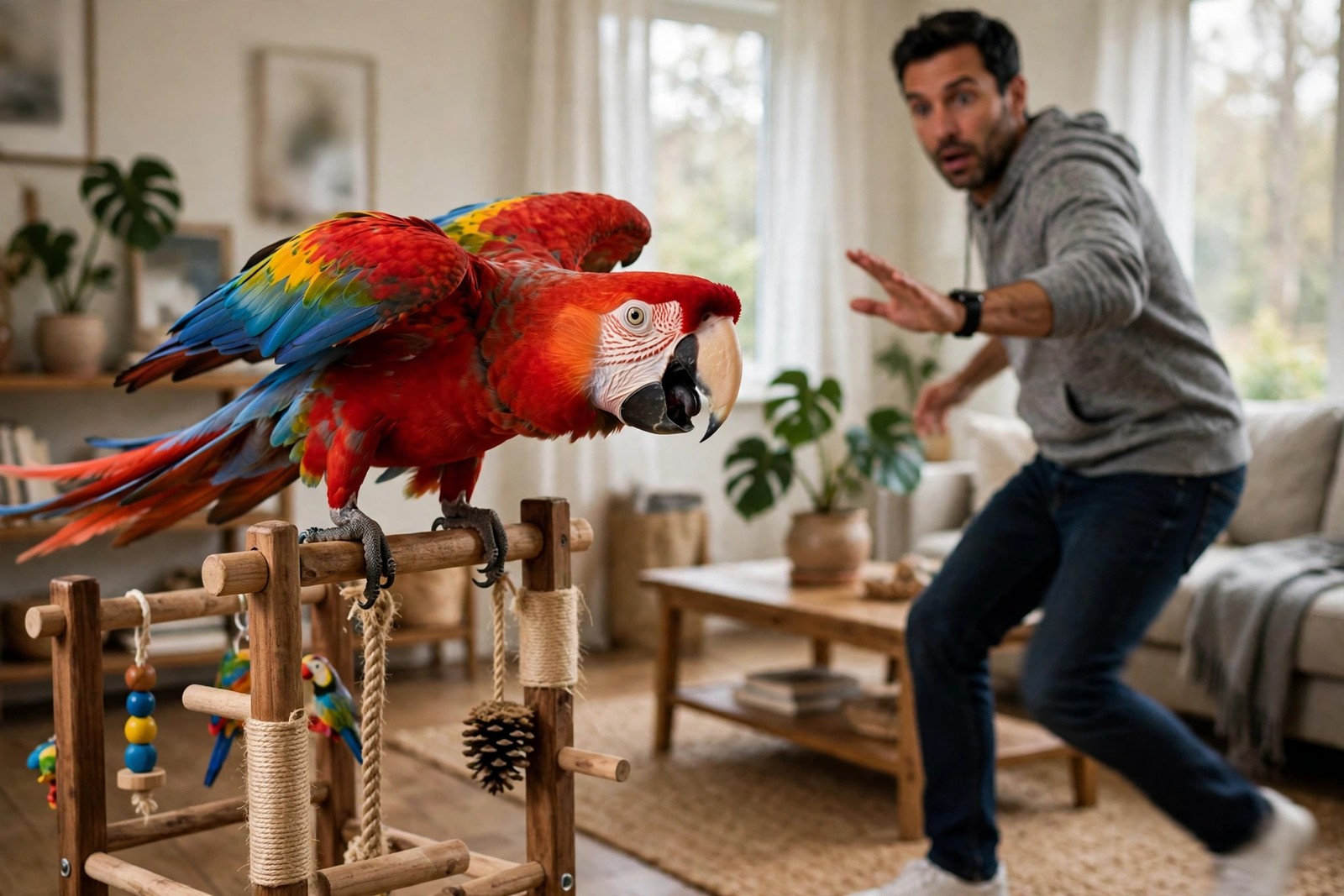
A macaw lunge is theatre with a real weapon behind it. The bird leans forward in a rush, beak open, eyes flashing, tail spread, and the visitor jumps back exactly as intended. Understanding which of the usual motives is driving your bird matters, because a territorial bird, a frightened bird, and a bird guarding his favourite human look similar at the moment of the lunge and need differently arranged rooms, routines, and guest rules afterwards.
Defending the Cage and the Stand
In the wild, a macaw's nest site is worth defending, and in a house the cage and favourite perch take that role. Lunging that happens mainly when visitors approach the cage, reach toward it, or walk between the bird and his food is usually territorial: he is telling a much larger animal to leave the one piece of ground he considers his. It tends to be worst through the bars, where he feels boldest, and milder on neutral ground such as a training stand in another room. Arranging for visitors to admire him from a respectful distance, and doing cage servicing without an audience leaning in, removes most of the rehearsals that keep the behaviour strong.
Fear and the Bluff That Follows It
Not every lunge is confidence. A macaw who was not well socialised with different people may find strangers genuinely alarming: unfamiliar faces, hats, glasses, fast movements, and people who approach head-on and reach over his head all read as threat. Fearful birds often show the lunge alongside leaning away, foot lifting, or attempts to retreat when retreat is available, and they lunge because the visitor kept coming after the bird had already signalled discomfort. Macaws are also famous bluffers; the dramatic rush, eye pinning, feather display, and beak gaping are calibrated to repel without contact, and a bird whose bluff has worked for years will open with it as a first resort. The catch is that a cornered or repeatedly tested bluffer can follow through, and a macaw bite is a genuine injury, so the display should be respected as a boundary, never called.
Guarding the Favourite Person
Many pet macaws bond intensely to one household member, and visitors who hug, sit beside, or make sudden moves near that person can trigger lunging that is really mate-guarding. Hormonal periods can sharpen it further: the bird may regurgitate to his person, guard them from a chair back, and treat other humans as rivals to be driven off. Punishing the bird for this is both unfair and useless, since he is performing bonded-pair behaviour with the cast he has. Management works better: the favourite person stays out of the greeting scene, the bird greets new people from a stand at a chosen distance, and calm behaviour around visitors earns attention and treats from the bird's own person rather than from the stranger's hand.
House Rules That Actually Reduce Lunging
Ask visitors to let the bird decide the distance, to approach from the side rather than head-on, never to offer fingers or try to touch the beak, and never to tease a reaction for entertainment, which rehearses the lunge more efficiently than any training undoes it. Children should be supervised and kept out of beak range entirely, however gentle the bird is with family. Work on voluntary skills away from guests: stepping onto a hand-held perch for a reward, and going to a station perch on cue, give you a way to move him calmly when visitors arrive instead of a wrestling match he will remember next time. If lunging is new, suddenly worse, or paired with appetite, droppings, or energy changes, an avian vet check comes first, because pain and illness lower any bird's tolerance. For the days when someone else hosts or feeds him, KinsLe's Care Pass shares a temporary, scoped care link carrying his greeting distance, perch routine, and no-fingers rule, so a sitter gets the whole boundary picture before they ever meet the beak.