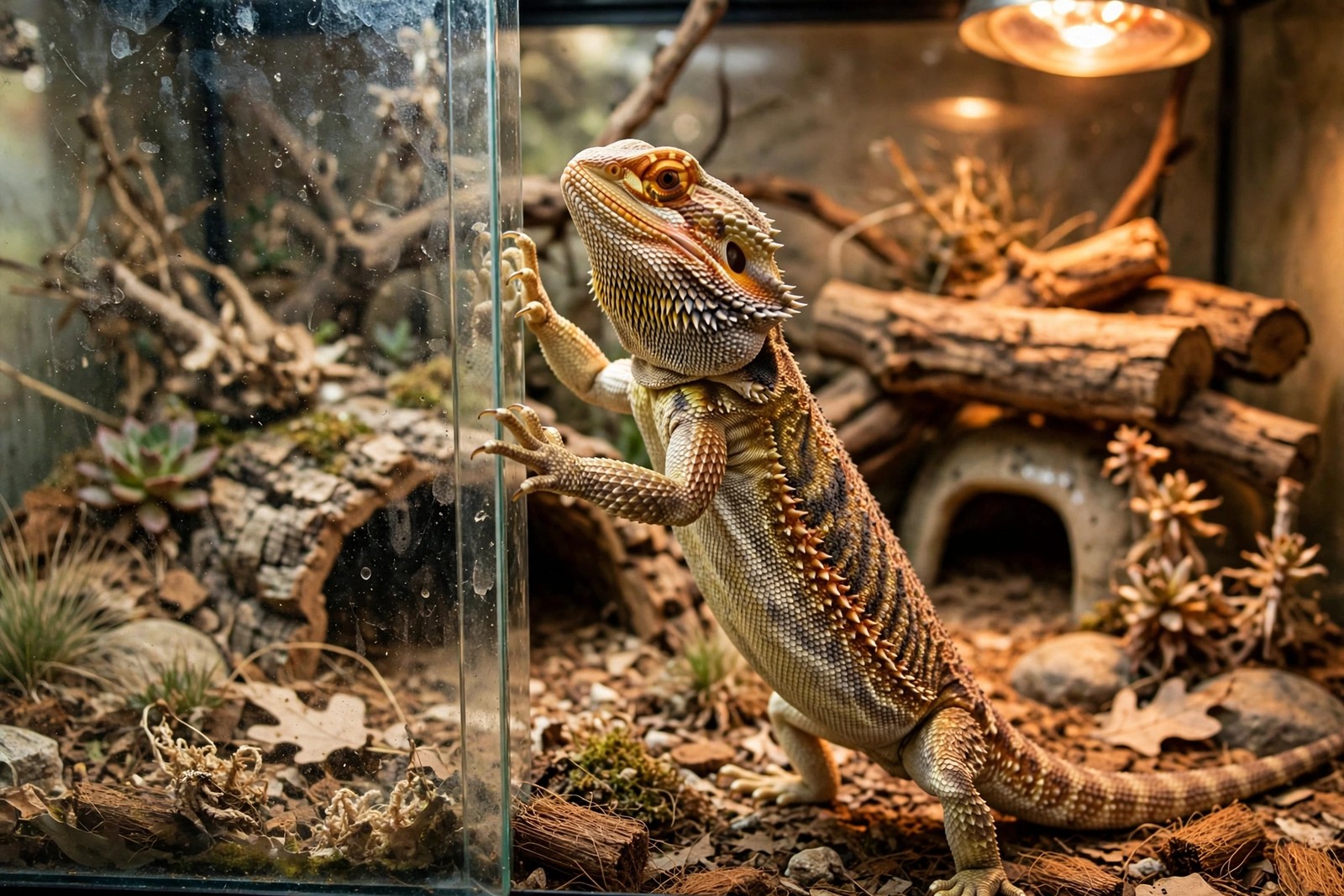
Glass surfing — a bearded dragon standing tall against the glass, scrabbling with its front legs, sometimes for long stretches — is a request, not a quirk. Dragons do not understand transparent barriers, so a dragon at the glass is a dragon trying to get somewhere or away from something. Working through the likely causes in order usually finds the answer, and each cause has a distinct fix.
Reflections and the rival in the glass
A dragon that surfs one particular wall, puffs its beard at the glass, and head-bobs at its own reflection is not trying to escape — it is confronting a rival that never retreats. Bright room lighting against a dimmer enclosure makes reflections stronger. Covering the outside of the problem panels with a background, or lining the lower inside walls, removes the rival, and reflection-driven surfing often stops quickly once the other dragon disappears. A dragon housed within sight of another reptile can react the same way to the real neighbour, so sight lines between enclosures are worth checking too.
Heat, space, and a setup that feels wrong
A dragon that is too hot scratches to leave the heat, and one in an enclosure that is too small, too bare, or too exposed scratches from general stress. Verify temperatures at the basking spot and the cool end with a thermometer you trust rather than the dial on the glass, confirm there are hides at both the warm and cool ends, climbing branches, and enough floor space to move between temperatures freely. Persistent surfing paired with a dark beard, hiding, or refused food suggests the setup still is not right; change one variable at a time and give each change a few days, so you learn which fix worked.
The urge to roam, and breeding-season restlessness
Some surfing is wanderlust. Active, healthy dragons — especially males in breeding season — patrol, explore, and try to range further than any enclosure allows. Supervised time out in a safe, warm, dragon-proofed room, with cables lifted, gaps blocked, and other pets shut out, gives that drive a legitimate outlet. Rotate decor and feeding positions inside the enclosure too, so the space itself offers more to investigate. Roaming-driven surfing comes from a bright, eating, active dragon, which separates it from the flat, stressed surfing of an unhappy setup.
A gravid female needs somewhere to dig
A female dragon who suddenly digs and scratches persistently, especially in corners and at the base of the glass, may be gravid — carrying eggs, which females can produce even without a mate. She needs a laying area: a box of deep, slightly damp, diggable substrate where she can excavate a burrow in private. Restlessness, digging, then lethargy, loss of appetite, or straining without laying are signs to involve a reptile vet promptly, because difficulty laying is a genuine emergency in reptiles, not something to wait out at home.
Protecting the dragon while you solve it
Persistent surfing is not harmless even while you work through causes, because a dragon that scrabbles at glass for hours can rub its chin and nose raw and wear down its claws. Check the snout for pink, rubbed patches each day the behaviour continues, and treat any open soreness as a reason to speak to a reptile vet rather than waiting for the setup fix to work. Padding is not the answer — a dragon determined to climb will climb padding — but removing the trigger is. If surfing happens only at one time of day, look at what changes then: room lights switching on and sharpening reflections, the household dog arriving, or the basking lamp cycling, each of which points to a different remedy.
Because each fix needs days to judge, a written record beats memory. KinsLe's Care Teams lets your household log temperature checks, out-of-enclosure sessions, and digging episodes with timestamps against your dragon's profile, so you can see plainly whether covering the glass or adjusting the heat actually reduced the surfing.