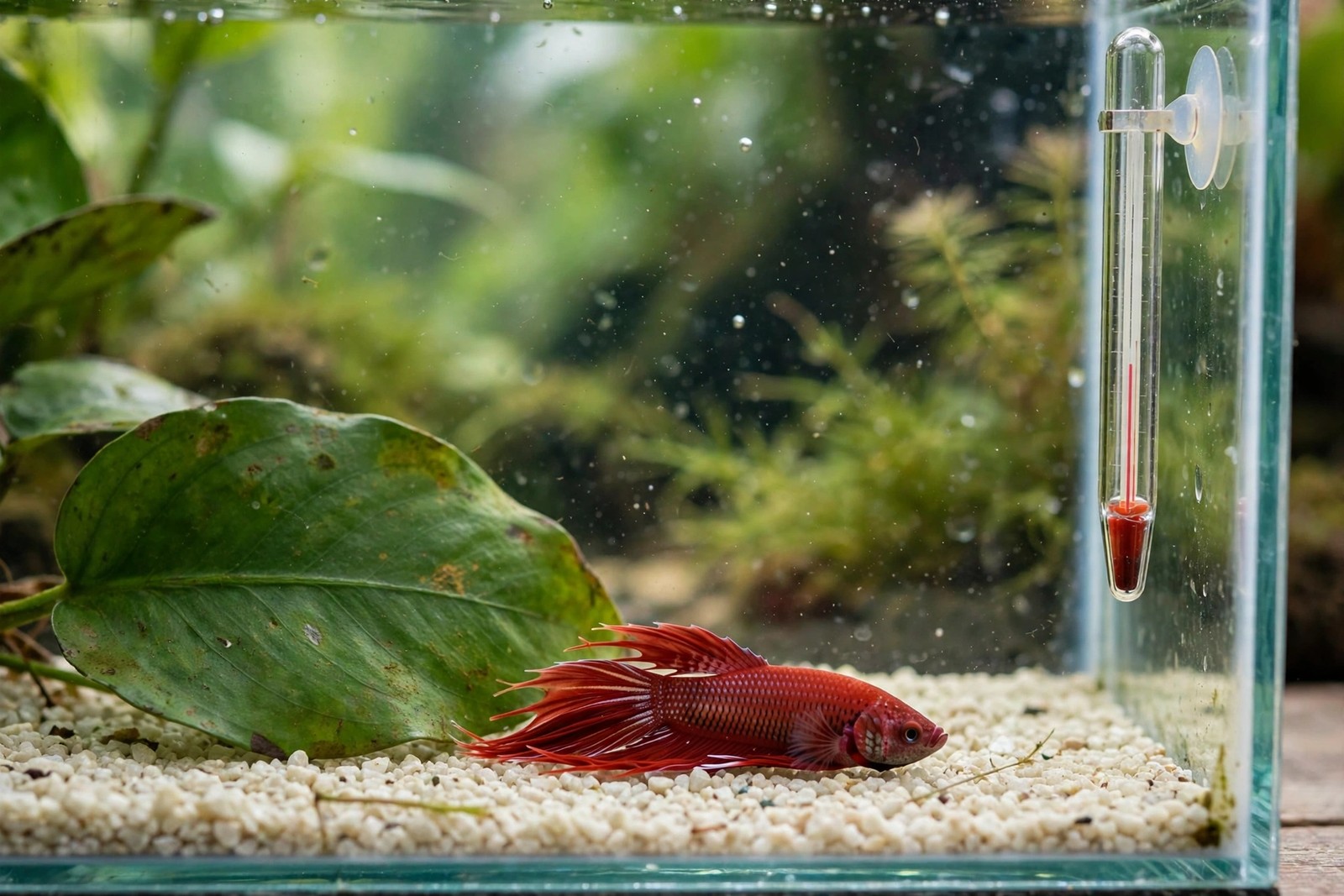
Bettas do rest on the bottom, and they also go to the bottom when something is wrong, which is why this sign worries owners. The useful response is not panic or guesswork but a short, ordered check: how your betta looks and behaves, then the water temperature, then the water itself. Worked through calmly, those three steps separate a sleeping fish from one who needs your help today.
When Bottom-Lying Is Normal
A healthy betta often naps on the substrate or draped on a leaf, particularly after lights-out, and long-finned varieties tire easily because their fins are heavy to carry. Older bettas rest far more than youngsters and may choose the bottom simply because it costs less effort. Normal rest has a pattern you can verify: the fish rouses promptly when you approach or food appears, breathes steadily, holds its fins open rather than clamped tight, keeps its colour, and swims up to the surface periodically — bettas breathe air at the surface with a specialised organ, so regular trips up are a good sign. A fish who rests, then eats eagerly and patrols the tank, is usually just a resting fish.
The Causes to Rule Out, in Order
Check temperature first. Bettas are tropical fish that do best in warm, stable water, roughly in the high seventies to low eighties Fahrenheit, and a failed heater or an unheated room can quietly drop a small tank well below that. A cold betta becomes sluggish, fades, and sinks to the bottom to conserve energy. Read a thermometer in the tank rather than trusting the heater dial, and warm the water back up gradually if it has drifted low.
Test the water second. Ammonia or nitrite in the water, or very high nitrate after missed changes, makes a betta lethargic and bottom-bound, and this is the most common fixable cause in home tanks. Test all three, plus pH if you can, especially in a new tank that is still cycling or after a filter clean that may have removed beneficial bacteria. If ammonia or nitrite shows at all, do a partial water change with conditioned water matched to tank temperature, retest, and repeat on following days until readings stay at zero for ammonia and nitrite.
Consider effort and digestion third. A filter outflow that is too strong exhausts a long-finned betta, who then rests wherever the current is weakest; baffling the flow or reducing it often restores normal swimming. A betta who is bottom-sitting with a swollen belly, curved posture, or trouble staying level may be constipated or having buoyancy trouble, which overfeeding makes worse — review how much you feed, since a betta's stomach is tiny and rich food given freely expands in the gut.
The Signs That Mean a Veterinarian
Treat bottom-lying as urgent when it comes with clamped fins, white spots or a dusty coating, frayed or rotting fin edges, rapid or laboured breathing, rubbing against objects, a pinecone appearance to the scales, or a complete refusal of food lasting more than a couple of days. Those signs point beyond husbandry, and no article can examine your fish. An aquatic veterinarian, or your veterinarian's referral to one, is the right next step, and your water test results and feeding notes will make that conversation far more useful. Prevention is mostly rhythm: weekly partial changes, tests logged rather than guessed, and feeding measured in pellets counted, not pinches estimated — and KinsLe's Care Teams turns that rhythm into assigned, timestamped tasks, so the weekly test, the partial change, and the heater check happen on schedule even when someone else is looking after your tank.