
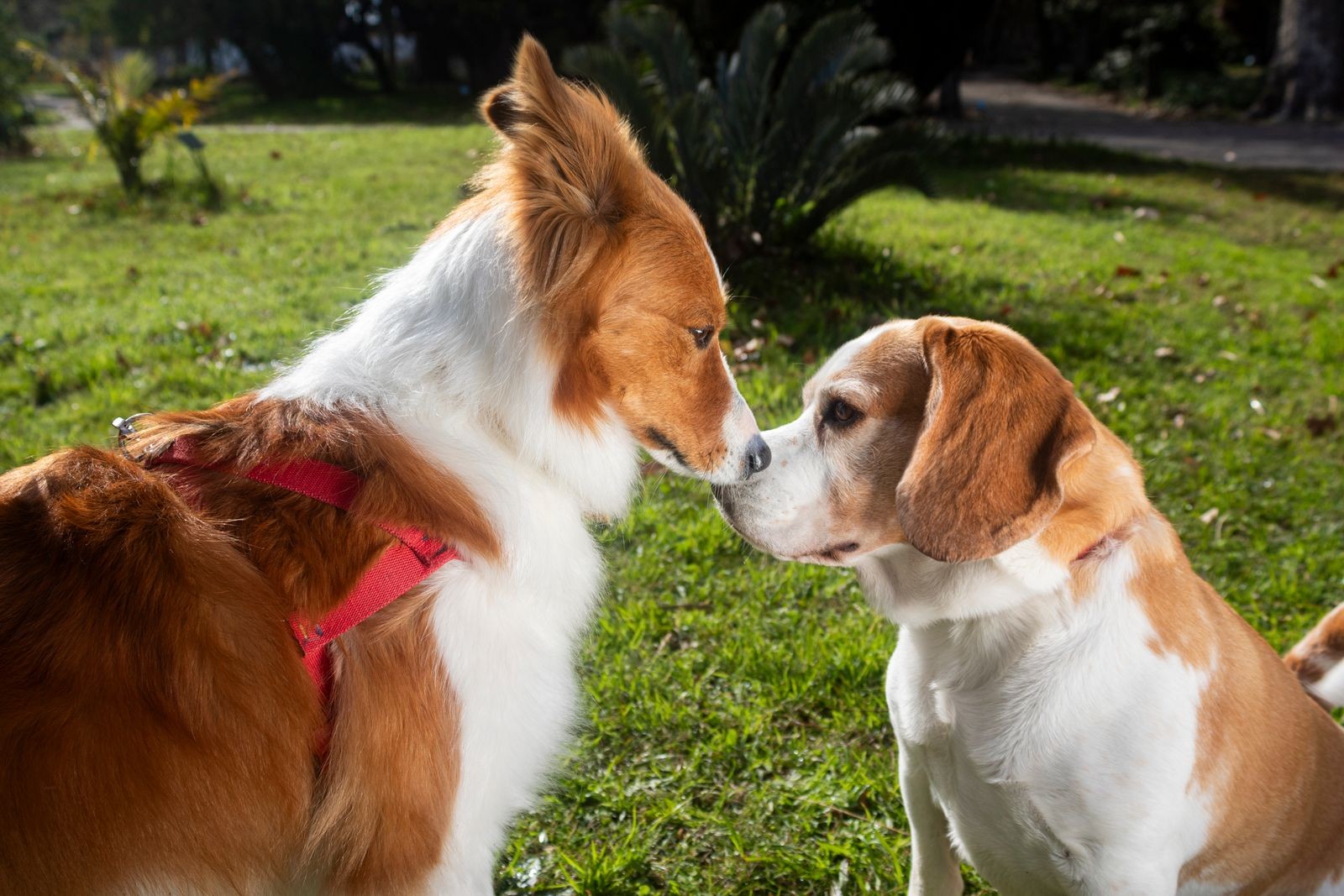
A dog can be reactive on leash yet relaxed off leash because the leash removes their natural options: they cannot move away, approach in a friendly curve, or finish a greeting and move on, so frustration and tension build until barking and lunging spill out. Many leash-reactive dogs are genuinely social in open, off-leash settings where body language flows freely and they can choose distance. The difference is usually the barrier and the restraint, not a dog who is "fine sometimes and bad other times" on purpose.
The leash changes the conversation
Dogs greet best in arcs, with loose bodies, sniffing, and the freedom to drift apart. A tight leash forces a head-on approach — which in dog language can read as confrontational — and holds your dog in place when they would rather retreat. Add a path where two dogs must pass within a metre, an owner tensing and shortening the leash, and hardware pressure on the neck or chest, and arousal climbs fast.
Frustration is the most common engine. Picture a dog who loves other dogs: every walk brings exciting sightings that never lead to a greeting, because you rightly keep walking. That repeated thwarted wanting is genuinely stressful, and barking becomes both protest and habit. Fear works the other way — a dog who wants distance finds the leash traps them near the scary thing, so a big display becomes self-defense that reliably makes other dogs leave.
Why off leash looks completely different
Off leash, in a suitable secure setting, the same dog can glance at another dog, choose a wide arc, exchange a quick sniff, and trot away. No restraint means no frustration pile-up and no feeling of being cornered. Owners are often stunned at the contrast at a secure field or a friend's garden, but it is one of the clearest signs the issue is leash and barrier frustration rather than a dog who cannot be around others at all.
That does not mean off-leash greetings everywhere are the solution. Recall, local rules, and other people's comfort still matter, and a leash-reactive dog should never be allowed to rush leashed dogs in public — those dogs may be reactive, elderly, recovering, or in training, and an unwanted approach can set everyone back.
Calmer walks, step by step
Start by changing the geometry of walks:
- Cross the street or turn off early, before your dog fixates — distance is your training tool
- Keep the leash loose where safe; constant tension feeds constant tension
- Reward check-ins and disengaging: when your dog notices a dog far away and looks back at you, mark and treat generously
- Practice simple, well-known cues at home and in quiet streets so they are available when you need them
- End greetings you do allow on a good note, and skip greetings on narrow paths entirely
Avoid retractable leashes in trigger-heavy areas, as they tangle, reduce control, and let distance vanish suddenly. A standard leash and a well-fitted harness give you and your dog clearer communication. Keep sessions short and finish while your dog is still coping — ten calm minutes teach more than an hour of repeated reactions.
If reactions are intense, frequent, or escalating, or if your dog has redirected onto a person, get in-person help rather than pushing through alone, and mention the change to your veterinarian in case discomfort or another health factor is lowering tolerance.
Get an in-person plan through KinsLe
A qualified trainer found through KinsLe's Pet Services Directory can assess your dog in person — watching distance, body language, and recovery on your real walking routes — and build a plan for calmer walks that fits your dog rather than a generic protocol. Look for reward-based, force-free methods and a trainer who starts below your dog's threshold instead of staging close confrontations.
On KinsLe, book a trainer listed in the Pet Services Directory for a first session on your usual route, and let that in-person assessment set the distance at which your dog can notice another dog and still turn back to you.