
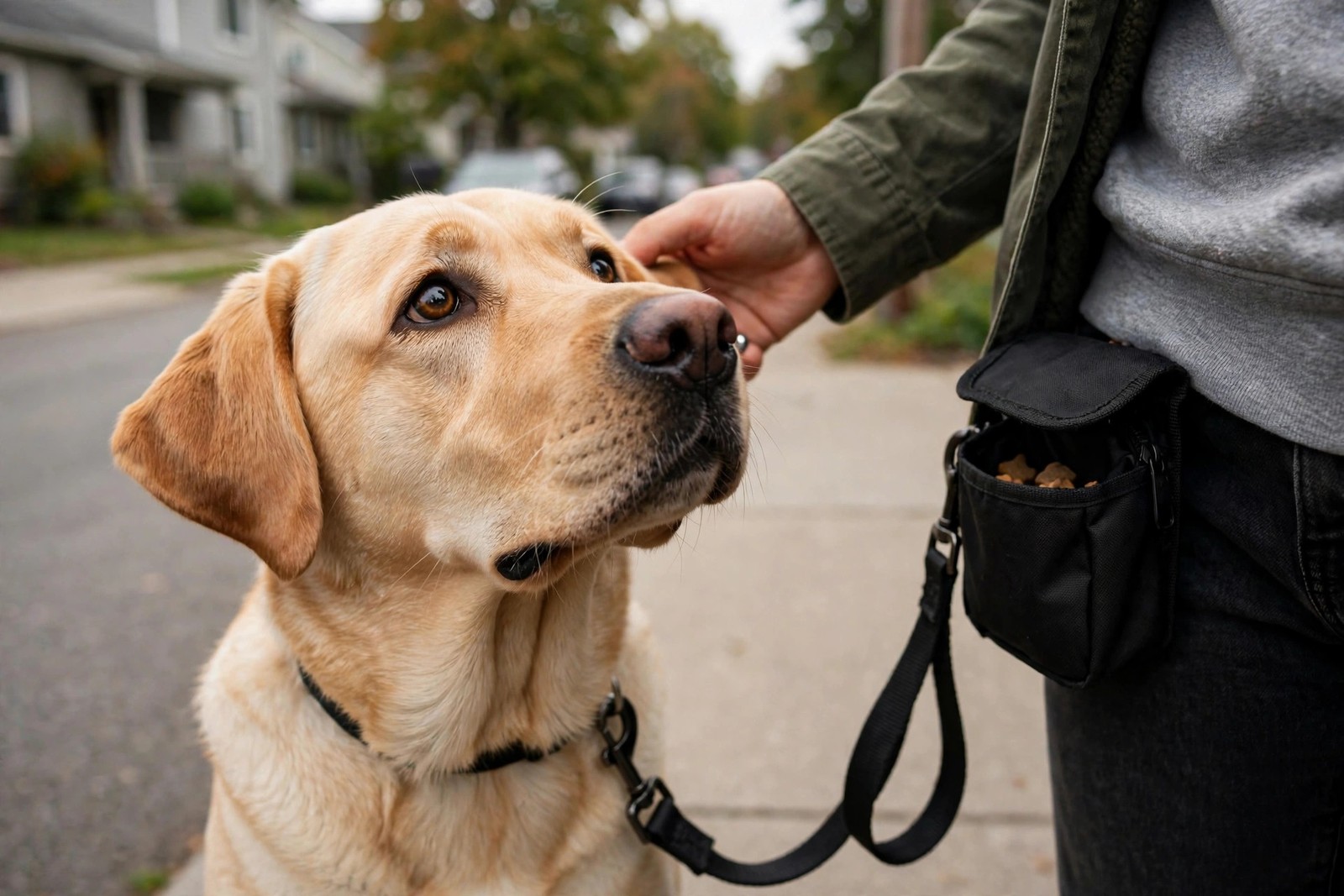
Yes — for most first-time owners a Labrador is an unusually forgiving dog to learn with. Labs were bred to work closely beside people, most love food and praise, and they tend to bounce back quickly when your timing is late or your cue is muddled. That eagerness is real, and it is why Labs so often top beginner-friendly lists. Easy to teach, though, is not the same as easy to live with while they are learning.
Why Labs Learn So Willingly
A typical Lab will work for a pea-sized piece of food, a tossed ball, or genuine delight in your voice, and will happily repeat a behaviour ten times in a row. Sit, down, and recall often come quickly in a quiet kitchen. Labs also read people closely and want to be in the middle of family life, so they notice routines fast: the lead coming out, shoes by the door, the treat pouch appearing. For a beginner, that responsiveness is encouraging — you get visible wins early, which keeps you practising.
Use that motivation cleanly. Reward within a second or two of the behaviour you wanted, keep sessions to about five minutes, and end while your dog still wants more. Several short sessions spread through the day teach a young Lab far more than one long, tiring drill.
The Caveats Nobody Should Skip
Adolescence is the honest challenge. From roughly six to eighteen months many Labs become stronger, bolder, and spectacularly distractible. A dog who recalled perfectly at four months may suddenly find other dogs, birds, and muddy water far more interesting. This is development, not stubbornness, and it is the phase where first-time owners most often feel the dog has gone backwards.
Mouthing is the other Lab speciality. Retrievers explore and carry with their mouths, so puppies mouth hands, sleeves, leads, and furniture. Redirect every time onto a toy, keep exciting greetings calm, and give legal chewing outlets daily. Jumping up follows the same pattern: a forty-pound youngster launching at visitors is enthusiasm in a body that no longer fits the greeting. Teach four paws on the floor and reward that, rather than only scolding the jump.
Size matters too. An adult Lab is a powerful dog, commonly in the 25 to 36 kilogram range, and lead pulling that is cute in a puppy becomes a shoulder problem by winter. Start loose-lead walking early, in low-distraction places, and build distance gradually.
A First Fortnight That Works
Exercise before you train. A Lab asked to concentrate while full of unspent energy is being set up to fail, so a walk, a game of fetch, or a sniffy garden search first makes the lesson that follows much easier. Then work on a small core: name response, sit, down, recall from a short distance, and settling on a mat.
Keep one cue word per behaviour and have everyone in the house use it. Mixed cues — one person saying down, another saying lie, a third pushing the dog into position — are the most common beginner slowdown, and it is a human problem, not a dog problem. Proof each skill at home, then in the garden, then on a quiet street, raising difficulty only when the easier level is reliable.
Expect plateaus, keep notes on what is improving, and consider a reward-based group class if recall or lead work stalls, especially during adolescence. KinsLe Care Teams supports that consistency at home by letting your household split walks, meals, and daily practice into clear assigned duties, so your Labrador hears the same plan from everyone instead of a different lesson from each person.