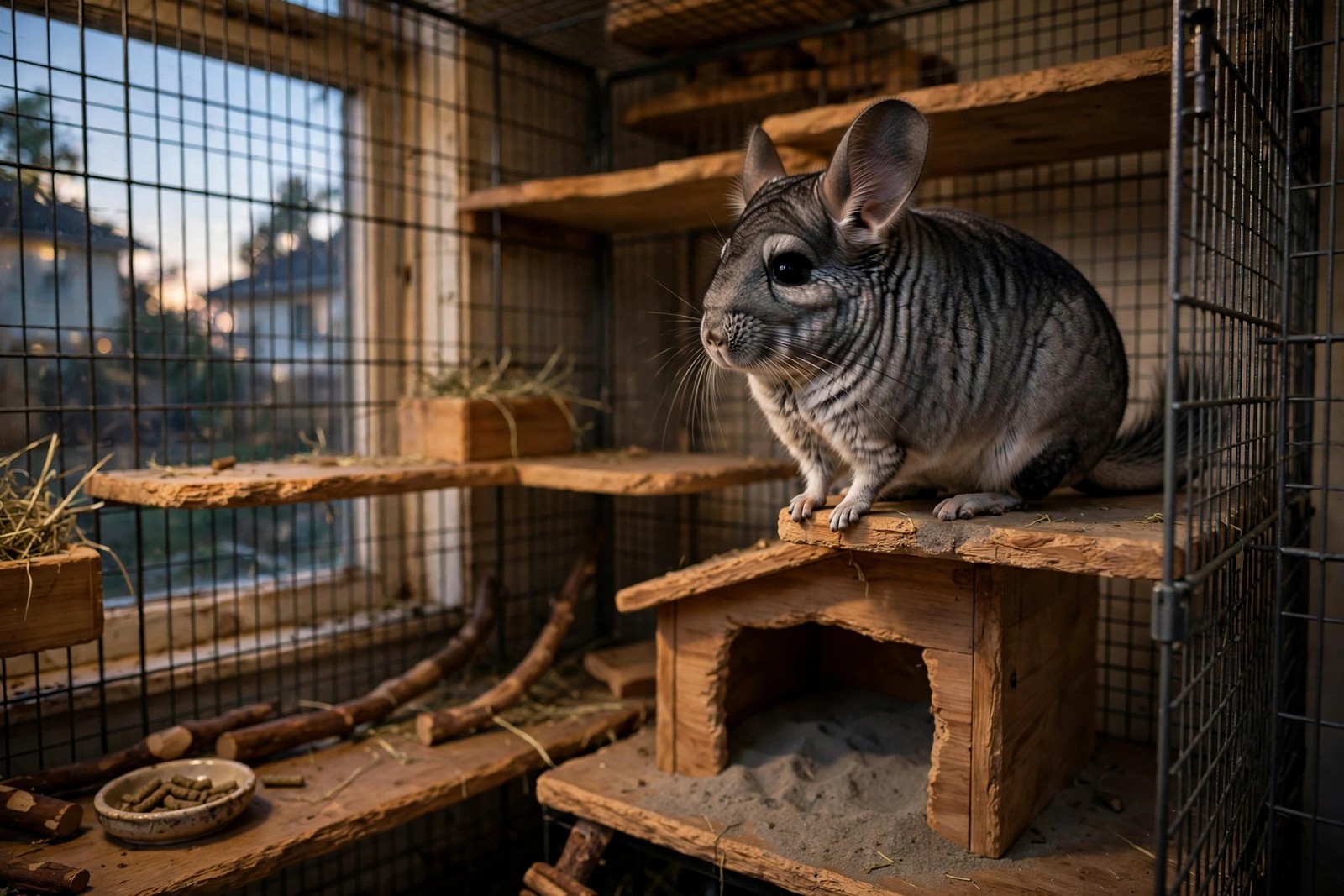
Solo living works for a chinchilla only when the people at home truly supply the companionship a cage-mate would otherwise provide. Chinchillas are social animals by design, and the honest question is never whether a single chinchilla can survive in a cage by itself, but whether its days contain enough contact, activity, and reassurance for a group animal living a solitary life.
What Social Means for a Chinchilla
In the wild, chinchillas live in colonies, resting in contact, grooming one another, and taking cues about safety from the group. A bonded companion provides something a person cannot fully copy: company during the hours you sleep, a warm body to sit against, and communication in the same language all day. Many chinchillas visibly relax in a pair, eat more confidently, and play more. That is why breeders and rescues often recommend pairs, and why a chinchilla who has always lived with a companion and loses one may grieve, eat less, and call or search. None of this makes single keeping wrong. It makes it a commitment with a daily price, and owners should price it honestly before deciding.
What a Single Chinchilla Actually Needs
A solo chinchilla needs substantial interaction every day, timed to its own clock. Chinchillas are most active at dusk and into the night and sleep deeply during the day, so company means evening out-of-cage play in a chinchilla-proofed room, time spent sitting near the cage talking and offering gentle handling, chew toys rotated before boredom sets in, and a dust bath offered regularly. A large cage with ledges, shelves, a hide, and things to gnaw is the stage that company happens on, placed in a room where household life passes by rather than a spare room visited twice a day. If your schedule means the chinchilla wakes to an empty house and sleeps through your only free hours, a single pet will feel that mismatch every day.
Signs a Chinchilla Is Not Coping Alone
Learn the quiet signals, because chinchillas hide trouble well. Fur-biting, where the coat looks chewed and uneven, can follow stress or boredom. So can repetitive cage-biting, barking or calling more than usual, hiding whenever anyone approaches, reduced appetite, smaller droppings, or a flat, uninterested manner in an animal who used to investigate everything. Any of these lasting more than a few days, and any drop in eating or droppings at all, deserves a veterinary check, since dental pain, gut trouble, and loneliness can look alike from outside the cage and only one of them is fixed by company. Do not wait for a thin chinchilla to prove the point.
Adding a Companion, Carefully
Introductions are a project, not a purchase. House the newcomer separately at first for a quarantine period and health check, keep the cages side by side so the animals swap scent and sight without contact, then try short meetings on neutral ground with nowhere to be cornered, watching closely. Chinchilla meetings can turn fast: chasing that ends in fur slips, mounting battles, or any bite means separate and slow down, and some pairs simply never bond and must live apart permanently. Pair same-sex chinchillas or take veterinary advice about neutering, because an unplanned mixed pair can produce litters quickly. Never house a chinchilla with a rabbit or guinea pig as a substitute friend; the species differ in diet, strength, and disease risk, and the companionship is not real for either animal.
Deciding for Your Household
Choose a pair when you know your time is limited, you travel with sitters covering basics, or you simply want the animals to have each other around the clock. Choose a single chinchilla only when someone at home will reliably build evenings around it for a lifespan that can stretch well beyond a decade. Through KinsLe's Family Sharing, the owner can give profile access for this solitary chinchilla to chosen relatives, widening the circle who know it beyond a single evening companion.