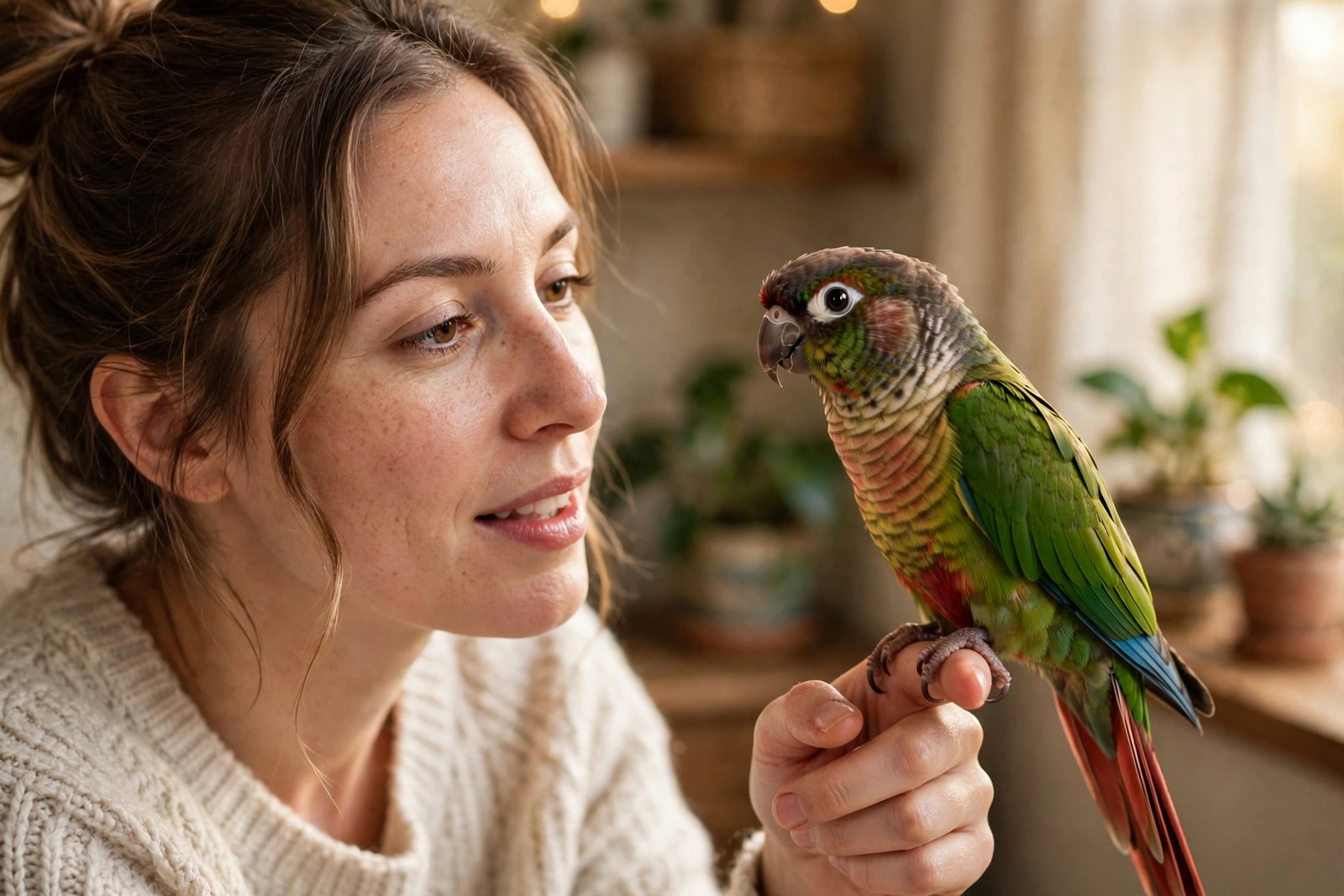
Yes, but keep expectations modest: conures are gravelly, raspy talkers who typically learn a handful of words or short phrases, and some learn none at all. Owners who choose a conure for its clownish affection, energy, and devotion get a wonderful bird. Owners who choose one expecting long, crystal-clear conversations are usually measuring a conure against the wrong parrots.
An Honest Picture of a Conure's Voice
The celebrated talkers of the parrot world, such as African greys and some Amazons, combine unusual clarity with large vocabularies. Conures sit elsewhere on that scale. A talking conure sounds like a small, hoarse version of you, speaking through gravel, often at low volume, and many of its words are clear mainly to the household who heard them learned. Green-cheeked conures are among the quieter conures with especially soft, scratchy voices, while the larger, louder species may project better without gaining much clarity. Individual variation runs wide: one bird picks up its name, hello, and a laugh within a year, while its sibling whistles, mimics the microwave, and never says a recognisable word. Both birds are normal, and the non-talker is not failing anything.
Teaching Words in Context
Conures learn the way toddlers do, by attaching sounds to moments. Say the same short word at the same event every day: hello as you uncover the cage, the bird's name as you offer a favourite food, step up as it steps onto your hand, goodnight at lights-out. Keep sessions short and lively, a few minutes at the times your bird is naturally vocal, often morning and early evening, with your face close and your voice animated and slightly higher pitched, which holds a bird's attention better than flat repetition. Work on one or two words at a time until one lands, and let the bird watch your mouth. Live, social practice with a bonded person beats recordings and video loops, because a conure is learning to talk to you, not to a speaker, and it is the interaction it keeps trying to join.
Rewarding the Attempts
The learning happens in the approximations. A conure first mumbles in the rhythm of a word, then shapes a rough version over days or weeks. Reward those attempts immediately with praise, excitement, and a tiny treat, because a bird rewarded only for perfection stops experimenting, and experimenting is the whole mechanism. Never withhold attention or food to pressure speech, and never drill a tired, fluffed, or disinterested bird; end while it is still fun. Household members can all join in, but everyone should use the same words in the same contexts, or the bird hears five versions of the lesson and masters none of them.
Talking Is Only One Channel
A conure communicates constantly without words: flock calls when you leave the room, chatter while it plays, beak grinding when content at bedtime, and body language that says more than its vocabulary ever will. Screaming for contact is natural flock behaviour, not a talking problem, and it is answered with routine, toys, foraging, company, and a proper sleep in a dark, quiet cage at night, not with speech lessons. Likewise, a bird who suddenly stops vocalising altogether, in words or otherwise, alongside appetite or energy changes, needs a veterinarian, because quiet in a conure is a symptom worth respecting. Teach talking as a game layered on a well-kept bird, and whatever words arrive are a bonus on an already talkative companion.
Building the Daily Habit
Consistency across people is the difference between a bird who hears one phrase fifty times a day in context and a bird who hears it twice on Sunday. Put the practice where it naturally happens, at uncovering, feeding, and bedtime, and let different family members own different moments. KinsLe's Care Teams supports that rhythm directly, assigning each short practice moment as a duty on the conure's list, so the whole household repeats the same words the same way and the bird gets its lesson every single day.