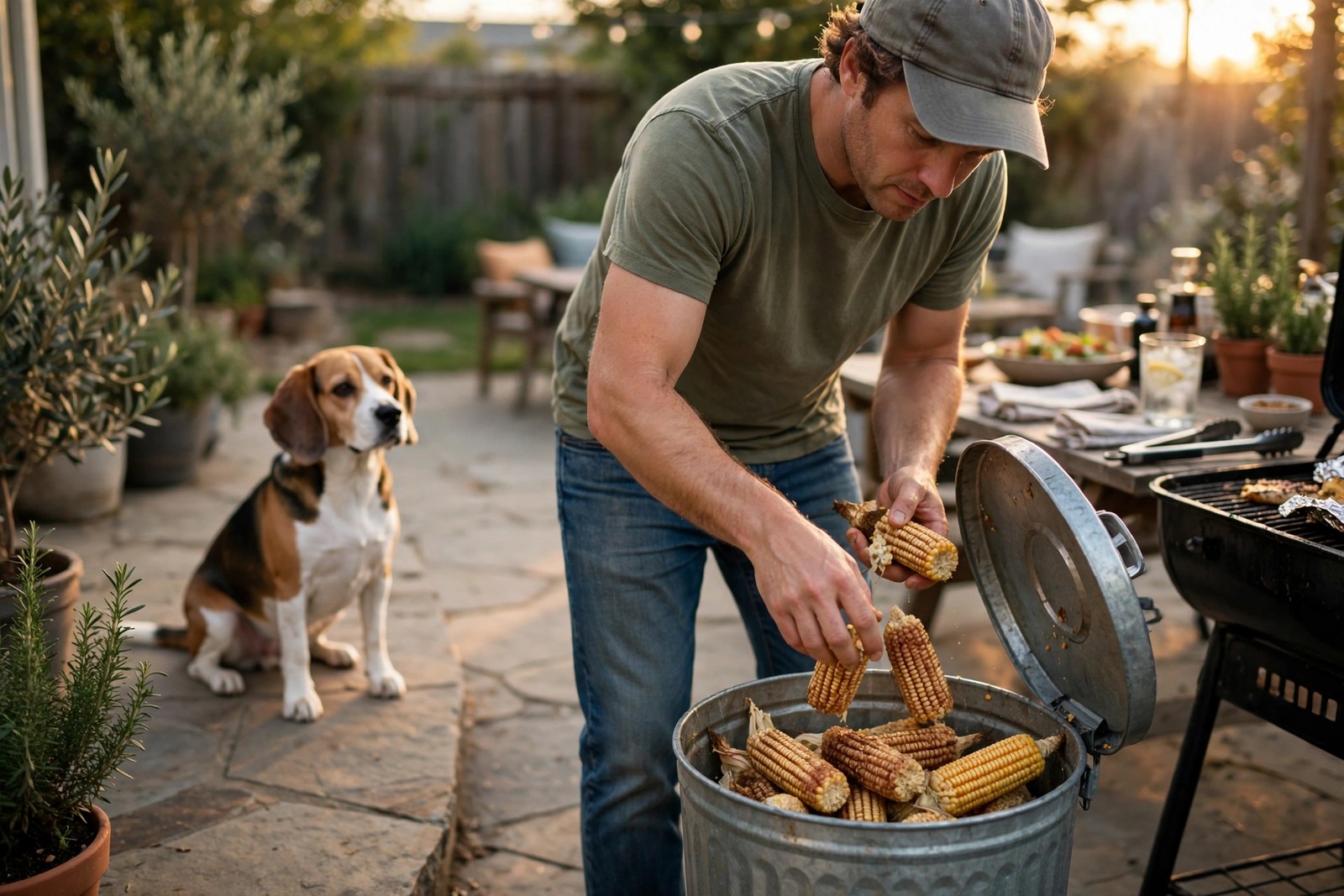
No — dogs should never be given corn on the cob. Plain cooked sweetcorn kernels, cut away from the cob and served in a small spoonful, are a harmless extra. The cob is a different matter entirely. It is the part dogs cannot digest, the part that causes blockages, and the part that should go straight from the table into a lidded bin.
Why the Cob Blocks the Gut
A dog does not nibble a cob politely the way a person rotates it and bites off rows. Dogs gnaw, crack, and tear, and they swallow dense chunks of the spongy core. That material does not dissolve in the stomach, and a chunk can be exactly the size and shape to wedge in the narrow small intestine. Once it lodges, food and gas build up behind it, the gut wall loses blood flow, and the situation turns into an emergency that often needs surgery to resolve. Even supervised chewing is not safe, because the dangerous moment is one hard bite that frees a chunk before anyone can react. The size of the dog offers little protection: a large dog simply swallows larger pieces, and a determined small dog can still tear off a chunk big enough to stick.
Signs a Piece of Cob Is Stuck
Trouble may take a day or two to show, which is why owners often fail to connect a sick dog with Saturday's barbecue. Repeated vomiting is the classic early sign, sometimes with the dog still drinking but unable to keep food down. Appetite fades, the dog grows quiet and uncomfortable, the belly may look tense, and the dog may resent it being touched, and stool becomes scant or stops altogether as nothing passes the blockage. Drooling, restlessness, and a hunched posture round out the picture. Any dog known to have chewed cob that then vomits repeatedly needs a veterinarian the same day, and a dog that is vomiting, lethargic, and not passing stool after cob access should be treated as an emergency rather than watched overnight.
If Your Dog Gets Hold of a Cob
Take what remains away calmly, count roughly how much is missing, and call your veterinarian promptly, even if your dog seems perfectly well. Say when it happened and how much cob you think was swallowed, because that timing shapes the advice you will get. Do not wait at home for vomiting to confirm the problem, and do not try to make the dog sick unless your veterinarian directs it. If only a few kernels were eaten and the cob itself is intact and accounted for, your veterinarian may simply advise watching the dog, which is another reason the call is worth making early.
Serving Kernels the Safe Way
If your dog enjoys sweetcorn, cut the kernels off a plain cooked cob with the cob held well away from the dog, and serve 1 to 2 tablespoons of kernels mixed into food. Skip butter, salt, and seasoned barbecue coatings, and never hand over the stripped cob as a chew afterwards, because a bare cob is still a cob. At outdoor meals, give finished cobs one destination only: a lidded bin or a bag tied shut, never a plate on the grass, an open compost heap, or the edge of a fire pit. Tell guests plainly that the dog may not be handed a cob, since a well-meant offering is how many cobs reach a dog. KinsLe's Care Teams lets you add the no-cobs rule and the bin routine to your dog's care duties before a cookout, so the sitter, the family, and the helpers all run the same plan.