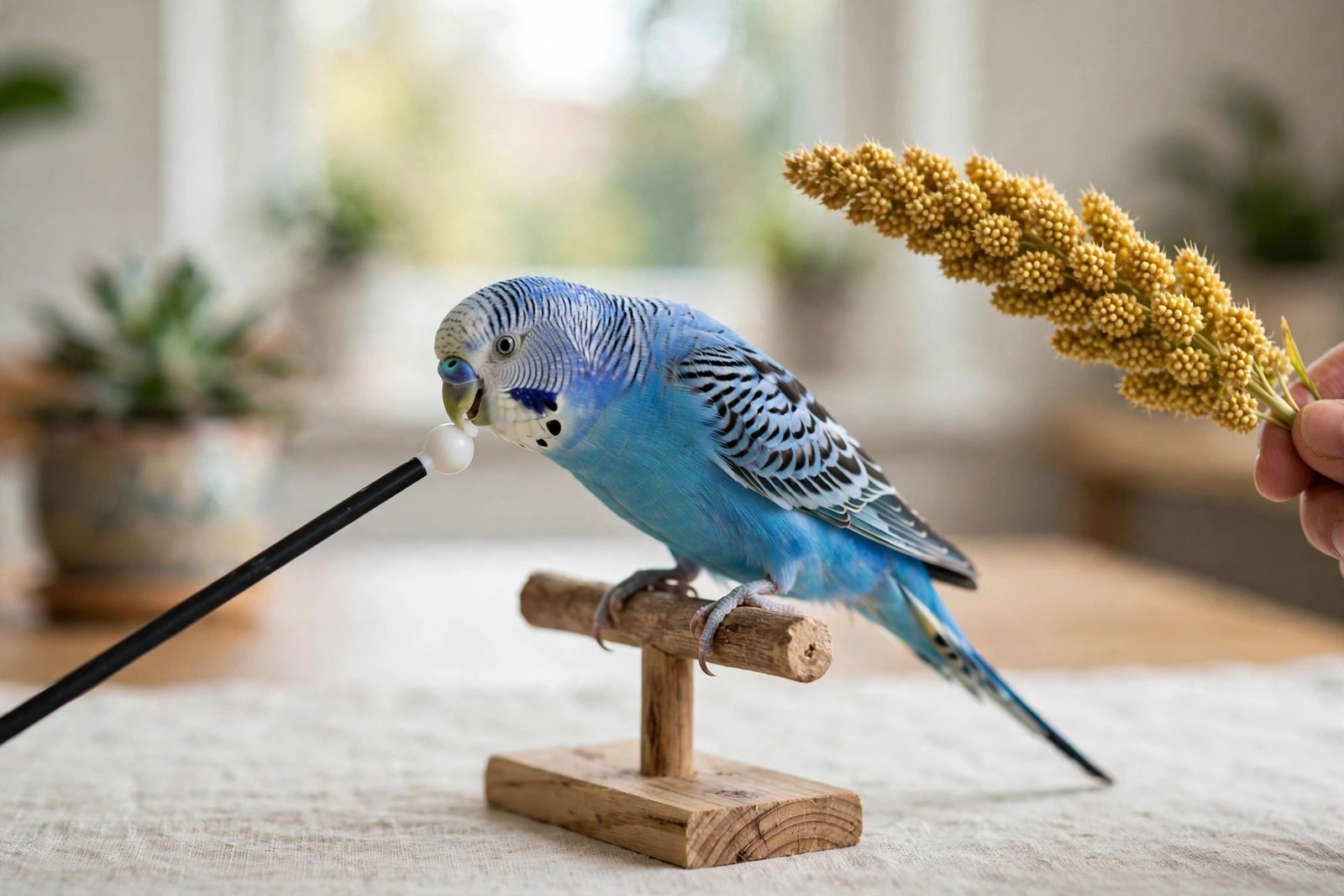
Yes. Budgies are quick, observant little parrots, and trick training suits them well because it gives their busy minds a job and builds trust at the same time. The tricks themselves are simple. What makes them work is method: a target stick, a reward worth having, sessions measured in minutes, and one small step taught at a time.
Start with the two foundation skills
Step-up comes first, because a budgie who will not step onto a hand or perch cannot be positioned for anything else. Offer a perch or finger just in front of the bird's belly, reward any step toward it, then the step itself, and pair the word step-up as it happens. Never push into the chest to force the step; a budgie who is pushed learns to bite or flee, not to step.
Target touch is the second foundation and the engine of most tricks. Hold a chopstick or similar stick a short distance from the beak and reward the instant your budgie touches its tip, using a tiny piece of millet spray held in the other hand. Budgies are naturally curious about a nearby object, so the first touches come easily. Once your bird follows the stick reliably, you can lead it in a circle, onto a scale, into a travel cage, or through a small hoop, all without ever grabbing the bird.
A first repertoire, in teaching order
With step-up and targeting in place, a sensible sequence is: turn-around, by leading the bird in a full circle with the target and rewarding at the finish; wave, by holding the target just out of reach near one foot so the bird lifts the foot toward it, then marking that lift; and short recall, calling the bird to fly a few inches, then gradually further, to your hand for millet. Each trick takes days to a couple of weeks of tiny sessions, not a single afternoon. Teach one new trick at a time, and keep polishing the old ones so sessions always contain easy wins.
Session craft that keeps a budgie keen
Train for three to five minutes, once or twice a day, ideally when your budgie is alert and a little hungry, before a main feed rather than after one. Millet works so well because it can be offered in single-beak tastes from the spray, keeping rewards small enough for twenty repetitions. Mark the right behaviour the moment it happens with a click or a short consistent word, then deliver the taste. End on a success, put the stick away, and let the bird go back to its day wanting more.
Watch body language throughout. A budgie leaning in, beak busy, eyes bright is working happily. A bird who sidles away, freezes, pants, or bites has had enough, and pushing on teaches only avoidance. Hand-taming comes before trick work for a nervous budgie: days of calm presence, millet through the bars, and no reaching into the cage at all.
Training also has to be safe. Work in a room with windows and mirrors covered, doors closed, and no other pets present, and keep early flights short in a small space while your bird's confidence and fitness build.
Little and often is the entire secret, and it is easy to let slip in a busy home. Using KinsLe Care Teams, those five-minute sessions can be set as small assigned duties for whoever is home and timestamped once done, keeping your budgie's lessons frequent, consistent, and always ended on a win.