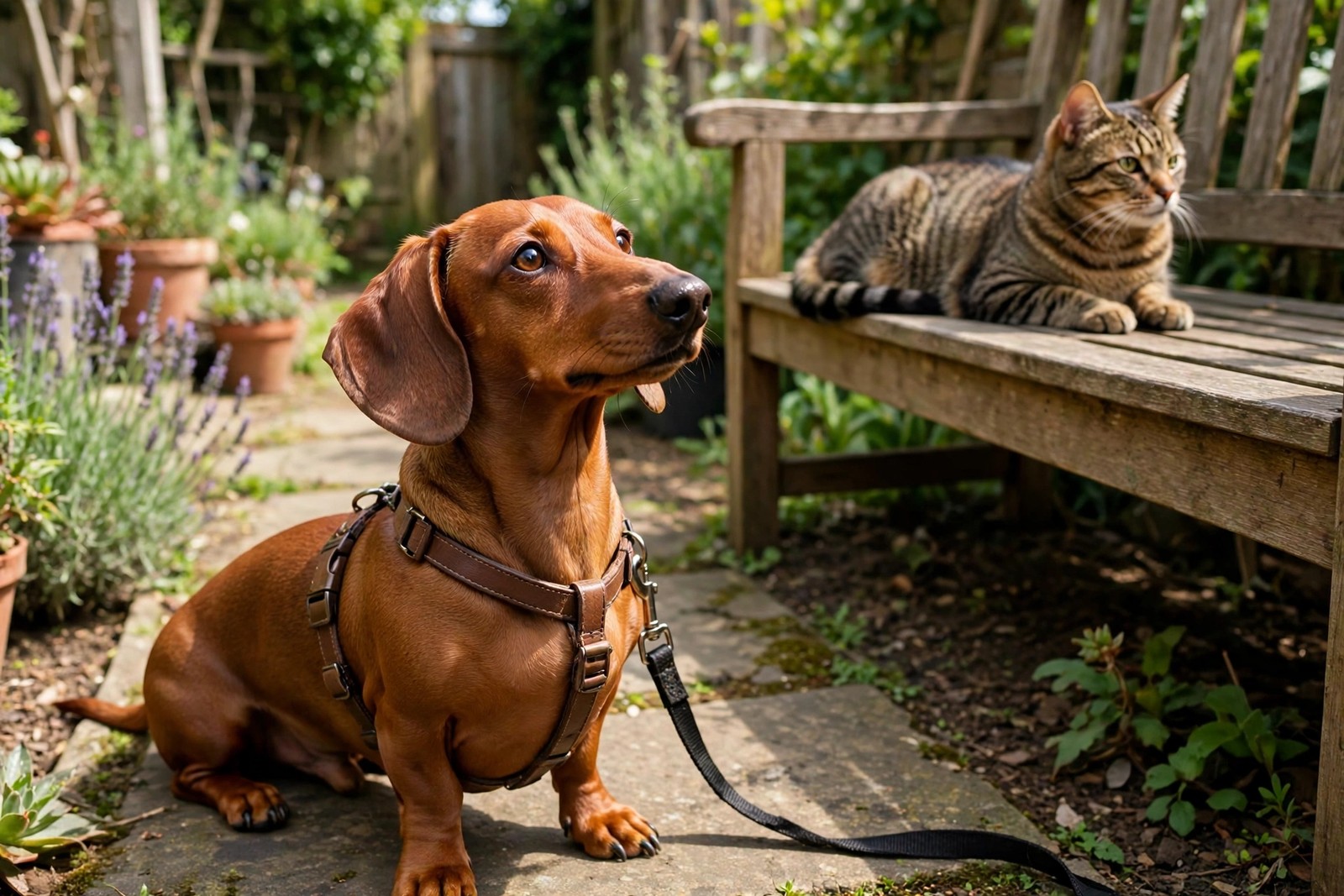
Whether a Dachshund gets along with a cat depends on the individual dog more than on almost any other breed pairing, because the Dachshund is a serious hunter in miniature. The breed was built to follow badgers into burrows and fight underground, work that selected for boldness, persistence and a strong drive to chase, seize and bark at quarry. A Dachshund raised with cats from puppyhood often files them under family and never shows that drive at home. An adult Dachshund meeting a cat for the first time may show anything from indifference to an intensity that no amount of goodwill should be trusted around a cat off-leash.
Assessing Your Dachshund Honestly
Read arousal rather than friendliness during the staged introduction. Relaxed signs are a loose, wiggly body, brief glances at the cat, sniffing the ground and the ability to take treats and answer cues. Warning signs are a body that goes still and hard, a fixed stare, quivering, high-pitched barking or whining that builds rather than fades, and lunging at the barrier. One difficult session means slow down; the same intense pattern across several sessions, with no improvement as distance increases, means this dog and cat should live permanently separated or with professional guidance, not with repeated hopeful meetings.
Size does not make the risk trivial: a standard Dachshund is strong for his height, with powerful jaws and terrier-like determination once engaged. Preventing chases also protects the dog, because leaping off furniture and scrambling up stairs in pursuit are exactly the twisting, high-impact movements a long-backed dog should be spared.
A Staged Introduction With No Shortcuts
Begin with scent swapping for several days, exchanging bedding and rubbing each animal with a cloth, so the new smell becomes background before any meeting. Then hold meetings through a secure gate with the Dachshund on a leash and a harness. Reward calm looking and looking away, keep sessions short, and let the cat come and go freely; she should always have a route that never passes close to the dog.
Only move to the same room when gate meetings have been dull for days. Keep a trailing house line on the dog, position the cat's exit away from the dog, and practise calling the dog away for high-value rewards before he becomes absorbed. Rushing this breed, or scolding him for prey interest he cannot help feeling, produces a dog who simply waits for an unguarded moment.
Household Management That Keeps the Peace
Give the cat a dog-free zone, with her food, litter tray, bed and high resting places behind a gate she can slip through and the dog cannot, and feed the dog separately as well, because Dachshunds are devoted eaters who will raid a cat bowl and may guard their own food with conviction. In the garden, supervise closely and use a lead or long line where the cat roams, because a cat sprinting across open ground is the strongest chase trigger there is, and fencing that stops a cat will not stop a Dachshund who has decided to dig.
Keep the pair apart when nobody is home until you have months of calm; Dachshund adolescence can revive chasing that seemed settled.
Deciding the Long-Term Arrangement
Many Dachshund and cat households reach a contented truce or a real friendship, with the dog saving his hunting passion for toys and scent games. If yours does not, a well-managed two-zone household, where the animals live comfortably in separate areas with full lives, is a legitimate, kind outcome and not a failure. A qualified behaviour professional can help you judge which outcome your dog is heading for, and your vet can advise if sudden behaviour change raises a health question.
A plan with stages, zones and supervision duties only works when everyone in the house knows which stage the pair has reached and follows it. KinsLe's Care Teams lets you record and assign those stages, from barrier sessions to separate feeding, so each family member follows the same plan, with every completed task marked complete with a timestamp.