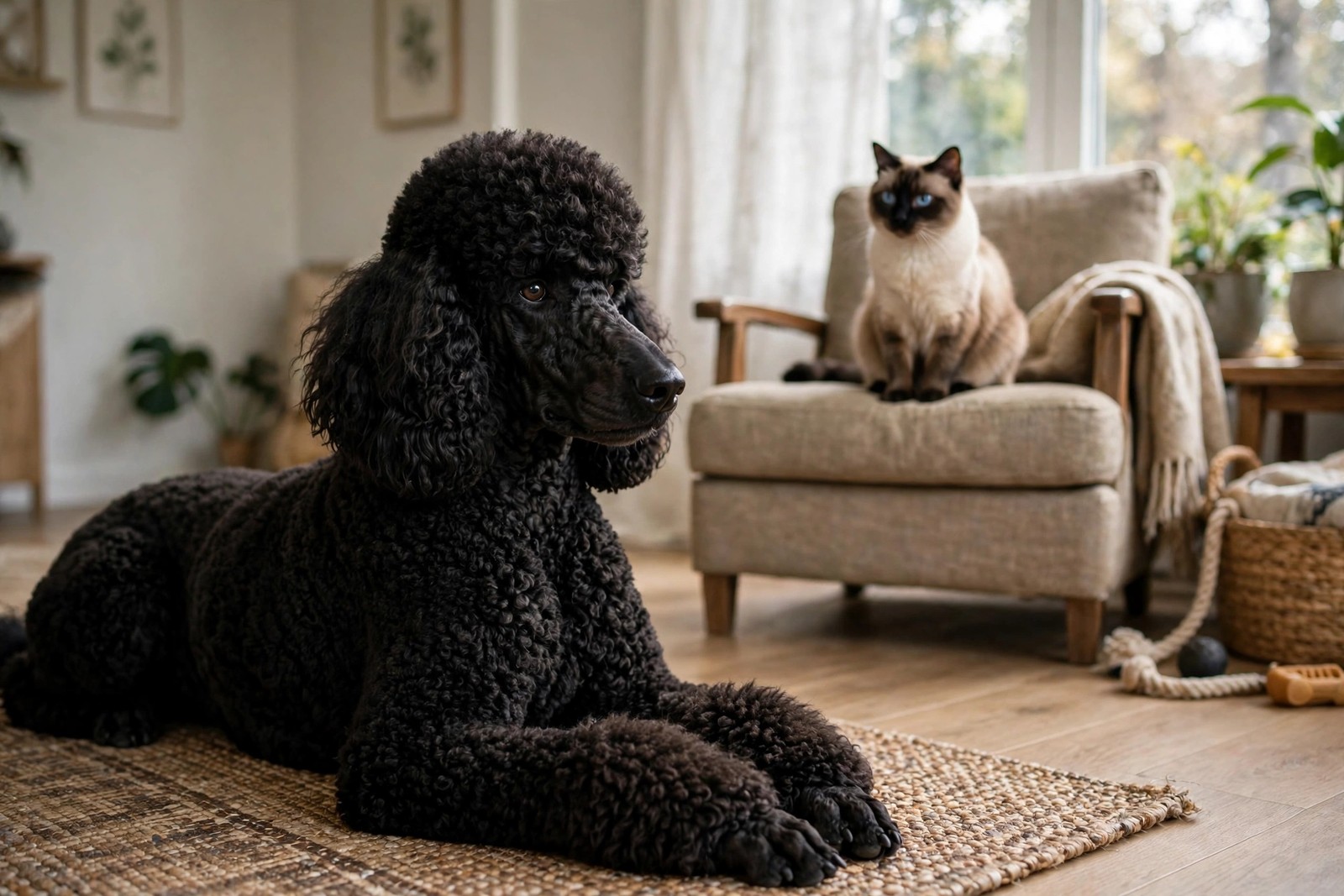
Poodles usually get along well with cats, and the reason is in the breed's head as much as its heart. Poodles were bred as water retrievers — clever, people-focused working dogs — and that heritage produced a breed that reads households quickly, learns rules after a few consistent repetitions and generally prefers being involved to being in trouble. Indoors, Poodles are not typically fixated hunters, so a cat is more likely to be classified as a housemate than as prey. The three sizes change the management, though: a Standard is a tall, athletic dog whose play can physically swamp a cat, a Miniature sits in between, and a Toy is the one at risk of injury from the cat.
Using the Poodle Brain During Introductions
Trainability is only useful if the training happens before the cat is in the room. Teach or refresh three behaviours first: a down-stay on a mat that the dog can hold while interesting things happen, a recall indoors that pays better than chasing, and a 'leave it' that covers food, objects and, later, the cat. Then stage the introduction over several weeks: scent swaps with bedding, feeding either side of the cat's safe-room door, barrier meetings with the Poodle practising its mat stay within sight of the cat, and finally shared-room time on a leash with the cat free to leave. A Poodle who gets mentally tired — a training game, a puzzle feeder, a sniffy walk — before each session will show you its best self.
Reading This Breed's Signals Around a Cat
Poodles are expressive, and their intentions are comparatively easy to read once you know the tells:
- A loose, wiggly body, play-bows directed at you rather than the cat, and glances that come back to you for treats all say the dog is relaxed and working.
- Intense staring, a closed mouth, creeping forward in slow motion or freezing over a toy when the cat appears are early warnings — increase distance and go back a stage.
- Barking in this breed is often commentary or demand rather than threat, but it still frightens cats and rehearses excitement, so reward quiet watching generously.
- Retrieving instincts may surface as carrying: a Poodle who starts picking up the cat's toys is amusing, but one who tries to mouth or carry a kitten needs the stages slowed and supervision tightened.
Size-Specific Notes: Standard, Miniature and Toy
With a Standard Poodle, manage physics: block doorways the cat uses, keep early play outdoors, and insist on the mat stay whenever the cat is moving around, because an excited Standard can knock a cat flying without a trace of malice. With a Toy Poodle, protect the dog: supervise every meeting, give the cat high escape routes so it leaves upward rather than through the dog, and watch for the cat stalking the small dog as prey or a plaything, which some confident cats genuinely do. Miniatures usually need a blend of both approaches, weighted by the individual dog's bounce. In all sizes, feed separately, keep the litter area dog-proof, and remember that a clever dog will learn to open doors and gates — latch the cat's safe room properly rather than trusting a closed door a Poodle can nudge.
Settling Into a Mixed Household
Success looks undramatic: the Poodle holds its stay while the cat crosses the room, chooses its own toys over the cat's, and treats the cat's movements as background. Adolescent Poodles can regress into bounce and testing, so be ready to reinstate the leash and barrier for a fortnight without treating it as failure. If staring, stalking or guarding persists through careful staging, a qualified behaviour professional can usually pinpoint whether it is arousal, fear or resource-based and adjust the plan. Households that log which stage they are on, who ran each session and how the dog responded find the process measurably calmer, and KinsLe Care Teams helps by letting you assign those introduction stages, training refreshers and separate feeding duties to specific people, with each completed duty marked complete with a timestamp.