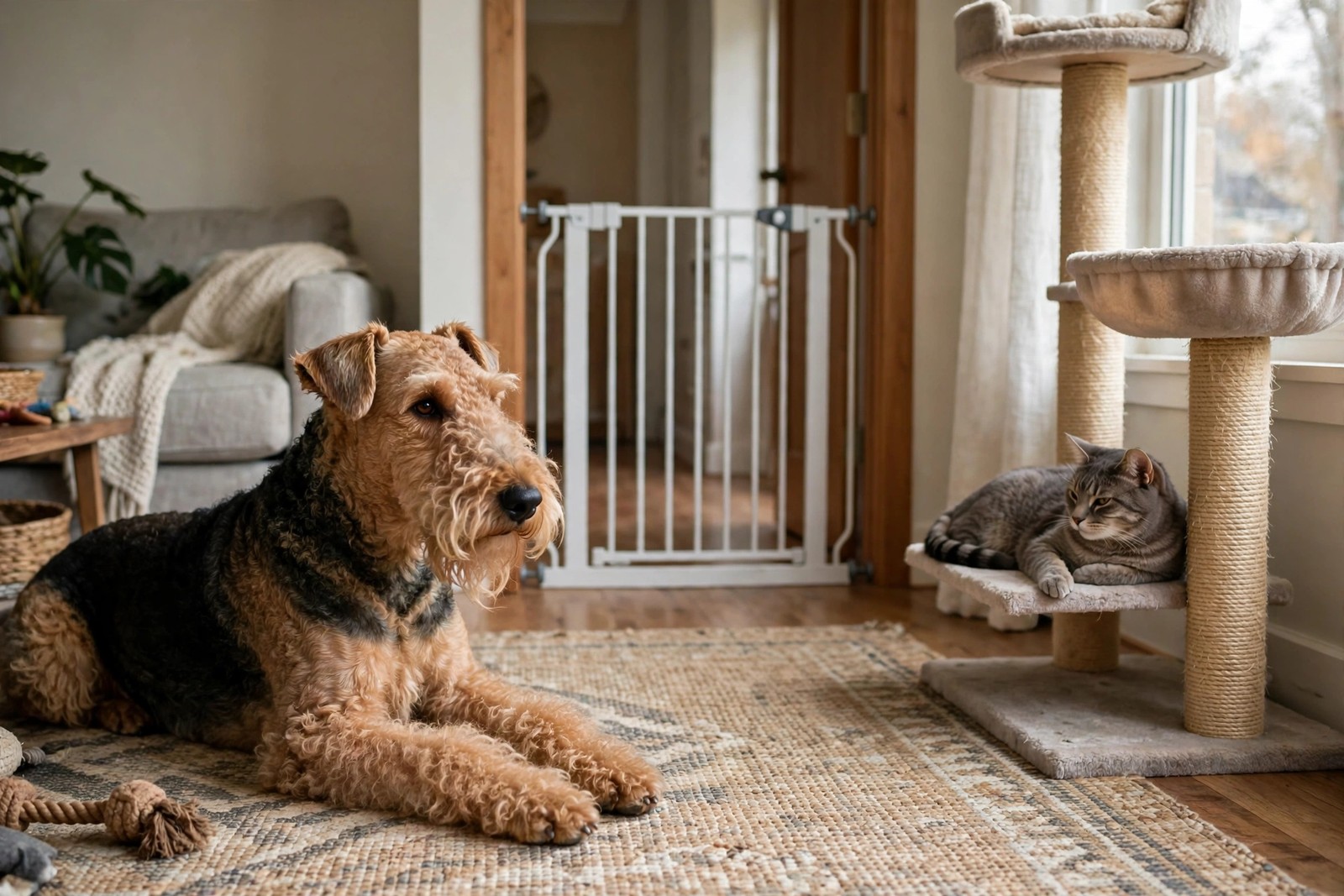
The honest answer is split down the middle. An Airedale raised from puppyhood with a cat usually files that cat under household, while dog-to-dog relationships are where this bold, assertive terrier most often needs thoughtful management. Neither half comes with a guarantee for an individual dog: breeding, early experience, and the other animal's temperament all play their parts. What an owner controls is the setup, and with Airedales the setup matters from the first weeks, because habits formed between a puppy and the animals around it tend to carry into adult life.
Cats They Are Raised With
A puppy who grows up with a cat learns its smell, its movement, and its rank in the household as ordinary facts of life, and Airedales commonly accept a cat raised alongside them as a member of the home. Protect that outcome in the early months: supervise interactions, interrupt rough chasing before it becomes a game, and always leave the cat a clear escape route, such as a gate the dog cannot pass, a high route, or a room that is the cat's alone. A confident cat who can leave is far safer than a cornered one, and a puppy corrected calmly at the first stare-and-lunge learns the household rule early.
The Standing Caveat: Strange Cats Outdoors
Acceptance at home does not transfer to every cat. A strange cat who runs across a garden or street can still trigger a terrier's chase instinct in a dog who sleeps peacefully beside its own cat an hour later, because movement and novelty, not species, drive that reaction. Manage outdoors accordingly: secure fencing, a leash where cats roam, and recall training that is practiced before it is needed near a fleeing animal. Tell sitters and walkers the same thing plainly, since the distinction between the household cat and any other cat is exactly the detail a new handler is most likely to miss.
Dog to Dog: Assertive, Sometimes Scrappy
Airedales were bred to work independently and stand their ground, and that character shows with other dogs. Many are playful and social, especially with dogs they know, but the breed can be assertive and scrappy, particularly with same-sex adults, and a challenge answered casually by another breed may be answered seriously by an Airedale. Early socialization helps a puppy read other dogs and recover from surprises, yet socialization is not a switch that removes breed character. Watch body language as dogs mature, be honest about tension at home or in regular play groups, and separate dogs whose relationship is deteriorating rather than hoping repetition will soften it.
Careful Introductions on Neutral Ground
Set new dog meetings up to succeed. Meet on neutral ground rather than in either dog's home or garden, walk in parallel at a distance where both dogs can notice each other without fixating, and shorten that distance only while both stay loose and able to look away. Keep leashes slack, meetings short, and first sessions boring; parallel walking teaches more than face-to-face greetings pushed nose to nose. At home, introduce resources gradually, feed separately at first, and give a resident dog room to retreat from a newcomer. With cats, the same patience applies in reverse: scent swapping and sight through a barrier before any shared room time, and no unsupervised access until the pattern is proven over weeks, not days.
Recording the Real Dog, Not the Breed Average
Transferrable Profiles keeps this dog's actual social history written down: that it lives peacefully with the household cat, that strange cats outdoors are a chase risk, which sexes and sizes of dog it relaxes with, and how introductions have gone in the past. That record protects the dog when a sitter, walker, family member, or future household takes over, because breed generalities are a poor substitute for one dog's known behavior. Introductions stay safer when known triggers and earlier reactions are written into the Transferrable Profiles record on KinsLe for every new caregiver.