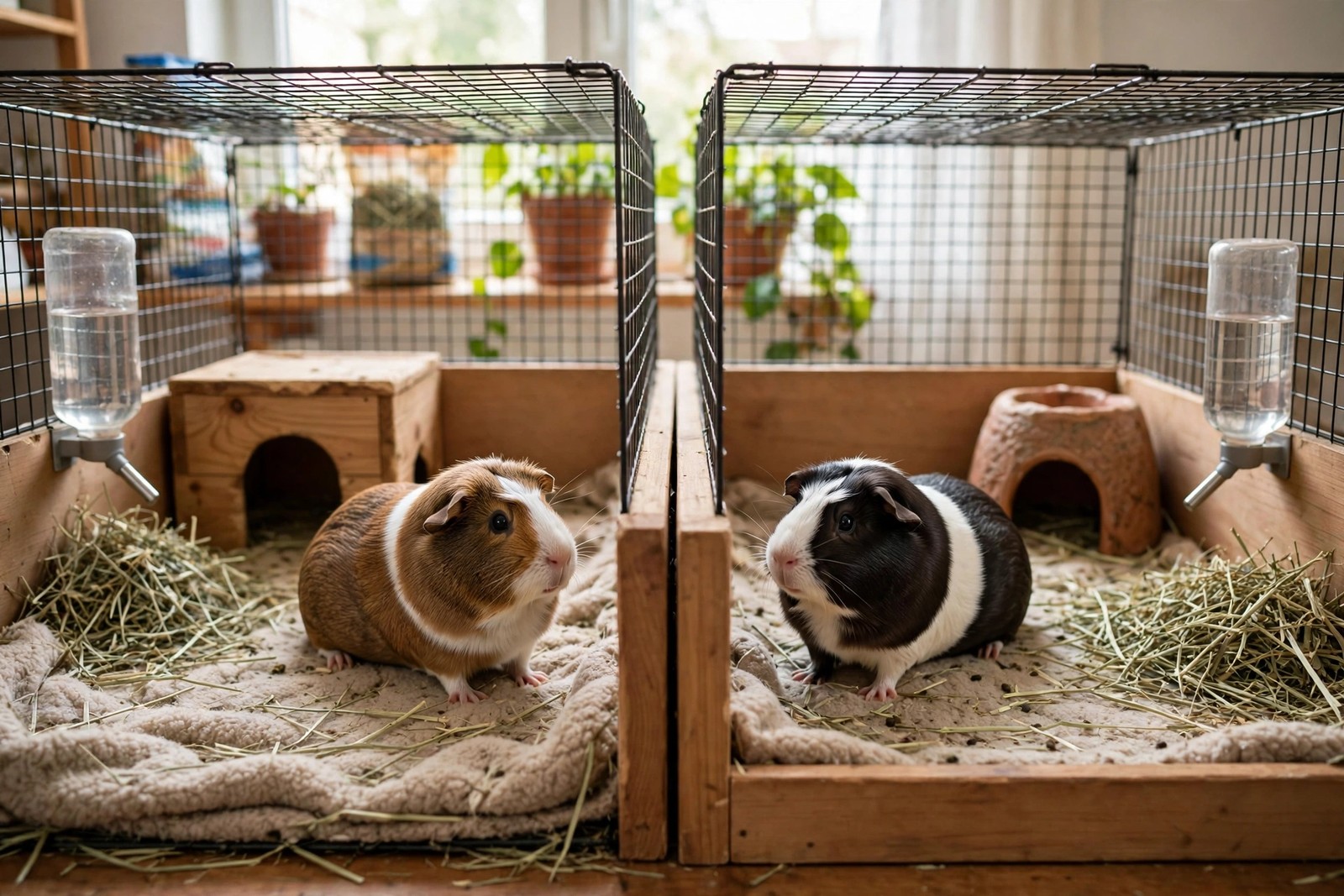
Two guinea pig groups can live as neighbors without ever sharing space. Guinea pigs are social animals who settle better with the sight and sound of other pigs nearby, and that companionship does not require physical contact. The zoning goal is precise: company through the barrier, with no route for noses, teeth, paws, or bodies to meet.
Two Enclosures Within Sight and Sound
Place the enclosures close enough that the groups can see movements, hear calls, and smell that other pigs live nearby, but with a real gap or a fixed divider between them. Each enclosure needs its own secure door or lid arrangement, because a pig who can push out of one zone defeats the whole design. Check corners, joins, and any spot where a determined pig could squeeze toward the neighbors. Leave people room to clean and latch each enclosure properly.
A Barrier That Noses and Teeth Cannot Cross
The divider is the heart of the setup. Make it solid at pig level: a smooth panel the pigs cannot bite through or climb, or two layers of mesh set apart, so a nose pushed into one layer still cannot reach a pig on the other side. Single mesh shared by both groups is not enough when animals can press mouths through the same openings from opposite directions. After fitting the barrier, test it the way a pig would: push at its base, rattle its edges, and look for flex, gaps, and gnawed corners. Recheck after any cleaning day when panels were removed and replaced.
Separate Equipment for Each Group
Give each group its own water bottles, food bowls, hay racks, hide houses, and cleaning tools, and keep those sets in their zones or in labeled storage beside them. Equipment should not travel between groups without a thorough wash first, and everyday convenience is not a reason to borrow a bottle from the other enclosure for a night. Hands get washed between groups too, before handling the second group's pigs, opening its food, or refilling its water. That habit protects both directions: it limits what passes between groups on skin and sleeves, and it slows everyone down enough to notice which zone they are actually working in.
Floor Time in Separate Sessions
Floor time is where zoning most often collapses, usually through kindness: someone sets both groups down together to see how it goes. Do not. Run floor time in separate sessions in the same room after the first group is fully back and its area has been tidied, or use genuinely separate spaces at the same time with a barrier as secure as the enclosure divider. Toys, tunnels, and greens used on the floor get washed or replaced between groups, just like enclosure equipment.
New Groups, Stable Groups, and Calmer Pigs
A newcomer group belongs apart first, in a quarantine space away from the established group, for a few weeks — the usual good practice — before the zones move side by side. Keep established groups stable once they are settled; swapping members between groups to experiment usually creates friction in both. A pig living with a settled companion in its own zone, able to see and hear the other group, is typically calmer than a pig kept in true isolation, and that visible company is exactly what this layout is designed to give.
One Shared Plan for Two Groups
Family Sharing brings both groups' care into one shared household plan, so feeding, cleaning, floor sessions, and hand-washing rules are written once and seen by everyone. The plan can name which group eats first, which bottles belong where, whose turn covers the weekend clean, and what changes when a newcomer is still apart from the others. When a helper steps in, the shared plan prevents the two classic mistakes: swapped equipment and a well-meant joint floor session. At floor time, bring one group back completely before the next emerges, then update the Family Sharing notes in KinsLe.