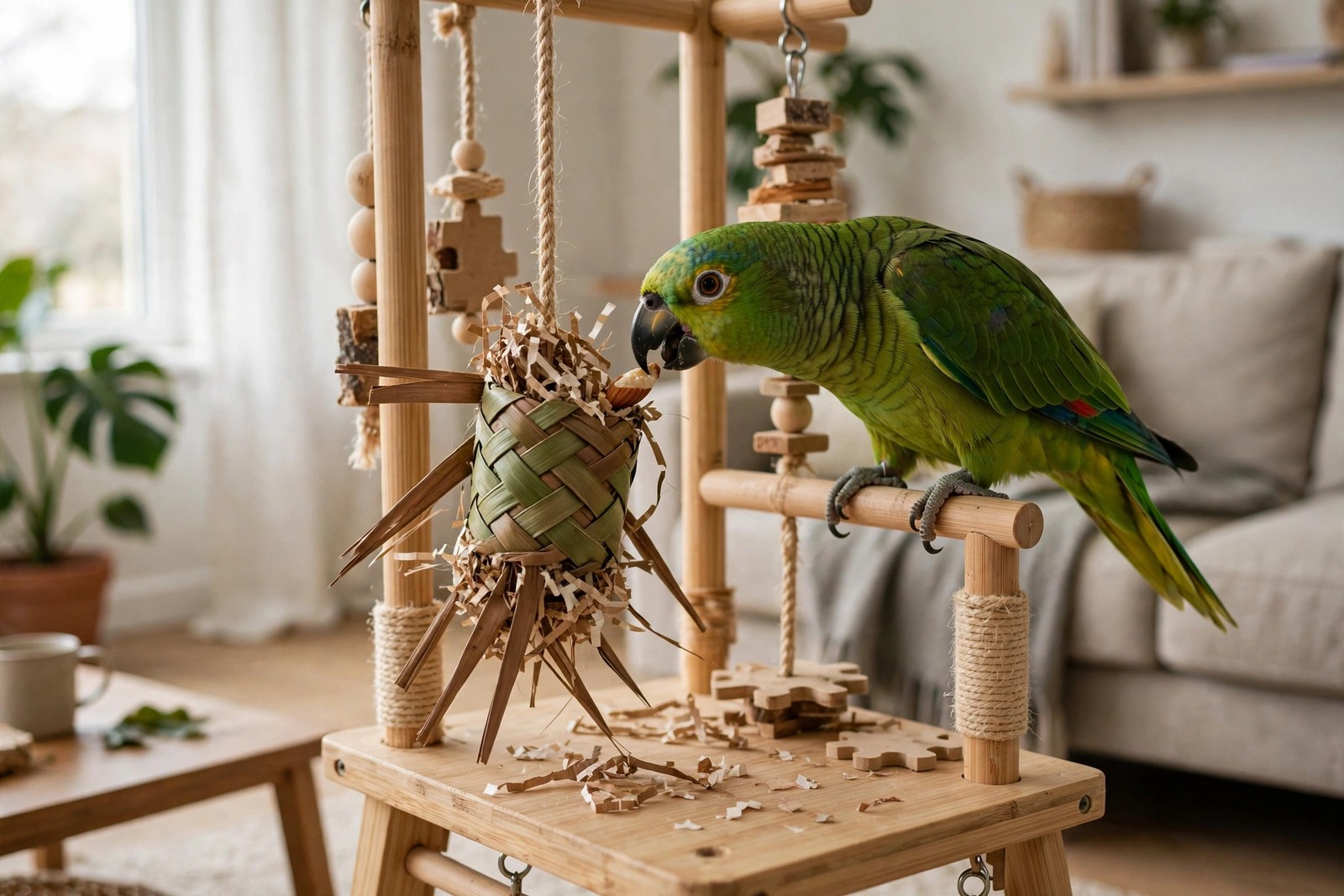
A parrot who walks past a new toy is usually giving you one of three messages: that object might be dangerous, I have no idea what it does, or nothing good has ever come from touching it. Your job is to answer all three, in that order.
Rule Out Fear Before Calling It Boredom
Parrots are prey animals, and a large, brightly coloured object appearing suddenly inside the cage can look like a threat, not a present. Place a new toy on a table near the cage, or hang it on the outside, for several days where your bird can study it at a chosen distance. Watch body language: a relaxed bird leans toward it, beaks at the bars near it, and carries on eating and preening nearby. A bird who leans away, slicks feathers tight, or refuses to approach that side of the cage needs more distance and more time, not encouragement to be brave.
Only move the toy inside once it has become background furniture, and hang it beside a perch rather than over the food bowl or favourite sleeping spot, so your bird can choose how close to sit.
Show the Bird What the Toy Is For
Parrots learn socially, so be the flock member who plays first. Handle the toy in view, tap it, spin it, pull its shreddable pieces, and react as if it is genuinely interesting. Offer it during out-of-cage time on a play stand, where the setting already feels like activity rather than territory defence. When your bird looks at it, steps closer, or touches it with a tongue or beak, mark that instant with praise and a tiny piece of a high-value food. Early rewards should be generous; you are paying for curiosity, and curiosity is the behaviour you want repeated.
Make Toys Pay: Foraging Beats Decoration
A toy that hides food teaches itself. Start easy: wrap a favourite nut or seed piece loosely in plain paper, tuck treats into the folds of a shreddable toy, or thread vegetable pieces onto a skewer-style holder made for birds. Your bird should succeed within a minute or two at first. A puzzle that never pays out is quickly classified as scenery, so increase difficulty only after your bird empties the easy version confidently — tighter wraps, a second layer, food in only some of the compartments.
Match the toy to the beak. A budgie or cockatiel needs balsa, cork, and thin shreddable textures it can actually destroy; a large macaw will dismantle those in seconds and needs denser wood pieces. Destruction is success here — a chewed toy was a used toy — so budget for replaceable shredding material rather than expecting one toy to last for years.
Rotate, Observe, and Keep What Works
Keep a small working set in the cage and swap one or two toys each week, returning old favourites later so they feel fresh again. Note which textures, colours, and positions get used: many parrots prefer toys at a particular height, beside a favourite perch, or on the outside of the cage for out-of-cage sessions. Remove anything with frayed rope that could trap toes, cracked parts, or loose pieces, and check fastenings when you rotate.
Progress can look modest — one beak mark, one pulled strip — before it becomes daily play, so judge over two or three weeks. In KinsLe, Care Teams can assign the rotation day, the foraging refill, and a quick note on which toy was actually touched, giving you a simple record of what your particular parrot truly enjoys.