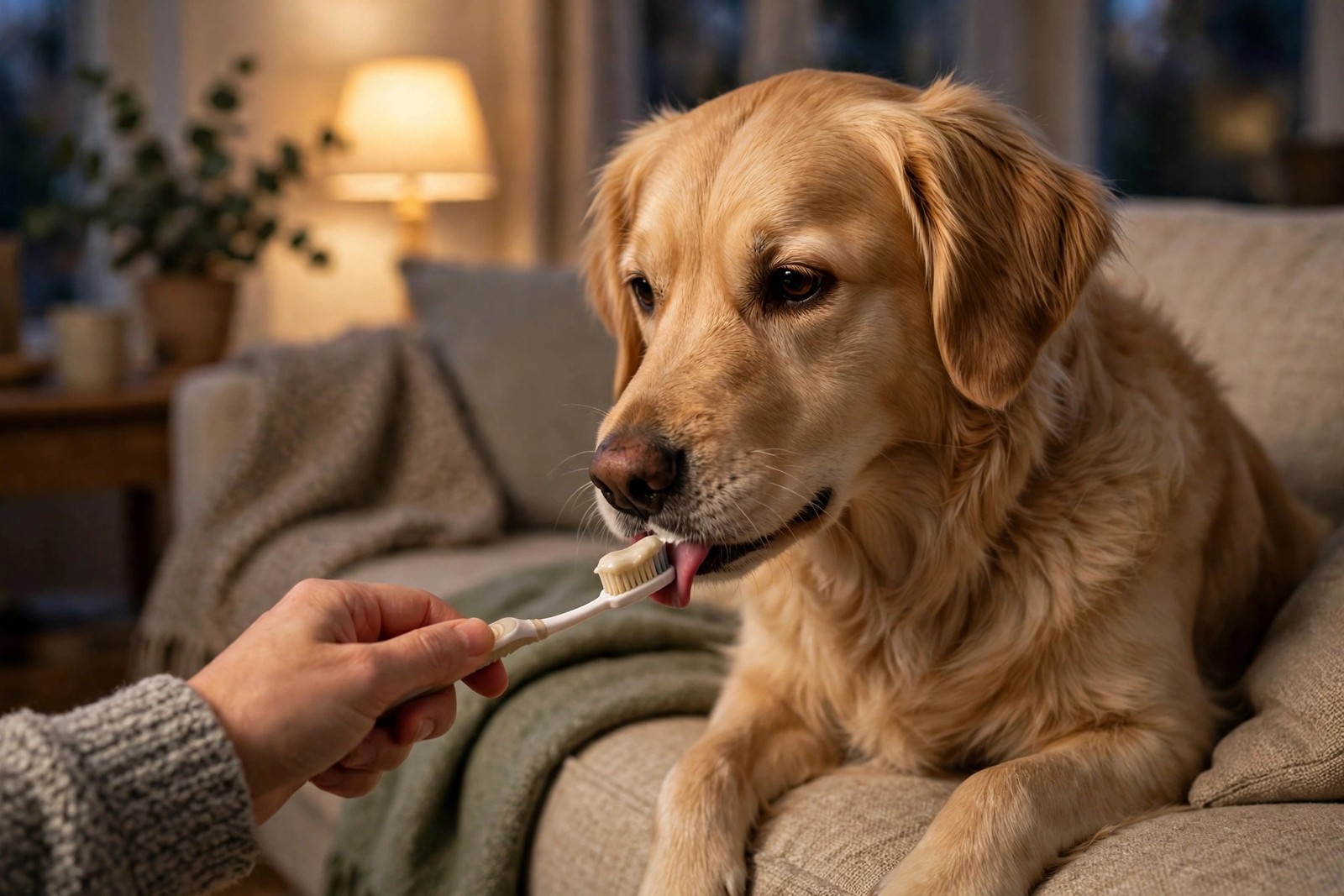
An adult dog who has never had his teeth brushed has no reason to trust a brush heading for his mouth, and he is strong enough to make a forced attempt miserable for everyone. So forget the finished routine entirely and restart from zero, building a chain of tiny permissions. Each link in the chain is earned separately, over days, and the brush earns its place by predicting good tastes and quick endings.
Choose a settled moment, such as after an evening walk when he is drowsy but not yet asleep, and work at floor level beside him rather than looming over his head. Let him stay free to walk off; a dog who is held in place learns only that teeth time means being caught.
Stage One: Sniff and Lick Dog Toothpaste
Begin with flavour, not equipment. Put a smear of toothpaste made for dogs on your fingertip and let him sniff it and lick it off, repeating across several short sessions until he looks for your hand with interest. Then offer the same paste from the brush itself, letting him lick it clean without the brush going anywhere near his teeth.
Dog toothpaste only, never human toothpaste: human formulas contain ingredients that are not meant to be swallowed, and dogs cannot spit and rinse. The dog version is designed to be eaten, which is exactly what this stage relies on. If he dislikes the first flavour, try another made for dogs rather than deciding he hates the whole idea.
Stage Two: A Brief Lip Touch
When licking paste from the brush is eagerly accepted, touch the brush briefly to the outside of his lip and reward straight away. Build toward lifting the lip for a moment with a finger, away from any brushing, so the sight of his own teeth being exposed becomes ordinary. Short touches repeated across days matter more than one long hold.
A finger brush or a cloth wrapped around your finger can serve as a stepping stone here, since a fingertip feels less foreign in the mouth than bristles do. Whatever you use, stop BEFORE he pulls away: if his head turns, his paw comes up, or his body stiffens, you waited a fraction too long, so end sooner next time and reward the attempt.
Stage Three: A Few Outer Teeth
Finally, brush a few outer teeth, starting with the large canine and the back upper teeth where plaque gathers thickest and access is easiest. Use small, gentle strokes for a few seconds, then stop and reward while he is still accepting. Grow the count slowly, a couple more teeth per session across the coming days, and accept that front teeth often come last because they are the most sensitive to touch.
Expect the full mouth to take weeks of these small permissions, with the back teeth on one side often accepted days before the other side feels as easy. Brief daily practice will always beat one long weekly battle, and a partial brush done calmly cleans more over a month than a full brush achieved through struggle once. If you find bad breath that does not lift, red or bleeding gums, a broken tooth, or reluctance to eat, have your veterinarian examine his mouth before you build further, because brushing a sore mouth is unfair and unproductive. Recording how many teeth he tolerated, and where you stopped, in KinsLe keeps Care Teams sessions honest, so the next person starts where he actually finished rather than where the plan hoped he would be.