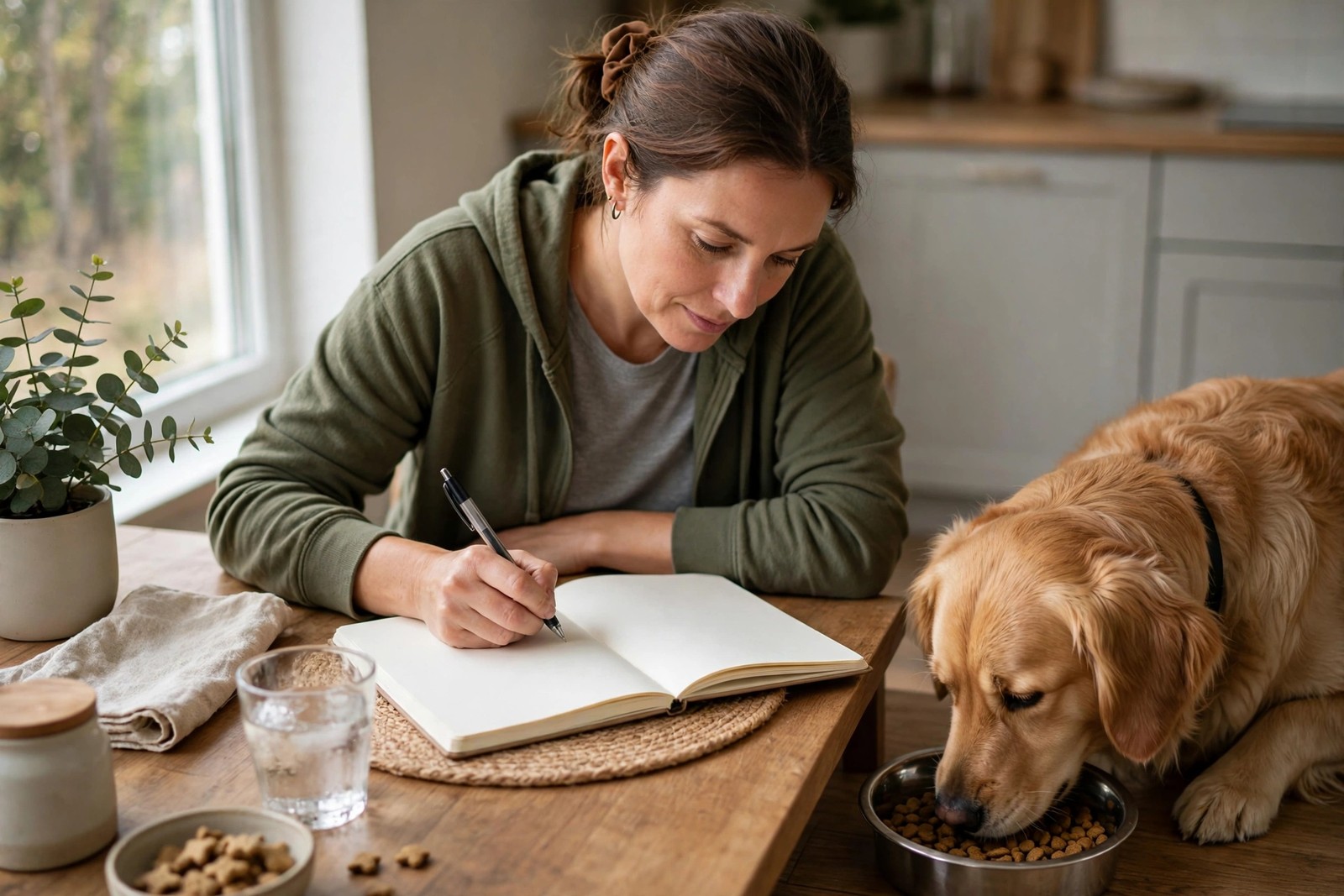
A behaviorist cannot work from stories about bad days. Patterns are what change guarding, and patterns only appear when every episode, and plenty of quiet non episodes, are written down the same way. A good log is dull on purpose: identical fields, plain facts, no verdicts about why the dog guarded, and a scale that means the same thing in week one and week six. Kept that way for several weeks, your log lets the behaviorist skip guesswork and start where the evidence points, whether that is distance, a particular food, tired evenings, or one person's approach.
The Fields, Every Entry, Every Time
Write these headings at the top of every entry, always in this sequence: date and time, what food and how much, where and who was present, what happened before, the guarding behavior shown, an intensity score, how it ended, and notes. What happened before deserves care: visitors arriving, a walk skipped, children near the bowl, another pet drifting close. How it ended matters just as much: who moved away, whether the food was removed, whether the dog relaxed or stayed tense. Notes hold the leftovers a behaviorist still wants: sleep the night before, exercise that day, any stiffness or appetite change. Leave a field blank rather than guessing at it later, because a blank is honest and a guess looks like data.
Anchor the Intensity Score in Real Behavior
A scale only helps if its points are tied to behavior anyone can see. Settle yours before the next episode: a freeze, still, hard eyed, and silent over the bowl, scores low; a growl, with the dog hunched over the food and eating faster, scores in the middle; a snap, lunge, or bite scores high. Write those anchored examples at the top of the log and score against them every time, even when an episode feels worse because it scared you. Two people scoring the same freeze differently will blur the pattern, so anyone who fills in the log reads the anchors first. The behaviorist will trust a log where a growl is always a growl far more than one where scores track how the writer felt that day.
Write It the Same Day, and Log the Quiet Days Too
Fill in the entry the same day, while details are still true, and never reconstruct a week from memory on Sunday night, because reconstructed logs quietly edit out the episodes that seemed minor and the triggers that seem obvious in hindsight. Log ordinary meals with no guarding as short entries too: same fields, intensity zero, nothing to report. Those calm entries are half the evidence, because they show the behaviorist the conditions under which guarding does not happen: this food, that room, nobody passing, after a long walk. Short, safe video can sit alongside the written entry when it happens naturally, but never stage or provoke an episode for the camera; the written log is the record, and provoking guarding to document it makes the problem worse.
Hand It Over Whole
When Alex feeds on weekdays, Alex writes the weekday entries; when Robin covers weekends, Robin writes in the identical fields and reads the anchored scale first. That shared discipline sits in the household plan, the Care Teams board, where the feeding duty and the logging duty are assigned together, so a meal is never fed by one person and logged, from memory, by another. Send the behaviorist the whole log, unedited, several weeks of it, ahead of the appointment if you can, so the first session starts from patterns already visible on the page: guarding that clusters around high value food, around one approach route into the room, or around evenings after poor sleep. Resist tidying the log into a summary; the raw entries, quiet days and all, are the useful thing. A behaviorist reads weeks clearly when your Care Teams log inside KinsLe keeps every feeder, observer, and note writer working from one format.