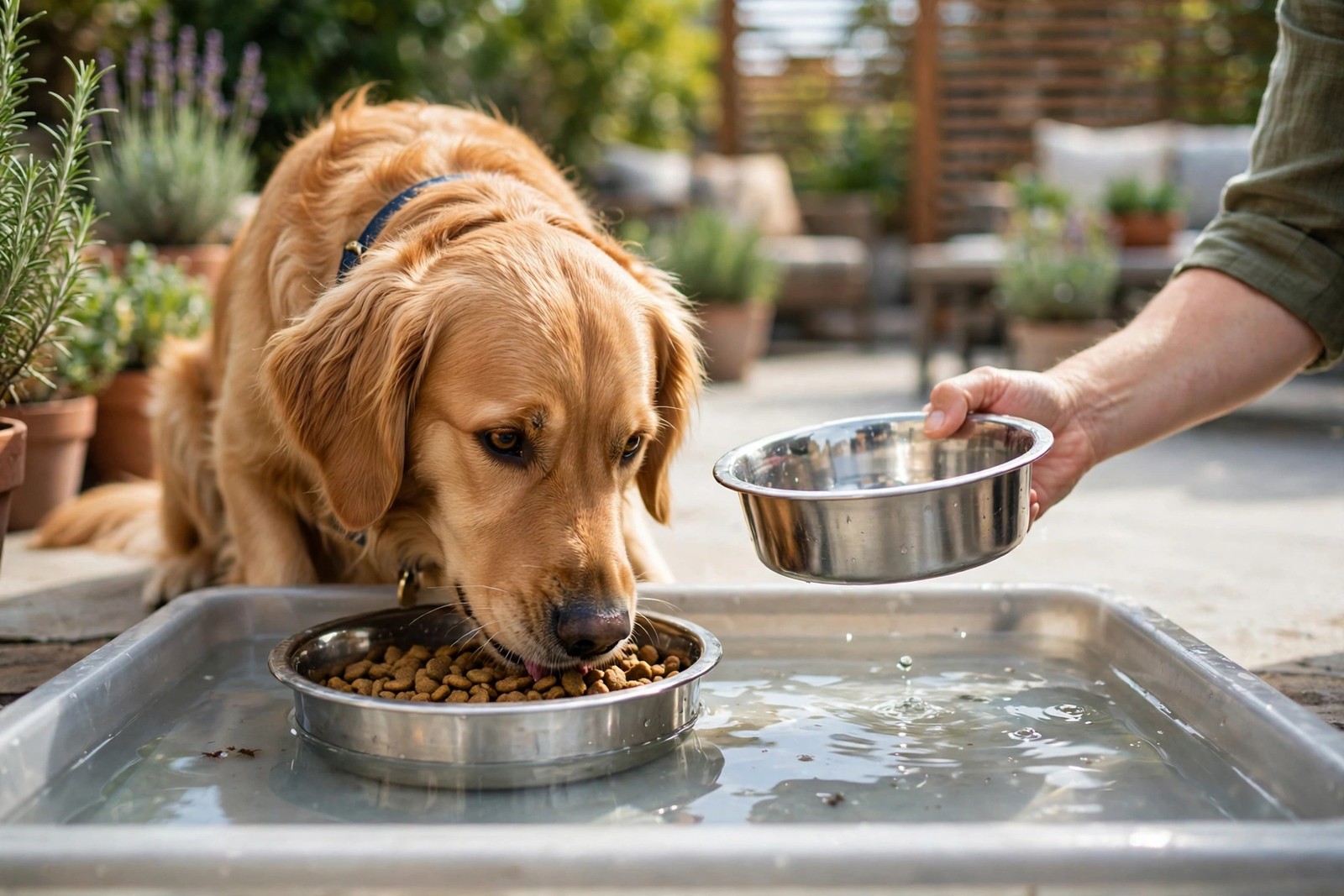
Ants and flies are not really interested in your dog; they are interested in food that stays in one place, outdoors, on a predictable schedule, with sweet spills around it. Every effective tactic attacks one of those facts: block the ants' route, shorten the time food sits available, and clean the signals that recruit the next wave.
The Water Moat: Stop Ants at the Edge
The simplest reliable barrier is a moat. Set the food bowl inside a wider, shallow tray, plant saucer, or low pan holding a centimetre or two of water. Ants scouting the bowl reach the water's edge and turn back, because the trail cannot cross it. Keep the moat topped up, since a dry moat in hot weather fails silently, and clear out drowned debris and fallen kibble daily so it does not form a bridge. Feed the water bowl separately or use the same moat arrangement for it in ant-heavy gardens, because sweet residue around a water bowl recruits scouts too.
Site the whole setup on a hard, sweepable surface rather than grass or bare earth where spills vanish into cover and keep scenting the spot. Ants run established trails along edges and cracks, so even moving the feeding station a metre or two off a trail line noticeably reduces traffic while the moat does the rest.
Timing Beats Treatment for Flies
Flies cannot be moated out; they arrive by air for food that lingers. The counter is timing. Feed measured meals at set times, stay nearby, and lift the bowl the moment your dog finishes and walks away, even if a little food remains. A bowl that exists for fifteen minutes twice a day gives flies almost nothing; a full bowl left out from morning to evening is a standing invitation, and it also goes stale, attracts wasps, and teaches your dog to graze rather than eat proper meals.
Wet food, gravy toppers, and raw diets draw flies fastest, so on hot days feed those meals indoors, or serve the outdoor portion plain and small. If your dog genuinely eats slowly, feed in the cooler parts of the day, early morning and evening, when fly activity drops.
Clean the Signals, Move the Spot
Wipe up every spill, drip, and smeared trail of food around the bowl straight after the meal, and hose or sweep the feeding patch daily. Ant recruitment runs on scent trails: one spilled smear of wet food can keep a column returning for days after the bowl itself is protected, and wiping the trail route with plain soapy water disrupts it. Store outdoor dog food in a sealed container rather than an open sack in a shed, and empty any bin holding food scraps away from the feeding area.
Rotate the feeding spot every few days between two or three places in the garden. Ants and flies concentrate on a fixed location; moving breaks the trail network and the learned routine before either gets established. If ants are entering from a visible nest hard against the feeding area, moving the station well away is kinder and more effective than fighting the nest at the bowl, and avoid scattering any insect treatments where your dog eats, licks, or lies.
The system only works if bowl lifting and moat checks happen at every single feed, and KinsLe Care Teams lets you set those exact tasks for whoever is feeding that day, marked complete with a timestamp so the evening feed never leaves a bowl out overnight by accident.