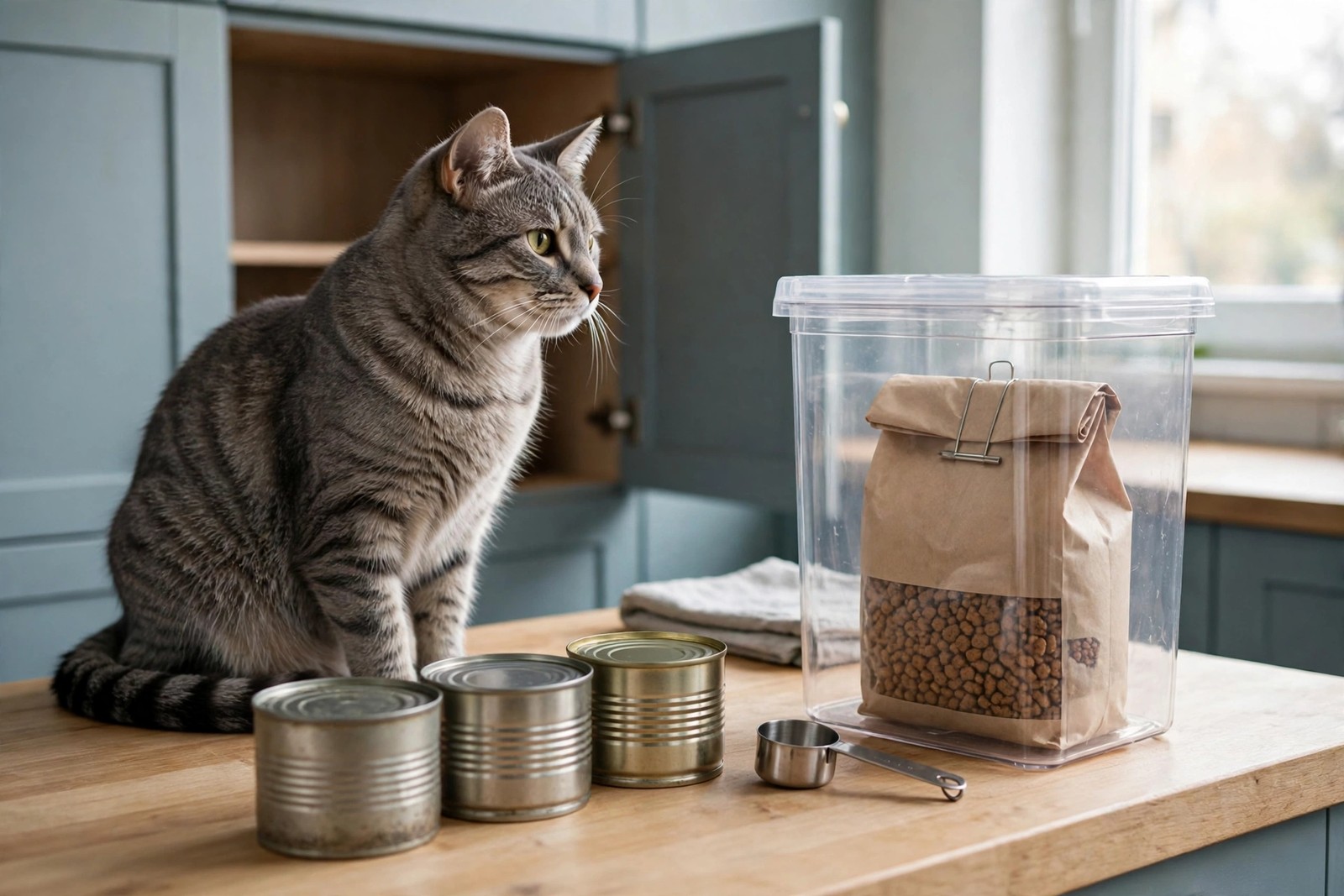
Monthly food planning fails in two familiar directions: the emergency evening run because the bag ran out on day twenty-six, and the stale giant sack still open in week seven because the big bag looked like a bargain. Your own cat's numbers drive every step, and the worked figures are illustrations of the arithmetic rather than prescriptions, because a growing youngster, a dainty senior, and a large active adult eat very different months.
Start With What Your Cat Actually Eats
For one ordinary week, measure what goes into the bowl and note what comes back uneaten. Feeding guides on packaging are starting estimates; your cat's real daily figure is the one that keeps weight steady, and that is the number the month is built on. Multiply the daily amount by thirty for the monthly total. Run the same sum with the example figures: 60 grams of dry food a day lands at about 1.8 kilograms across the month, so one bag around that weight — or two smaller bags opened in sequence — covers it without a long-open surplus. Do the same sum separately for wet food in pouches or cans per day, and add a small buffer of a few days' worth so a delayed delivery or a busy week never becomes an empty bowl.
Buy Sizes That Finish While They Are Fresh
Dry food begins losing ground the day the bag opens: air works on the fats in every kibble, and flavor and quality fade steadily even in a well-kept cupboard. The buying rule follows directly — choose sizes your cat will finish within a few weeks of opening, even when a larger bag looks like better value, because food thrown away stale was never a saving. Rotation at home mirrors rotation in the shop: new stock goes behind old stock, and the oldest is always used first, so nothing ages quietly at the back of a cupboard.
Store Dry Food in Its Own Bag, Inside a Container
The original bag is part of the storage system, not packaging to discard. It is made to protect the food's fats from air and light, and it carries the lot number and expiry date — the two pieces of information you would need instantly if a manufacturer ever queried a batch. Roll or clip the bag shut inside a clean, dry, sealed container, rather than tipping the food loose into the bin, where old residue coats new batches and the date information is lost. Keep the container in a cool, dry place away from radiators, sunny windows, and the humid air near a cooker or dishwasher, and use a clean, dry scoop so moisture and crumbs from hands never enter the bag.
Wet Food and the Monthly Sweep
Unopened cans and pouches are the forgiving part of the plan — long-dated, stackable, and portioned — provided the home rotation above keeps the oldest at the front. Once opened, wet food belongs in the refrigerator, covered, and is best used within a couple of days; serve it by taking the chill off briefly rather than leaving a bowl out for hours. Tie the whole system together with one monthly expiry sweep on a fixed day the household shares: ten minutes checking dates in the food cupboard, moving soonest-dated items forward, noting anything close to its date into the coming week's meals, and updating the buying list with what the next month actually needs based on what was used.
A Routine the Whole Household Can Run
Food plans quietly collapse when one person buys, another stores, and nobody knows what the other did. Family Sharing turns this into one household routine everyone can see: the shared buying list with the month's amounts, where each food is stored, which bag is currently open and when it was opened, and who owns this month's sweep. Keep the routine inside the Family Sharing list on KinsLe, and any family member can do the monthly shop without a briefing call from the kitchen.