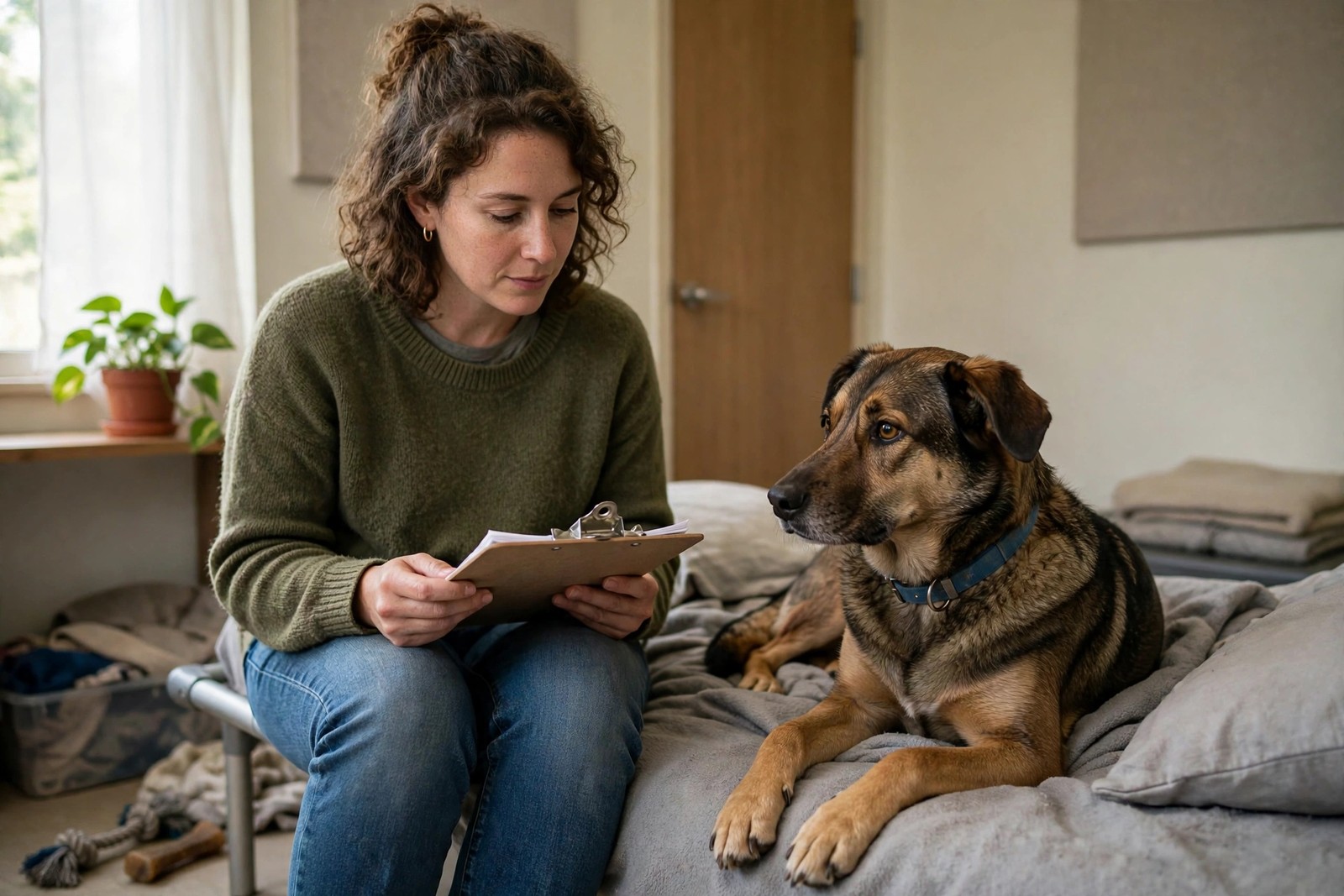
Shelter behaviour notes are written by busy staff about a dog living in a highly stressful environment: noisy, confined, full of strangers and other frustrated dogs, with little control over any of it. That does not make the notes useless — they are often an unusually honest record — but it does mean they need translating. Read every note asking two questions: what exactly did the dog do, and in what circumstances did he do it?
Separate the Observation From the Interpretation
Good notes contain observations: pulls toward other dogs on walks, takes treats gently, freezes when his collar is grabbed, settles on a bed after exercise. Interpretations — friendly, dominant, anxious, untrainable — are a staff member's summary of observations, and two experienced people can summarise the same behaviour differently. When a note uses a label, ask for the observation underneath it. Guarding, for example, covers a wide range: a dog who eats faster when approached is a different prospect from a dog who has bitten over a bowl, and the note that just says resource guarding does not tell you which dog you are meeting. Ask how long the dog has been at the shelter and who wrote the notes, because a dog assessed on day two, still unsettled from arrival, is not the same dog the staff know after three weeks of walks, playgroups and quiet time.
Discount the Kennel, Weight the Calm Moments
Behaviour at the kennel front is the least reliable evidence in the file. Barking, jumping, spinning and lunging in the kennel commonly reflect barrier frustration and the arousal of the whole row, and many dogs who present that way are calm and affiliative within minutes of leaving the building. Weight more heavily what staff report from quieter contexts: how he behaves on a walk away from the shelter, in a play yard, in an office or foster home, and after exercise when he has had the chance to settle. If the notes only cover kennel behaviour, ask directly whether anyone has seen him relaxed, and arrange your meeting in the quietest space the shelter has, ideally after he has had a walk, rather than judging him through the bars in a barking corridor.
Probe the Three Areas That Shape Daily Life
Ask specifically about sociability with other dogs, because notes often record it in passing — walked past dogs calmly, played roughly in a group, avoided dogs in the yard — and the detail decides whether he fits a home with resident dogs or dog-heavy walking routes. Ask about resource guarding around food, chews, toys and resting places, and about handling: whether he accepts being touched all over, having paws handled, being lifted or restrained, and being examined, because grooming and vet visits will test exactly that. Ask also what helps him: the staff usually know that a particular dog settles with a chew, dislikes being left, or relaxes once he has sniffed a yard for ten minutes, and those practical details are worth more to your first month than any label. If the notes mention a bite, growling around children, or behaviour that worries you, ask for the full circumstances without minimising them — context explains behaviour, it does not erase it, and a dog whose history you understand is safer than one whose history was softened for you.
Meet the Dog the Notes Describe — and the One They Cannot
Use the notes to structure your meeting: if they mention food guarding, you will not test him with a bowl, but you will watch his body language around treats; if they mention wariness of strangers, let him approach you rather than reaching for him. When you adopt, ask for a copy of the full notes rather than a summary. KinsLe's Transferrable Profiles moves that shelter history, behaviour record and routine information into the dog's own profile when he transfers to you, so what the shelter learned about him is never lost at the kennel door.