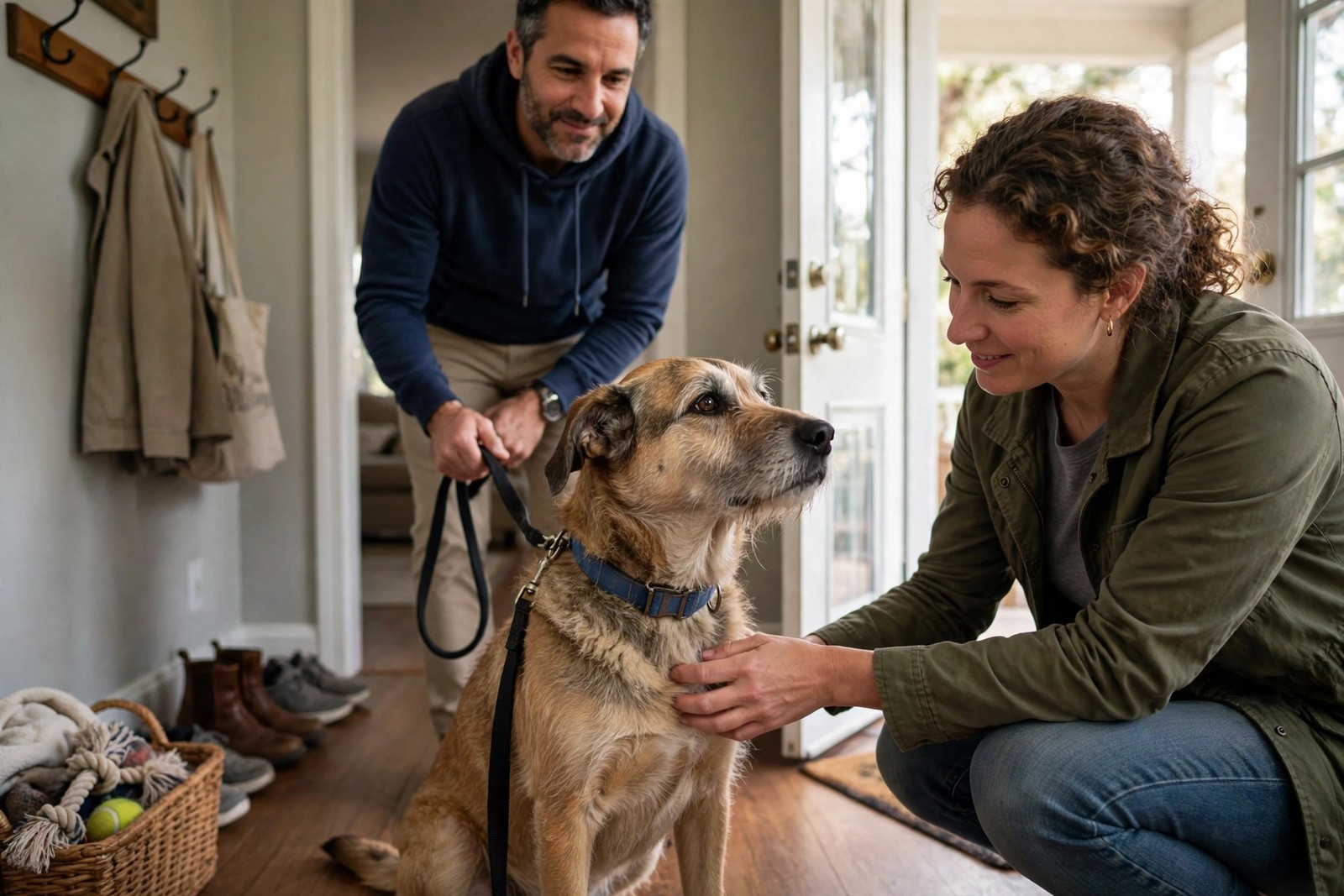
Years of being shut away when the bell rings teach a powerful lesson: visitors mean exile, and the sounds of arrival mean the best part of the day happening without you. That history is why this dog explodes at the door; the excitement is part joy, part protest at being left out again. Retraining works by rewriting the sequence at a distance where the dog can succeed, then closing that distance over many calm repetitions until greeting becomes an ordinary, slightly boring job.
Understand What Shut-Away Arrivals Taught
Your dog has never actually practised meeting guests, so do not judge the behaviour as rudeness. The skills were never built: no rehearsed way to approach, no experience of greetings ending, no evidence that calm behaviour at the door earns anything. Expect the first sessions to look messy even at a distance, with whining or pulling toward the visitor, and plan for progress across weeks of rehearsals rather than days. Choose one trusted, dog-savvy person as your stooge visitor for the early work, brief them fully, and keep every other arrival in the house managed exactly as before until training is ready to take over.
Start Far From the Door
Set your dog behind a gate or on a lead in the room furthest from the door where calm is still possible, with a mat to settle on and excellent food ready. The stooge rings the bell, enters, hangs up a coat and sits down, ignoring the dog entirely. Pay settled behaviour at your distance: four paws down, a glance away from the visitor, a sigh, a lie-down. Hold three short rehearsals a week and end each one while the dog is still coping, even if that means the visitor never comes within two rooms. Over sessions, move the mat one room closer, then into the hallway behind the gate. Distance is the dial you turn down a notch at a time; if a notch produces frantic behaviour, you turned it too far, and the previous notch is where the learning lives.
Give the Greeting a Beginning and an End
When your dog can watch a visitor from the hallway with a loose body, add the greeting itself as a short, shaped event. Bring your dog out on a lead, let them approach, ask for a sit, let the visitor stroke the chest once or twice, then call your dog back to the mat and pay the return handsomely. The return matters as much as the approach: dogs who learn that greetings end on cue stop escalating them, because they no longer need to grab all the contact they can before it vanishes. Keep the visitor seated, calm and briefed to ignore jumping by standing up and turning away rather than pushing the dog off. Lengthen the greeting across sessions only while the dog stays under the frantic threshold.
Keep Big Gatherings Managed While You Train
Training arrivals and real gatherings are different sports, and mixing them too early erases rehearsals. For parties and family events, keep your dog in a separate room with a chew and company in rotation, not as the old punishment but as honest management, and say so cheerfully when you set it up. Graduate to real single visitors before any group event, and choose the calmest guest first. If door behaviour ever tips into snapping or hard guarding of the doorway, pause the home plan and work with a qualified behaviour professional, because doorway tension can have more behind it than excitement.
In KinsLe, Care Teams keeps the retraining orderly across the household: schedule the three weekly rehearsals as assigned duties, note which distance your dog last handled calmly, and log each session with a timestamp, so nobody skips a stage and rushes the dog to the front door too soon.