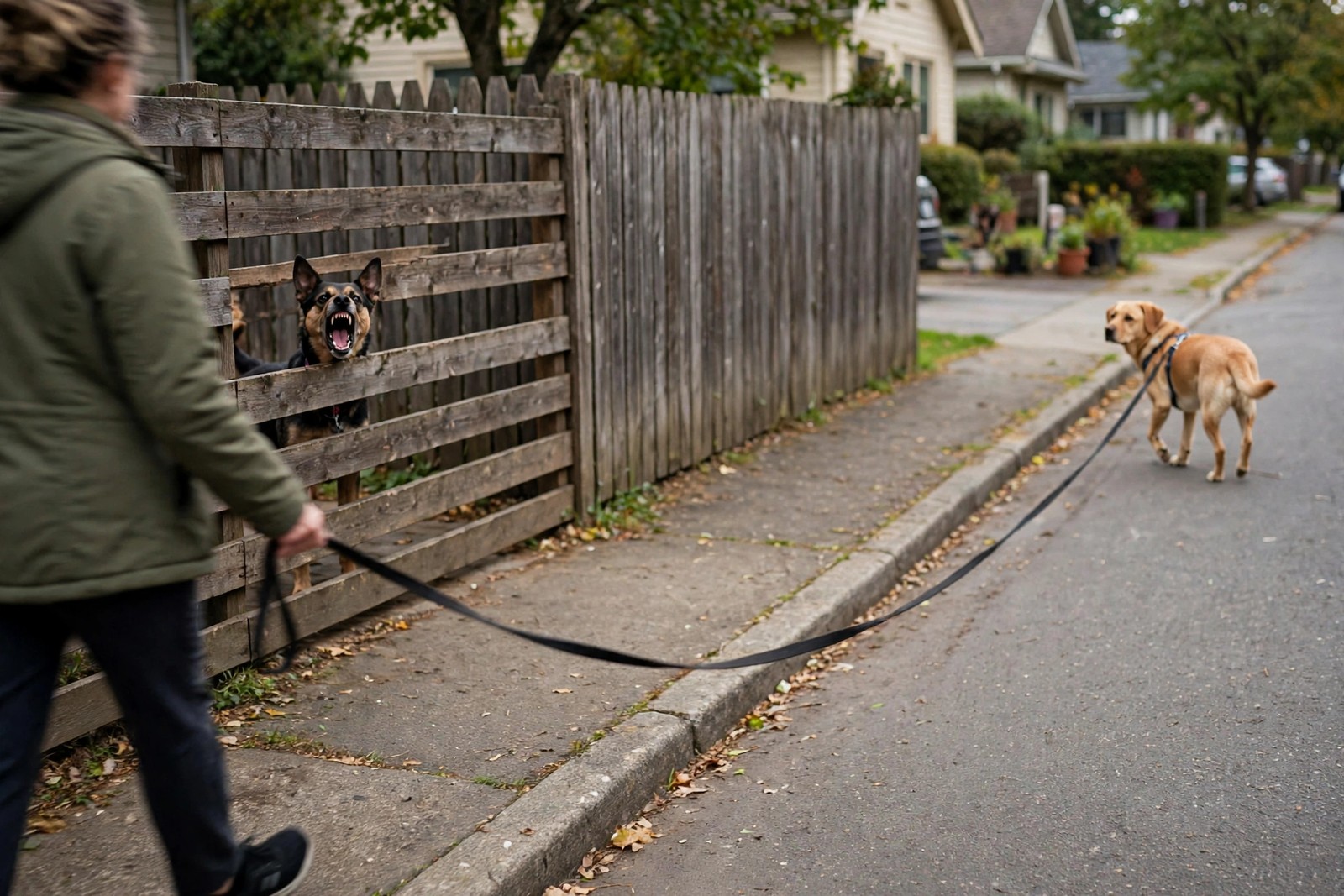
A barking dog behind a fence is a perfect storm for the dog walking past: the noise is loud and close, the other dog is invisible or half-seen, and neither dog can complete the encounter or escape it. Your dog is not being stubborn when she answers back; she is reacting to a frustration and arousal trap that the street layout built. Training works by shrinking that trap gradually, at distances you choose, rather than by marching her past the same fence daily and hoping she gets used to it.
Find the working distance for each fence
Every fence on your route has its own geography of difficulty. A low chain-link fence with a charging dog is harder than a tall solid fence with a dog barking behind it. For each problem fence, find the distance at which your dog notices the barking, flicks an ear or glances, but can still look back at you and eat. That might be the far pavement, the middle of a quiet road, or a detour through a side street for the worst offenders. Work at that distance without apology: crossing early, before the fence dog winds up, is training strategy, not defeat.
Pay the notice-and-check-in sequence
The behaviour you are building is a loop: she hears the fence dog, orients, then turns back to you. Mark and reward the turn every time at first, with food good enough to matter against that much noise. Some dogs do better with an engagement game: watch the fence for two seconds, then get called back to you for the payment, which teaches her that looking is allowed and leaving pays. Keep your lead loose throughout; a lead that tightens as you approach the fence tells her your body expects trouble and adds restraint frustration to the noise. Walk at her working distance past the fence line, pay the final check-in more generously than the rest, and keep moving rather than stopping to celebrate in the trigger zone.
Give her a job for the worst fences
For the one or two fences that reliably defeat ordinary passing, install a task. A repeated hand touch as you pass keeps her head swinging toward you in a rhythm. A walking pattern game works just as well: count three steps aloud together, feed on the third, and repeat for the length of the fence, which gives her a predictable sequence to follow instead of a barking match to join. Treat scatters in the grass verge just before the fence can also carry a dog past, nose down, while the noise happens above her. Practise whichever job you choose on quiet streets first, so the game itself is automatic before it is asked to compete with a fence dog at full volume.
Build the map over time
Repetition across many fences generalises faster than drilling one fence. Walk new streets at quiet times, use the same routine at every barking fence you meet, and let the working distance shrink naturally over weeks as the loop becomes habit. Expect setbacks on days when the fence dog is already at full charge before you arrive, when your dog is tired or unwell, or when a dog appears on your side of the fence off lead; simply add distance and resume. If your dog redirects onto the lead, lunges, or cannot recover for the rest of the walk, a qualified behaviourist can assess her in person, and a vet check is sensible for any sudden change in reactivity.
One fence map for everyone who walks her
Progress unravels when one walker practises at distance and another marches her down the fence line to get home faster. Agree the problem fences, the working distance for each, and the job you are using, and write the route down for the household. KinsLe's Care Teams puts that plan into practice, because each walk can be assigned to a named person who follows the same fence map and marks the walk complete, keeping your dog's education identical on every outing.