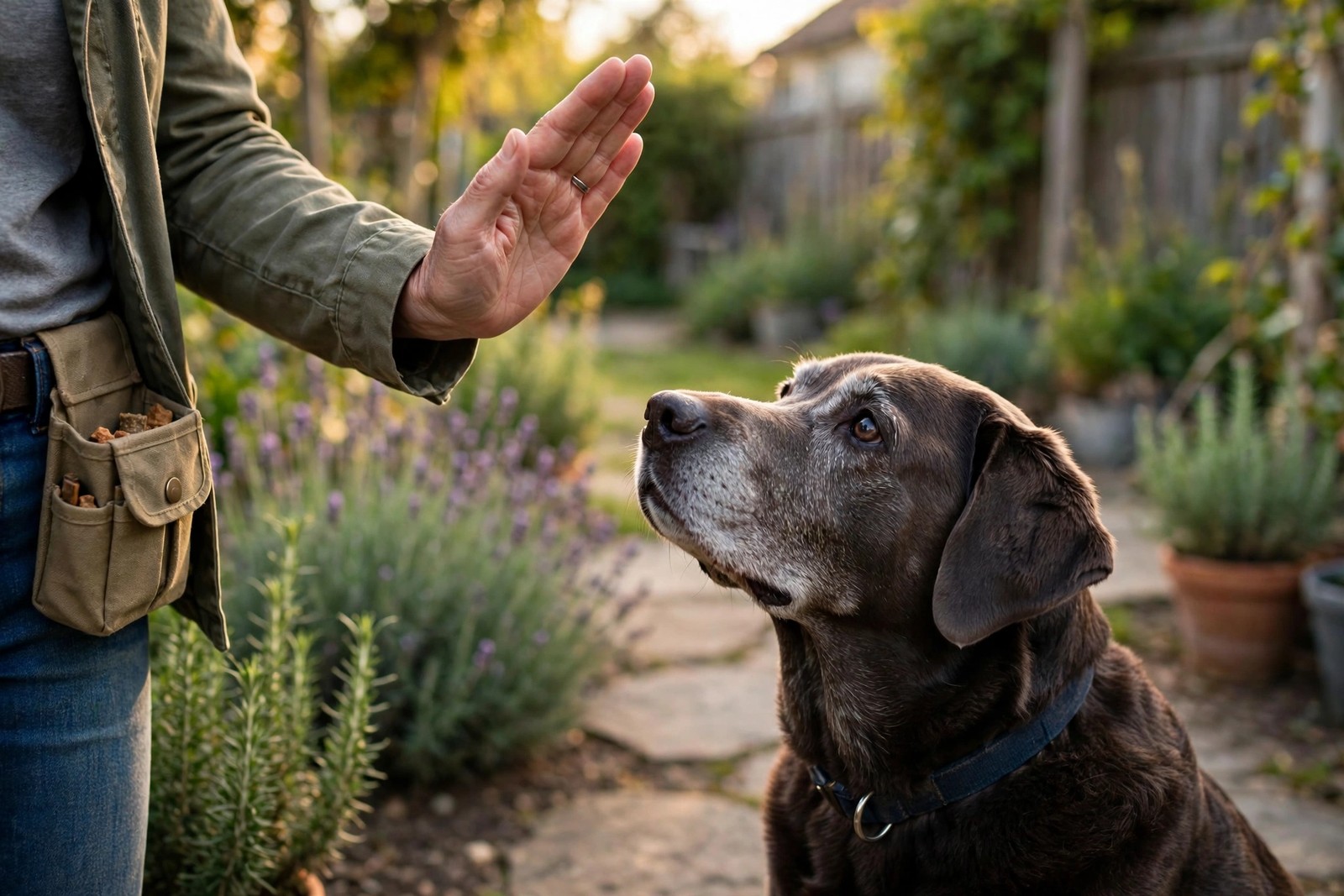
Losing her hearing does not slow an older dog's learning; it simply moves the conversation to a channel she can still receive. Owners are often surprised how quickly a deaf dog picks up new cues once signals and rewards both arrive visually and the family uses identical gestures. If deafness arrived suddenly, or comes with head shaking, discharge, or loss of balance, have your vet examine her before training begins; the work below assumes gradual, age-related loss.
Build a small, unmistakable signal vocabulary
Choose signals that cannot be confused with each other at a distance or in poor light. A flat palm pushed toward her for stay, a sweeping arm beckoning for come, an index finger pointing to the floor for down: each has a different silhouette, which matters far more than elegance. Avoid similar small finger movements; ageing eyes miss them. Teach one signal at a time. Show the signal, lure the behaviour with food in your other hand for the first repetitions, then fade the lure so the signal alone produces the behaviour. Keep your body still apart from the signal itself, since deaf dogs read shoulders, weight shifts, and facial expressions keenly, and stray movement muddies the message.
Replace the clicker with a marker she can see
Marker training still works; the marker just has to be visual. A thumbs-up raised in her line of sight, or a quick double blink of a small torch in dim conditions, both work once charged: marker, then treat, repeated until the marker alone makes her brighten. Use the marker at the exact moment she performs the behaviour. One caution with torch markers: shine the light at the floor or wall beside her, never into her eyes, and skip the torch entirely if she finds light changes startling. A gentle touch on the shoulder, paired with food every time, works as an in-reach attention cue; whatever cue you choose must always predict good things and never function as a correction.
Teach the vibration attention cue deliberately
Your recall system depends on a way to reach her when she is looking away. Indoors, stamp once on the floor: a typical floor carries the vibration to a resting or standing dog. Outdoors on grass, vibration fades, so rely on the long line and line of sight instead. Condition the stomp in brief sessions twice a day: stomp, and the instant she lifts her head or turns toward you, give the visual marker and deliver an excellent treat. Repeat until the stomp alone swings her head around. Then use it sparingly, and pay it every time for the first weeks, because an attention cue that stops paying is an attention cue that stops working.
Manage safety around the missing channel
A deaf dog cannot hear traffic, cyclists, other dogs, or your warning shout, so management replaces voice control outdoors: a lead or long line in any unfenced place, secure garden fencing she cannot slip, and an ID tag and profile that state she is deaf, so a finder understands her silence. At home, avoid waking her with a sudden grab; touch her shoulder lightly the same way every time, or let the smell of a treat reach her nose first, so waking never startles her into a snap. Approach from where she can see you, and teach visiting children the same shoulder-touch rule.
Keep sessions senior-friendly
An older brain and older joints suit short work: brief sessions twice a day, on a surface with grip, with rewards soft enough for older teeth. Watch for stiffness after training positions such as repeated downs, and swap any cue that asks for a movement she finds hard for an easier equivalent, such as a stand-stay instead of a sit. KinsLe's Care Teams keeps the whole household honest about the signal set, because the person assigned each practice session works from the same agreed gestures and marks the session done, so your dog is never asked to translate three different versions of the same cue.