Desensitisation with recordings is powerful precisely because it is controllable: you choose the sound, the volume, and the length, and you can stop instantly. Flooding is the opposite approach — surrounding the dog with the full-strength noise until she stops reacting — and a dog who has gone quiet under flooding has usually shut down rather than relaxed, which is why flooded dogs often come back more frightened the next time. The whole craft of this work is staying under the line where fear starts, and inching that line outward over weeks.
Find her threshold before you train
Begin by playing a recording quietly in another room while she does something she enjoys, and watch her body rather than the speaker. Noticing looks like an ear flick, a glance, or a brief head lift followed by returning to her chew. Reacting looks like lip licking, panting with the mouth pulled wide, pacing, whining, hiding, or coming to you for contact she does not usually seek during that activity. Your starting volume is the highest one that produces noticing without reacting, and for many dogs that is barely audible to human ears. Note the sound, the volume setting, and her response each session, because the ladder is climbed by numbers, not by feel.
Pair the sound with the best parts of the day
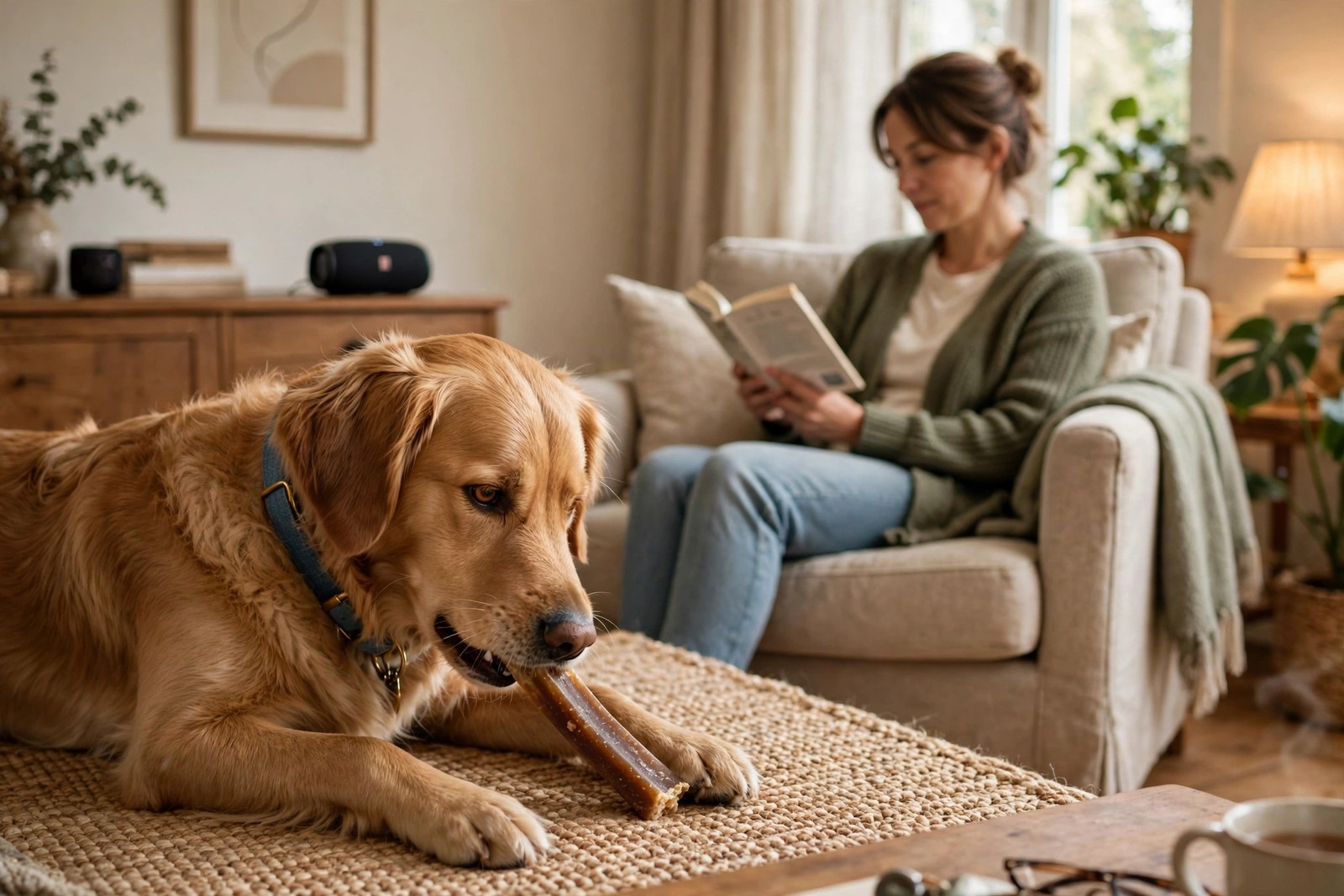
Play the recording beneath good things: scatter feeding in the garden, a long-lasting chew, a favourite indoor game, or training she already loves. Keep sessions to five to ten minutes, a few times a week, and end while she is still relaxed rather than when she starts to tire of the exercise. Raise the volume by the smallest step your equipment allows only after she has been visibly unbothered at the current level across more than one session. Vary the recordings as you progress — different firework displays, thunder at different distances, doorbells and banging if those are her triggers — because dogs generalise poorly and a dog comfortable with one specific track may still fear a different recording of the same noise.
Honest limits of a speaker
A phone or television speaker cannot reproduce the deep bass of real fireworks, and it carries none of the pressure changes, smells, or flashes that make the real event overwhelming. That gap is why recorded work is preparation rather than proof: it raises her tolerance and teaches her that bangs predict good things, but her first real display should still be managed as an event, with curtains drawn, a familiar room, background sound she knows, and a safe hiding place she chooses herself. Never test her by taking her outside to watch a display, and never practise on a night when real fireworks are expected nearby, because real noise arriving mid-session destroys the controlled ladder.
When to bring in professional help
If she injures herself trying to escape noise, stops eating for a day around displays, or her sensitivity is spreading to new sounds despite careful work, this has outgrown a home programme. Your vet can rule out pain, including ear pain, that amplifies sound sensitivity, and can discuss whether short-term support for predictable events is appropriate alongside a behaviour plan from a qualified behaviourist. That conversation belongs well before firework season, not on the afternoon of a display. Severe cases still improve; they simply improve on a professional timetable rather than a playlist.
Climb the ladder with one pair of hands
A common home error is a second family member cranking the volume to show a visitor how well the dog is doing, resetting weeks of careful steps. Agree that only the assigned person touches the volume, and that the written ladder rules every session. KinsLe's Care Teams enforces that rhythm, because each five-to-ten-minute session can be assigned to one named person and marked complete with a timestamp, so the ladder is climbed in order, at her pace, by everyone in the house.