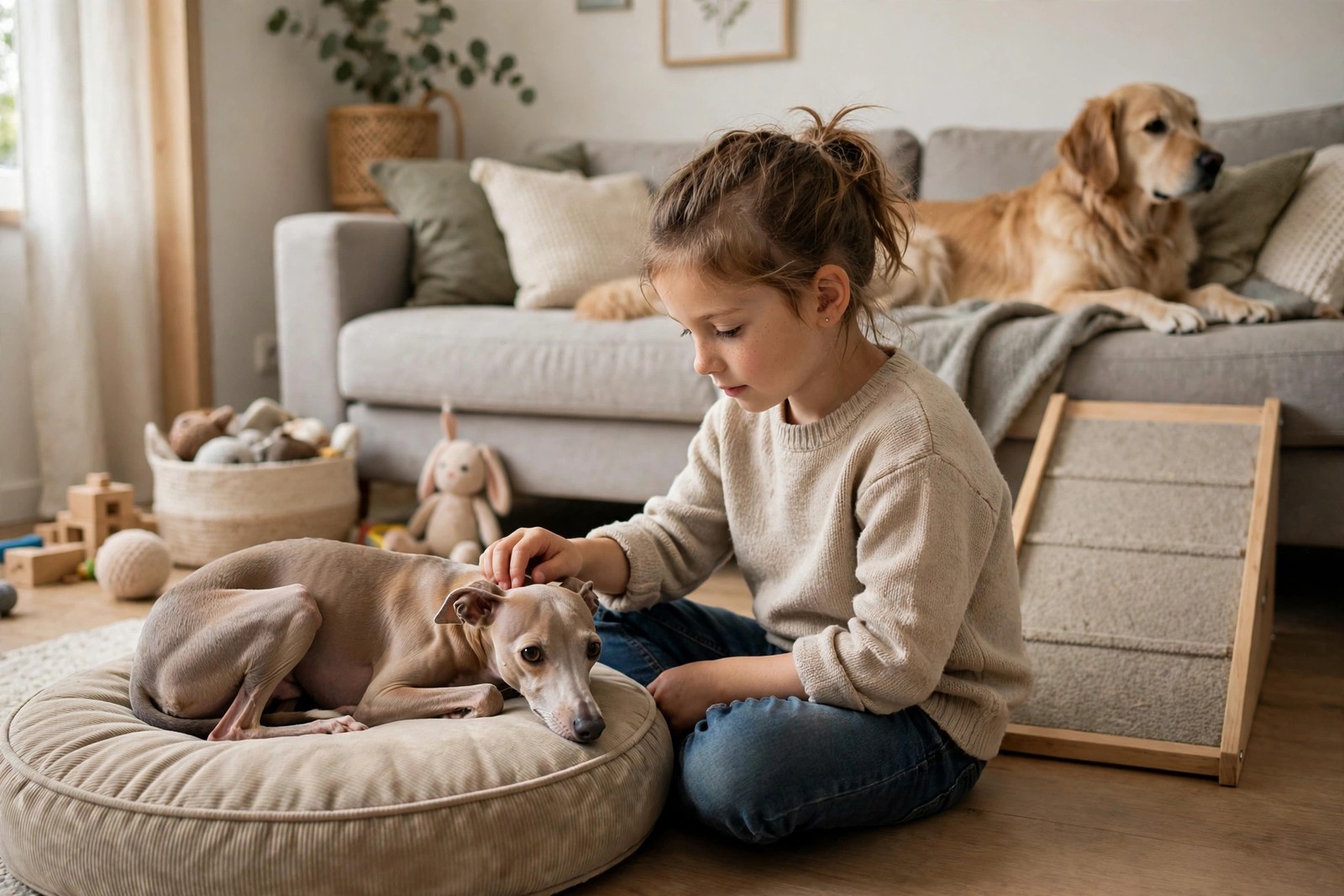
Fragile is the right word, but it needs defining. An Italian Greyhound is not a sickly dog, and a well-bred adult is active, playful and long-lived. The fragility is mechanical: the breed stands on long, very fine leg bones, and those bones can break under forces a stockier breed absorbs without noticing. In a busy home, managing that single fact is the difference between a breed that thrives and a breed that spends its first year in a cast.
Where Fractures Actually Come From
The classic accidents are ordinary household moments. A puppy or young dog leaps from the back of a sofa, from a bed, or out of someone's arms, lands on a hard floor with one front leg taking the force, and the bone gives way. Being dropped is the other common route, which is why carrying is the central rule with children: a wriggling dog and small hands are a poor combination, and a fall of even a short distance onto a hard surface is enough.
Risk is higher in the first year, because young bones are still developing and young dogs are the least sensible about heights, but an adult is never as impact-proof as a terrier of the same weight. Hard floors throughout the house raise the stakes of every jump and slip, so rugs and runners on the main routes are a practical safety measure rather than decoration.
The Rules for Young Children
Children and this breed can be devoted to each other, provided the adults set the geometry. Cuddles happen seated on the floor, with the dog free to walk away; a child never carries the dog, picks her up, or chases her to retrieve her. Teach children to call the dog to them and to stroke her where she stands, and supervise every interaction until the child has proved, over time, that the rules hold without reminders.
Furniture rules protect both sides. Either the dog is lifted on and off sofas and beds by an adult, every time, or she uses a ramp or low steps and is taught to use them rather than launching herself. In practice the ramp only works if everyone enforces it, including visiting children, so brief guests as part of the welcome rather than after a near miss. Baby gates that keep the dog out of the roughest play area at the wildest times of day are a kindness, not an exclusion.
Living With a Bigger Dog
A gentle bigger dog who plays in short, soft bursts can be a good companion, but the size difference turns ordinary play into a hazard when it escalates: a large dog bowling into an Italian Greyhound at speed, a paw coming down on a fine leg during wrestling, or both dogs arriving at a doorway together. Supervise all play in the early months, separate the dogs when the bigger dog becomes boisterous, and feed them apart so there is no contest over food. Give the smaller dog an escape route and a retreat space the bigger dog cannot enter, and watch stairs, where a small dog jostled on a descent can fall badly.
Also plan for the cold, because thin coats and low body fat mean this breed needs a jumper or coat outdoors in winter and warm bedding indoors, and a shivering dog is more tense and injury-prone on slick floors.
If a leg injury does happen, or your dog is non-weight-bearing, yelping when a leg is touched, or holding a limb at an odd angle, that is a same-day veterinary visit, not a wait-and-see injury. Ask any breeder directly about broken legs in their lines, and walk away from one who dismisses the question, because breeding and early nutrition play a part in bone strength.
Writing the floor-cuddle rule, the ramp rule, the supervised-play rule and the feeding-apart rule into the notes every household member can see in KinsLe's Family Sharing keeps the protection consistent, so the dog's safety does not depend on which person happens to be in the room.