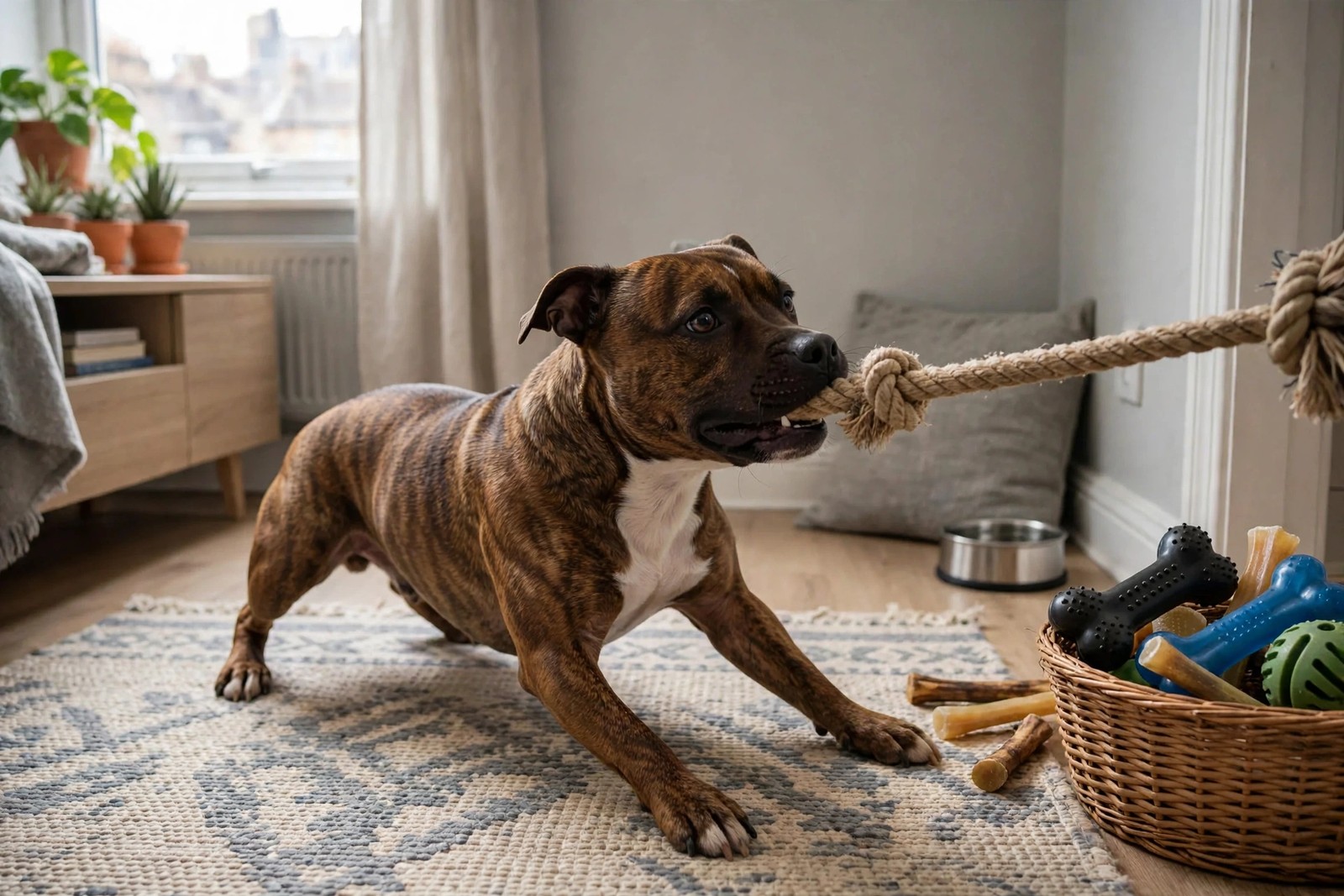
Small homes do not disqualify energetic dogs; unmanaged energy does. A Staffordshire Bull Terrier in an apartment is a strong, busy, people-focused dog living close to your belongings, and the arrangement succeeds on structure: exercise delivered outdoors on a schedule, entertainment provided indoors on purpose, and a home arranged so the dog's chewing lands only on things bought for that purpose. Owners who wait to see what the dog does with free time and furniture usually find out.
The Daily Exercise Budget
For a healthy adult Staffy, plan on about an hour to ninety minutes of exercise and play each day. That total is a blend, not a single march: a brisk morning walk with sniffing time, a shorter midday outing, and an evening session that mixes walking with something more athletic such as fetch in a fenced area, flirt-pole play in a park, or a training game that works the brain as well as the legs. Mental work counts honestly toward the budget; fifteen minutes of learning a new trick or hunting scattered treats in grass tires many dogs more completely than fifteen minutes of plodding. Puppies and seniors sit outside this range and need their own pacing, and a dog new to exercise builds up gradually rather than starting at the full amount. The measure that matters is the dog at home afterward: a dog who settles, naps, and greets the evening calmly is telling you the budget was about right.
Chew-Proofing Is Management, Not Hope
A Staffy has powerful jaws and a genuine occupational need to chew, so the apartment has to be arranged around that fact. Nothing chewable stays within reach: shoes into closets, remote controls onto shelves, laundry behind doors, cables tidied out of temptation's path, and trash behind a latched lid. In their place, provide a deliberate rotation of sturdy chews, keeping a few types in reserve and swapping them every couple of days so yesterday's ignored chew returns as a novelty. Offer the chew at the moments chewing pressure peaks: settling after walks, evenings on the rug, and any time the dog starts investigating furniture with intent. When destruction happens anyway, read it as information rather than spite. A dog who chews door frames or sofa arms is typically bored, under-exercised, anxious alone, or some braid of the three, and the fix is adjusting exercise, company, and chew supply, not scolding damage discovered hours later.
Splitting the Work in a Shared Home
A daily budget of about an hour to ninety minutes of exercise and play each day is far easier to protect when it is divided explicitly instead of assumed. In the Care Teams plan, name who covers the morning walk, who handles evening play, and who rotates the chews and checks the apartment for stray chewable items before leaving, and record what actually happened so a missed session is visible the same day rather than discovered in chewed woodwork. That written division also protects the dog from feast-or-famine weeks where one person's busy stretch quietly halves the dog's world.
Small-Space Living Skills
A few trained behaviors pay outsized rent in a small home. A solid settle on a mat gives the dog a default station during meals, calls, and visitors. A reliable drop-it, taught with fair trades, protects the one irreplaceable item that inevitably ends up in the dog's mouth. Short, frequent training sessions fit apartment life better than rare long ones and double as entertainment on rainy days when the exercise plan moves indoors to hallway games, cardboard-box searches, and trick practice. Noise matters too: a dog who gets active play and company tends to be a quieter neighbor than one who spends the day rehearsing frustration at the window.
Judged by the dog's behavior rather than the square footage, most Staffies adapt to apartment life contentedly when the exercise is real and the chewing is planned. KinsLe's Care Teams keeps one adult on the morning walk, another on evening play, and the chew rotation recorded where the whole household can see it.