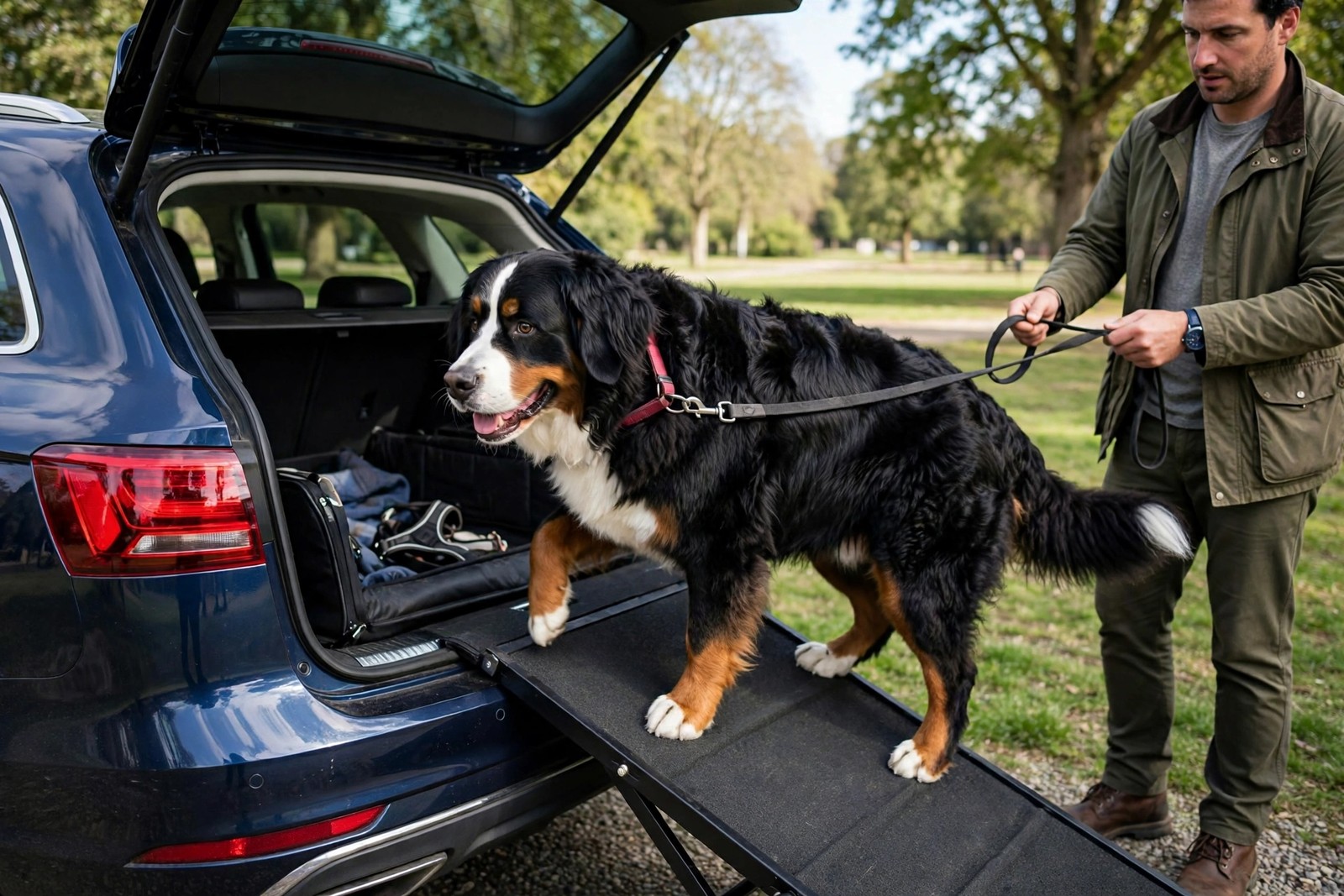
Honesty about a Bernese Mountain Dog starts with the adult in front of you: a dog of around 100 pounds, long-bodied, deep-chested, and heavy-boned, who will take up roughly the floor space of a small coffee table wherever it chooses to lie. The puppy fits anywhere. The adult needs a home, a daily exercise pattern, and a car that were all chosen with that adult size in mind, and this breed feels cramped, hot, and stiff faster than its gentle temperament suggests.
Floor space: turning, stretching, and rising
A Bernese needs clear floor room to turn around without backing out of corners, to stretch fully on its side with legs extended, and to stand up without bracing against furniture. In practice that means a large bed, big enough for the dog to lie flat rather than curled, placed in a cool, draught-free spot out of the main walkway, plus turning room in the hallway and kitchen where the dog will spend its day. Hard, slippery floors are hard on a heavy dog's joints when rising, so rugs or mats on the lying and turning areas genuinely help. A garden is valuable for toileting and pottering but does not replace walks; what the dog needs indoors is uncramped room to exist at full size, all day.
Exercise: sixty to ninety minutes, split up
Plan on sixty to ninety minutes of exercise a day for a healthy adult, split into two or three walks rather than one long march. Two walks of thirty to forty-five minutes each lands inside that total and suits the breed's steady, unhurried style: a Bernese is a working dog who enjoys a purposeful walk and some free running on soft ground, not a distance runner. Warm weather changes the calculation, because a heavy, thick-coated dog overheats readily; in summer, walk in the cool early morning and evening, shorten the midday outing to a toilet break, and keep the day's total within the same sixty to ninety minutes by lengthening the cool walks. Consistent moderate exercise, not weekend extremes, is what keeps a big dog's weight and joints right.
Car room: lie down, turn, and a ramp
Measure the car against the adult dog, not the puppy you collected. A Bernese needs a large boot with the rear seats folded, or the load space of an estate car or SUV, with enough room to lie down fully, stand, and turn around; a small hatchback boot that forces the dog to curl tightly is not honest car room for journeys of any length. The dog should travel secured, with a guard or harness, on a non-slip surface, with ventilation reaching the back. Add a ramp to the plan: asking a dog of around 100 pounds to jump in and out loads the shoulders and hips on every trip, and you cannot simply lift a dog of this weight when it is injured, elderly, or post-surgery. Practise the ramp while the dog is young and light enough to guide easily.
The honest overall picture
None of these numbers is extreme on its own; together they describe a dog who needs a roomy corner of every part of your life: floor space at home, sixty to ninety minutes of your day in two or three walks, and the back of a large car, reached by a ramp. A Bernese also matures slowly and ages as a giant breed, so the space and ramp decisions you make for the prime adult will serve the elderly dog who needs them most. If the car and the hallway only work for the puppy version, they do not work. KinsLe's Care Teams helps the household run the exercise side fairly, assigning the two or three daily walks to named people, each marked complete with a timestamp, so the sixty to ninety minutes reliably happens.