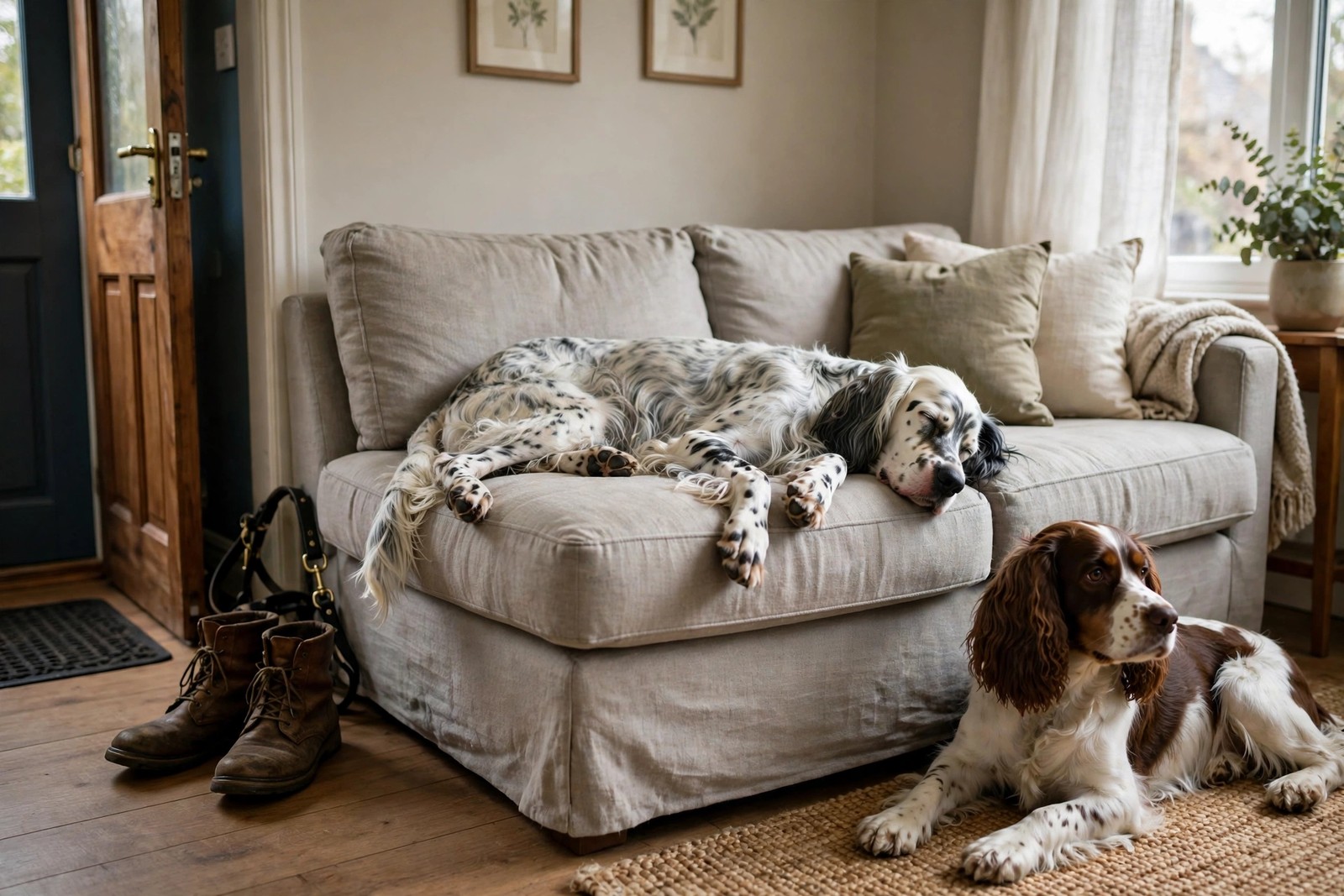
The contrast surprises people who meet an English Setter only in the field. Outdoors the breed works with real drive, quartering ground with its nose, ranging widely and locking onto scent with complete focus. Indoors, a well-exercised adult Setter is one of the calmer gundogs to live with, and it is that split personality, rather than the total energy level, that defines the breed at home.
Outdoors: Every Bit a Working Gundog
Do not mistake the home manners for a low-energy dog. A Setter needs a long daily outing with genuine freedom to run, sniff and work ground, not a short lead walk round the block, and adolescents need that outlet supervised because the nose can carry them a long way from you. Recall training around scent and game is real work with this breed: a Setter who has found birds is a dog who has stopped hearing you, so long lines, whistle recall and practice in enclosed ground come before freedom in open country.
Spaniels ask for the same total commitment outdoors but in a different style, working close, busy and fast through cover. Pointers range at least as widely as Setters, often further, with a harder, more single-minded edge. If your day cannot contain a long, absorbing outdoor session, none of these breeds will show you their good indoor side.
Indoors: Where the Setter Pulls Ahead
Given that exercise, a Setter typically switches off at home. The classic picture is a dog stretched full length on the softest available surface, content to doze through the evening, following you from room to room mainly to resume sleeping nearer to you. Setters are affectionate, people-oriented home dogs, and their energy indoors is social rather than frantic.
A working-bred spaniel, by comparison, often brings the job indoors: pacing to the door, checking windows, carrying objects, and reappearing with a toy the moment you sit down. Some of that is training and some is the breed's close-working busyness, but many owners find the spaniel's indoor tempo noticeably higher than a Setter's at the same age. A working pointer at rest is often calmer than a spaniel yet less inclined than a Setter to seek out laps and sofas; pointers can be more independent indoors and slower to settle in a busy, noisy household.
Individual dogs vary, and a show-bred Setter is often steadier again than a dog from hard-working lines, so ask any breeder honestly which lines a puppy comes from and what the parents are like at home in the evening, not only how they work.
When the Indoor Calm Breaks Down
The Setter's off switch is conditional, and the conditions are exercise, company and routine. Miss the long outing and the same dog will pace, counter-surf, chew skirting, dig at doors and invent games with your belongings; that is stored field energy with nowhere legal to go. Setters also dislike long daily isolation, and a bored, lonely Setter can become vocal and destructive even when walked, because the breed's home life is built around being near its people.
Teach a deliberate settle from puppyhood: a bed or mat in the living room, a chew or a stuffed food toy given there after the walk, and calm praise for choosing it, repeated until post-walk means bed. Run that routine at the same point in the day and the dog starts to offer it unasked. Adolescence, roughly the gangly middle period before maturity, is when the indoor manners wobble; hold the routine, increase supervision, and remove tempting items rather than concluding the breed description was wrong.
Finally, budget for the coat: the long feathering collects mud and water on wet outings and deposits it indoors, so a rinse and towel routine by the door is part of owning this dog in winter.
Recording the long daily outing, the settle routine and the door-side drying as named duties in KinsLe's Care Teams means every member of the household delivers the exercise the Setter's indoor calm actually depends on.