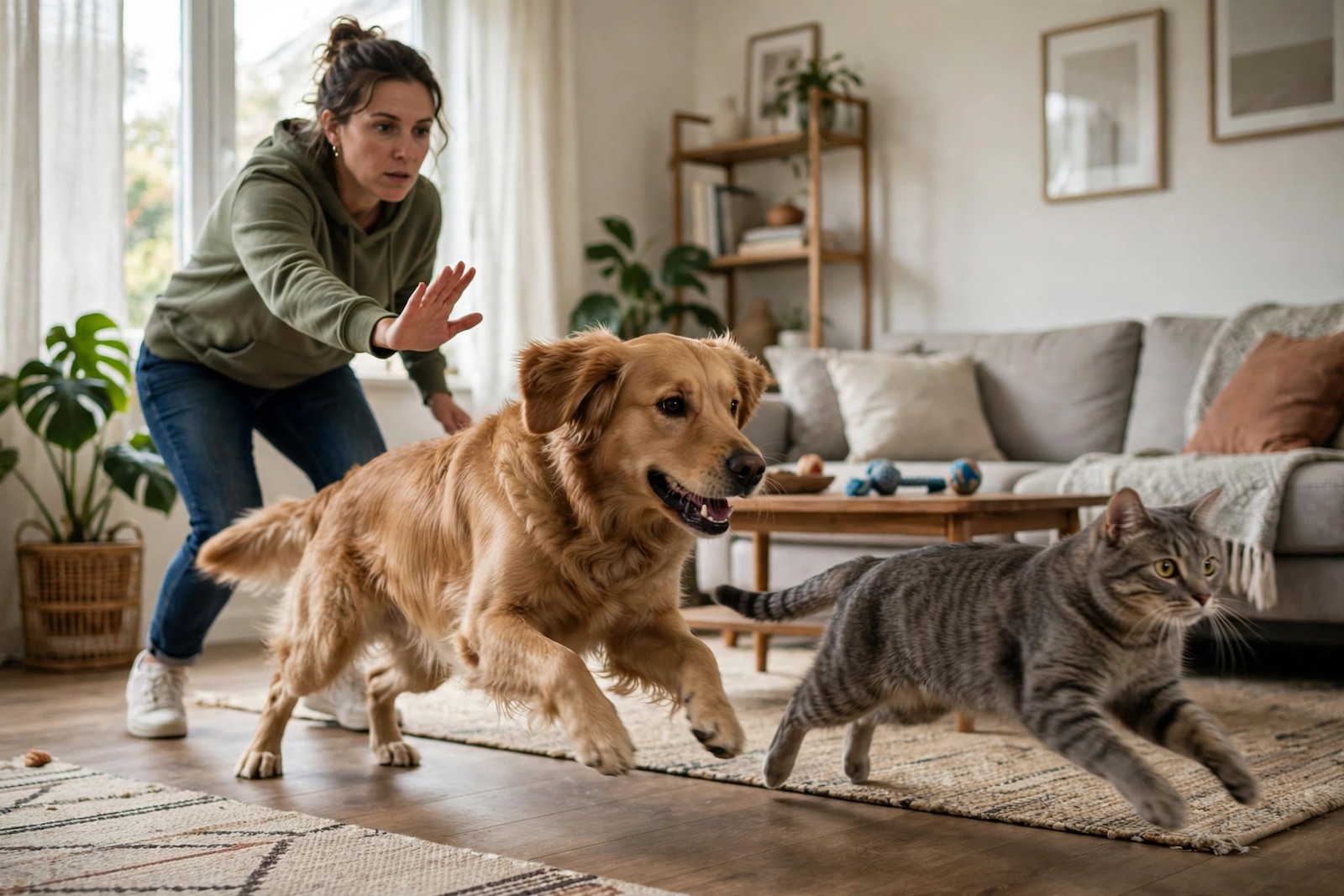
A still cat can be easy for your dog to ignore; a moving one flips a switch. That gap is where the training belongs — not in calling a dog who is already sprinting, but in rewarding the glance, the head turn, and the decision to disengage that happen a breath before the chase begins. Until that earlier moment is reliable, management carries the rest: a trailing lead during cat-active times, gates that give the cat dog-free routes, and no unsupervised access. A chase rehearsed daily is a chase strengthened daily, so prevention is not the backup plan; it is half the plan.
The Moment Before Movement
Learn to read the half-second before your dog commits. Ears prick, the body stills and leans forward, the stare hardens, and the weight shifts onto the front feet — that frozen instant is your working window. Set sessions up so you can use it: the cat walks, rather than runs, at a distance where your dog notices her but can still turn away and take food. Pay that turn generously, every time, then let your dog look again. If your dog cannot disengage at that distance, the setup is too hard; add space, add a barrier, or let the cat move more slowly. You are building a habit of noticing-and-choosing, not testing how much temptation your dog can withstand before failing.
Building a Reflexive Interrupt
Teach the interrupt itself far away from the cat, where nothing competes with it:
- Pair a whistle blast or a hand-touch cue with an outstanding reward, repeated until the cue alone makes your dog spin toward you
- Practise the cue in every room and in the garden, at random moments, so it works wherever the cat appears
- Add the walking cat at your chosen distance and use the cue at the stare, not after the first stride
- Shorten the distance gradually over weeks, and drop back a step after any rehearsal that ends in a chase
- End each session while your dog is still succeeding, so the last memory is an easy win
The cue has to arrive before the chase starts, because a dog at full stretch after a running cat is working on instinct, not listening. Owners who practise the interrupt daily, in tiny ordinary moments, end up with a response that is there on the one afternoon it really matters.
Living With Both Animals While It Sticks
Fit the practice around the times the cat is most active — early morning zoomies and the evening prowl are typical flashpoints — and keep the lead-and-gates routine in force at exactly those hours, even on days when training went well. Consistency across everyone in the house matters as much as the cue itself: one person letting the dog roam unsupervised can undo a week of careful setups. For households sharing the work, KinsLe offers Care Teams to hand each duty — gate checks, lead supervision, practice rounds — to a named helper, and timestamped completions show which steps were actually done that day.