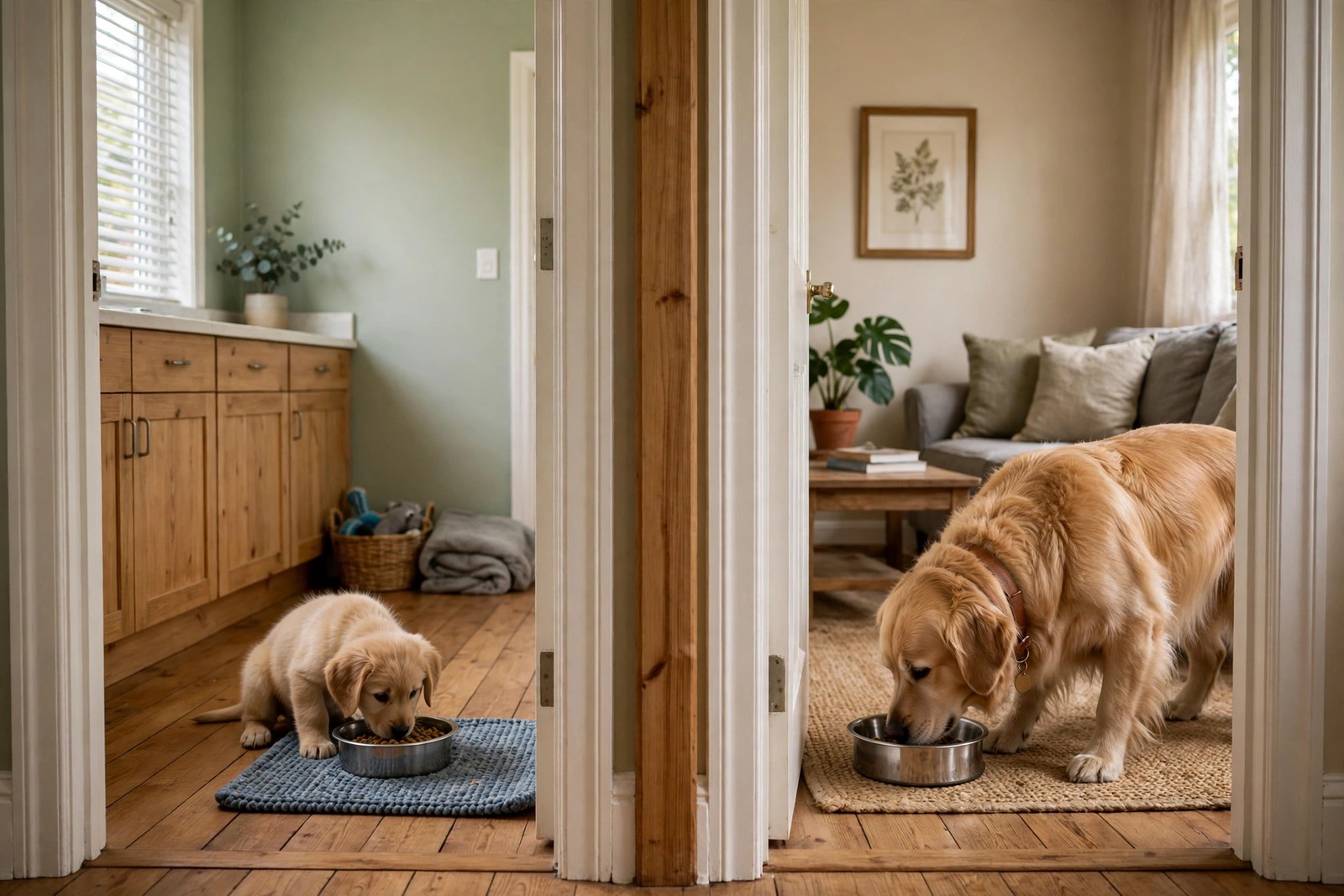
Separate spaces are the sensible default when a puppy and an adult dog share a home. A closed door, a stair gate, or a crate used calmly all create the one thing mealtimes need: each dog eating without an audience that wants the bowl. Puppies and adults usually eat different foods built for different jobs, and meals are a classic setting for guarding, stealing, or gulping to appear. Feeding apart removes the contest entirely, so nobody has to police a bowl, scold a thief, or wonder afterwards which dog actually ate the portion you measured out at the counter.
Different foods, different reasons to protect them
A puppy's growth food is energy dense and appealing, and an adult who raids it regularly can gain weight on meals nobody counted. An adult's larger portion, larger kibble, or food intended for a health condition is not a suitable puppy meal, and a puppy who finishes it may miss the balanced growth ration the day was planned around while also learning that wandering between bowls pays. Supplements or medicines folded into one dog's food raise the stakes further, since the wrong dog eating a doctored bowl is a problem beyond calories. Separation keeps each ration intact, which means weight changes, loose stools, or a refused meal can be traced to the dog who actually ate that food.
Setting up two feeding stations that work
Choose the puppy's station where you can supervise without hovering: a kitchen corner behind a gate, a utility room, or a crate with the door closed during the meal. Feed at the same times each day, put both bowls down within a minute or two of each other, and stay within earshot rather than leaving the pair to sort it out. When a dog walks away and loses interest, lift the bowl rather than leaving food down for grazing, because a lingering bowl invites the other dog to investigate the moment a door opens.
Reading behaviour around the bowls
Watch body language in the minutes before and after feeding, when excitement peaks. A dog who eats faster as footsteps approach, freezes over a bowl, hovers in a doorway, or shadows the other dog toward its station is telling you the current setup still carries pressure. Keep your response plain: no reaching into a guarded bowl, no taking food away as a test, and no punishment for growling, which is a warning worth hearing rather than suppressing. If guarding appears between the dogs or toward people, keep full separation in place and raise the behaviour with your veterinarian or a qualified behaviour professional, because mealtime tension deserves a plan rather than repeated experiments at the gate.
When same-room feeding can be trialled
Graduation is earned slowly, and many households sensibly never bother. Consider a trial only when the puppy has matured, eats at a steady pace, leaves a finished bowl without touring the room, and shows no tension when the adult passes at a distance. Begin with the dogs fed far apart in a large room, an adult human near each bowl, and a gate still between them if distance alone feels thin. Treats and long-lasting chews stay separated even after meals graduate, because a high-value chew restarts competition that an ordinary dinner no longer triggers.
Puppies, visitors, and busy evenings
Hold the routine steady when life gets noisy. Guests who feed scraps, children carrying snacks at puppy height, and a visiting dog added to the mix all raise mealtime risk, so feeding apart matters more on those evenings, not less. Tell everyone in the house which station belongs to which dog, and keep spare bowls, the puppy's food, and the adult's food in clearly separate containers so a helper cannot serve the wrong ration in good faith. That rota runs cleanly inside KinsLe, where Care Teams assigns the puppy station, the adult station, and the bowl-lifting check to named people, with finished meals stamped in order.