
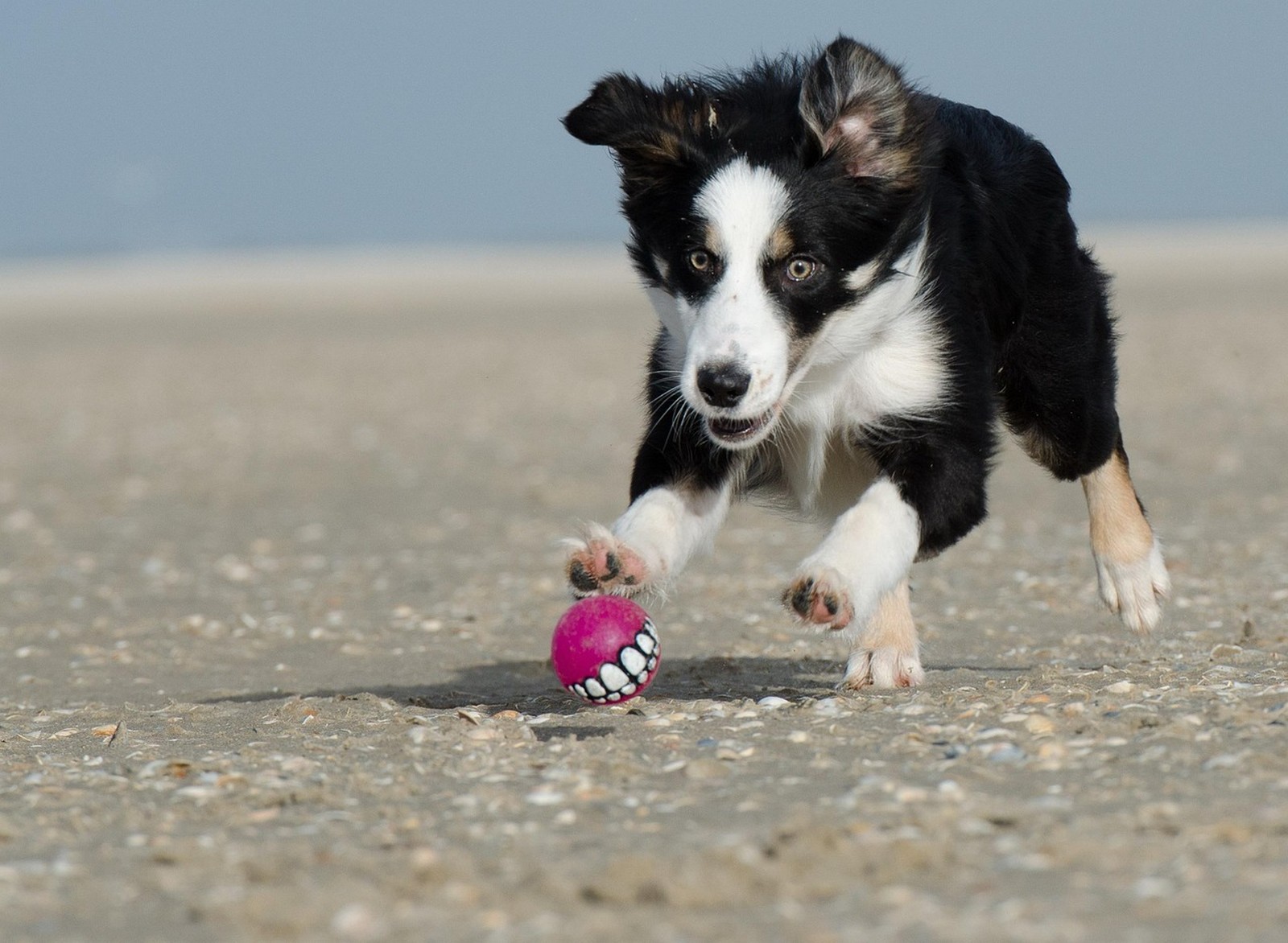
A Border Collie's first year reveals a mind that processes your household like a system to be optimised. Collies learn cues in a handful of repetitions, spot patterns in your behaviour before you notice them yourself, and apply the same intensity to solving the problem of an empty afternoon. Year one is about employment and rest in equal measure.
The early months: manage the stare and the chase
The herding sequence appears young: a puppy drops into a crouch, fixes moving targets with the famous stare, then chases and circles. Children running, cyclists, joggers, cars, and other pets can all become targets, so management starts immediately. Keep the puppy on a lead or long line around movement, reward disengaging and looking back at you, and channel chasing into games you start and finish, like fetch with a wait built in and tug that stops when you say so.
Socialise broadly but calmly. Collies can be sound-sensitive and wary of novelty, so pair new experiences with distance and rewards rather than pushing a worried puppy closer. Note reactions to vacuum cleaners, fireworks sounds at a distance, and visitors, because a puppy whose worries get worked on gently early makes a steadier adult than one left to practise alarm.
Training: fast learning, faster loopholes
Formal training flies with this breed, which creates its own trap: the dog learns the exercise and also learns exactly when you cannot enforce it. Keep criteria crisp, practise in many locations, and build the unglamorous skills, recall, loose-lead walking, leaving things, and settling while nothing happens, to the same standard as the flashy tricks. A collie who can perform twenty tricks but cannot lie quietly in a café is only half educated.
Rest is the other half of the programme. Young collies do not self-regulate, and an overtired puppy becomes nippy, frantic, and deaf to cues. Enforce naps in a quiet crate or pen after activity, and treat the ability to switch off as a trained skill you celebrate as much as any recall.
Adolescence: the testing and inventing phase
Mid-year brings physical power plus a brain that has mapped every weakness in your fencing, gates, and routines. Bored collies herd the children, dig escape routes, chase shadows or reflections, and bark at the window's changing light. Shadow-chasing and other repetitive fixations deserve early attention and a vet or qualified behaviourist conversation if they appear, because rehearsed fixations harden quickly in this breed.
Give the energy structure: scent work, trick sequences, controlled herding-style games, and food hidden in genuinely difficult puzzles. Keep high-impact jumping and sharp-turn games modest while joints mature, favouring thinking over athletic punishment. Walks themselves become training sessions with this breed, because a collie practising eye contact, waits at gates, and recalls away from sheep is working even at a walking pace.
Where the year leaves you
A well-managed young collie at a year old is an astonishing partner, responsive, athletic, and ready for dog sports or serious hiking life. The input is daily invention from the humans, and when your repertoire runs dry, you can ask Kinny in KinsLe for a fresh training challenge or scent game in the moment, keeping what works stored alongside your collie's profile.