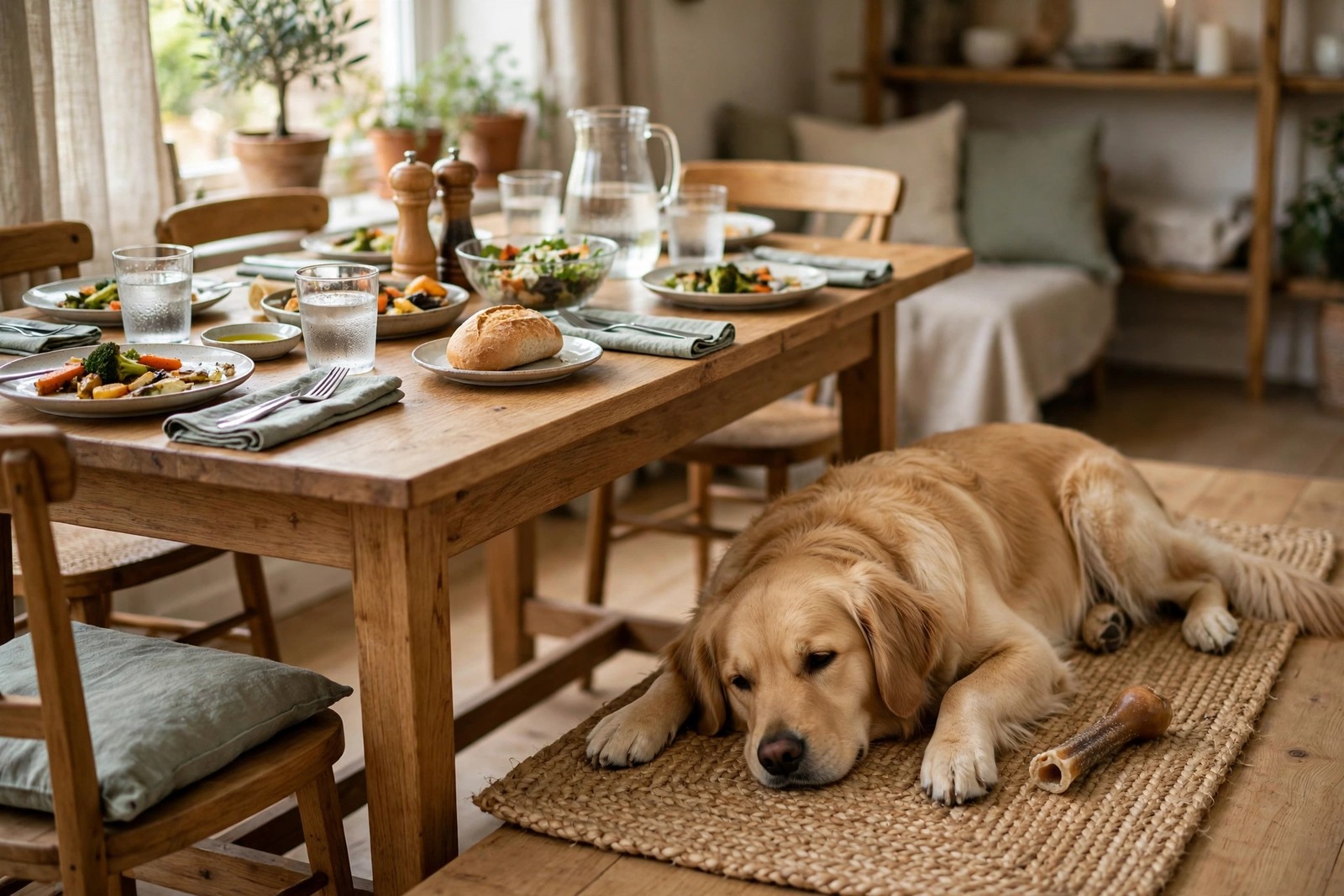
Begging persists for one unglamorous reason: it works. A dog who stares, whines, paws and drools beside the table has learned, accurately, that this behaviour sometimes produces food — and sometimes is all it takes, because an occasionally rewarded behaviour is harder to give up than one that is always rewarded. Kindness here is not softness; it is clarity delivered gently. The dog is never scolded for begging, never teased with food it will not get, and is taught a different job at mealtimes that pays reliably and honestly.
Give the Dog a Job That Pays: The Mat Settle
Teach the settle away from mealtimes first. Send the dog to a mat or bed, reward lying there calmly, and build duration gradually — a minute, then several, with rewards arriving for staying, at intervals that stretch as the dog improves. Add mild distractions in training: someone walking past, a plate carried across the room, people sitting at the empty table. By the time the mat appears beside a real meal, the dog should already understand that this spot produces good things for calm behaviour.
At the meal itself, set the dog up to succeed: feed the dog its own meal first or provide a long-lasting chew on the mat, place the mat near enough that the dog is included in the social picture but not within paw's reach of plates, and reward settled behaviour early and often during the first meals — a quiet word, a treat delivered to the mat, never from your plate. If the dog leaves the mat, guide it back calmly once or twice; if it cannot settle at all, the step was too big, so move the mat further from the table next meal and rebuild distance gradually.
The Zero-Payment Rule at the Table
Every person, every meal, without exception: nothing travels from a human plate to the dog — not the crust, not the last bite, not because guests think it is cute. The rule includes food dropped deliberately, food fed from the sofa during a film, and tidbits given in the kitchen while cooking if you want the mealtime behaviour to change, because the dog does not distinguish kitchens from tables nearly as well as the humans hope it does. If you like giving the dog leftovers, save them, put them in the dog's bowl after the meal, and let the bowl be the only source; the association you are protecting is between plates and nothing at all.
Expect the extinction burst and do not mistake it for the plan failing. When a paid behaviour stops paying, dogs try it harder for a short period — louder whining, closer staring, a paw on a knee that never came before. This peaks and fades if nobody pays it, and it restarts the whole process if somebody does, which is why the plan lives or dies on its weakest moment: the visiting grandparent, the soft-hearted teenager, the tired evening when a crust seems harmless.
Children, Guests and Real Life
Teach children the mechanics without framing the dog as naughty: the dog is learning, helping means holding food still and high, ignoring the show, and never feeding from the table. Give younger children a role they can succeed at — placing the mat before the meal, delivering the dog's chew to it — so helping feels active. For guests, a short explanation before the meal works better than corrections during it, and a stair gate that keeps the dog in sight but out of the room is a kind management tool while training matures.
Judge progress over a fortnight of consistent meals, not over one difficult Sunday lunch. The dog who once patrolled the table will begin going to the mat when it appears, sighing, and settling — behaviour worth rewarding precisely because you want it to last. Agreeing the rule and the dog's current settle duration in KinsLe Care Teams, where every family member can see them, stops the plan quietly dissolving because one person never heard it.