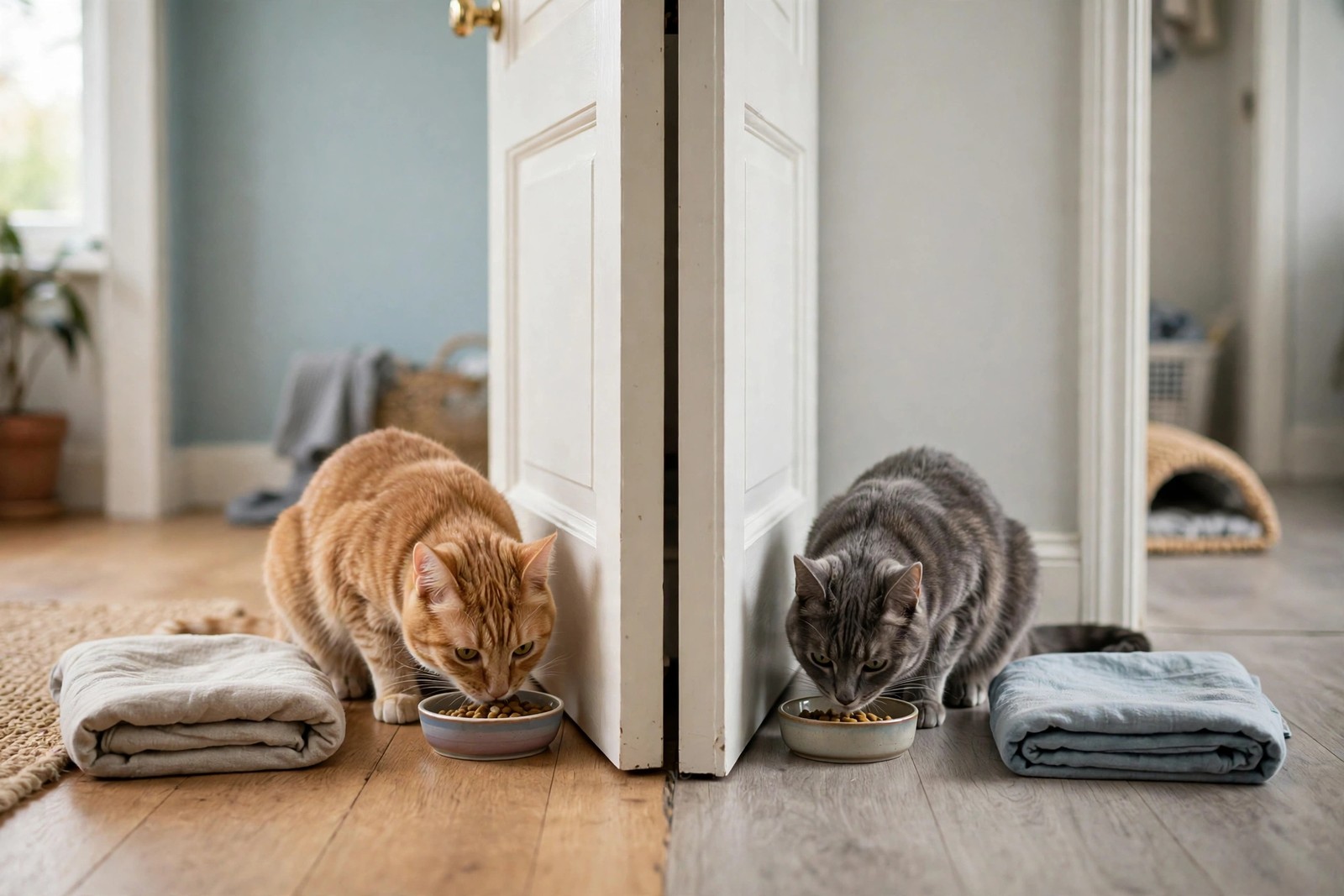
Cats usually meet more calmly through doors before they meet through eyes. A room-by-room introduction gives each cat information in the order it can handle: smell first, sound and routine next, sight after that, and shared space last of all.
Stage One: The Sanctuary Room
The new cat starts in one sanctuary room with the door closed and every need inside it: food, water, bedding, a scratching post, a litter tray set away from the food, and somewhere to hide that still lets you reach the cat gently. The resident cat keeps the rest of the home, unchanged, which protects the resident's confidence while the newcomer's smell begins to exist in the house. Spend time in the sanctuary room daily, playing and sitting quietly, so the new cat bonds with people and relaxes into its base camp before any cat-to-cat work begins.
Stage Two: Scent Before Sight
Next, trade smells deliberately. Rub a soft cloth along each cat's cheeks and let the other cat investigate that cloth near a resting spot, and swap bedding between the sanctuary and the resident's favorite places. You are watching reactions as much as delivering scent: sniffing and then relaxing, or rubbing against the cloth, is the calm response the stage is looking for. Hissing at a cloth is information to slow down, not a failure to scold.
Stage Three: Feeding at the Closed Door
Now pair the smell with something good. Feed both cats on opposite sides of the sanctuary door, starting far enough back that each cat eats relaxed, then moving bowls gradually closer to the door across sessions. Meals at the door teach each cat that the other's presence predicts dinner rather than trouble. If one cat will not eat near the door, the bowls are too close; move back to the distance that worked and build again in smaller steps.
Stage Four: First Sight, Briefly
With scent familiar and door meals calm, allow sight in controlled doses: the door cracked with a guard in place, or a gate or screen between the rooms, so the cats can see each other with a barrier doing the safety work. Keep first sightings short and end them while things are still calm, offering food or play on both sides.
Stage Five: Meetings and Room Swaps
Short supervised meetings follow, held in a neutral room neither cat owns, with escape routes open, vertical space available, and people present but not hovering. Alongside meetings, swap rooms: let the new cat explore the wider home while the resident cat spends time in the sanctuary, so each cat walks the other's ground and reads the full scent map without a confrontation. Across the second week, meetings lengthen as calm holds, until shared space stops being an event.
Each stage carries its own jobs, and households do better when those jobs are named rather than assumed. The stage plan in the Care Teams schedule on KinsLe assigns who feeds at the door, who runs the scent swaps, who supervises meetings, and who logs each cat's reactions, so a stage is never rushed because one person did not know another had seen tension at breakfast.
The Pace Rule
One rule governs every stage, and it is worth stating exactly: a stage repeats until it is calm, the two weeks are the shape, the cats set the speed, and slower is not failure. Forcing a meeting to keep a schedule can undo days of scent work in one bad minute, while repeating a calm stage costs nothing but time. Judge by the cats in front of you: eating well, using their trays, playing, and relaxing near the other's smell are the green lights, in whichever week they appear.
Care Teams on KinsLe holds the stage list, the helper responsible for each door feeding, and a short reaction note, so the next stage starts only when the cats are calm.