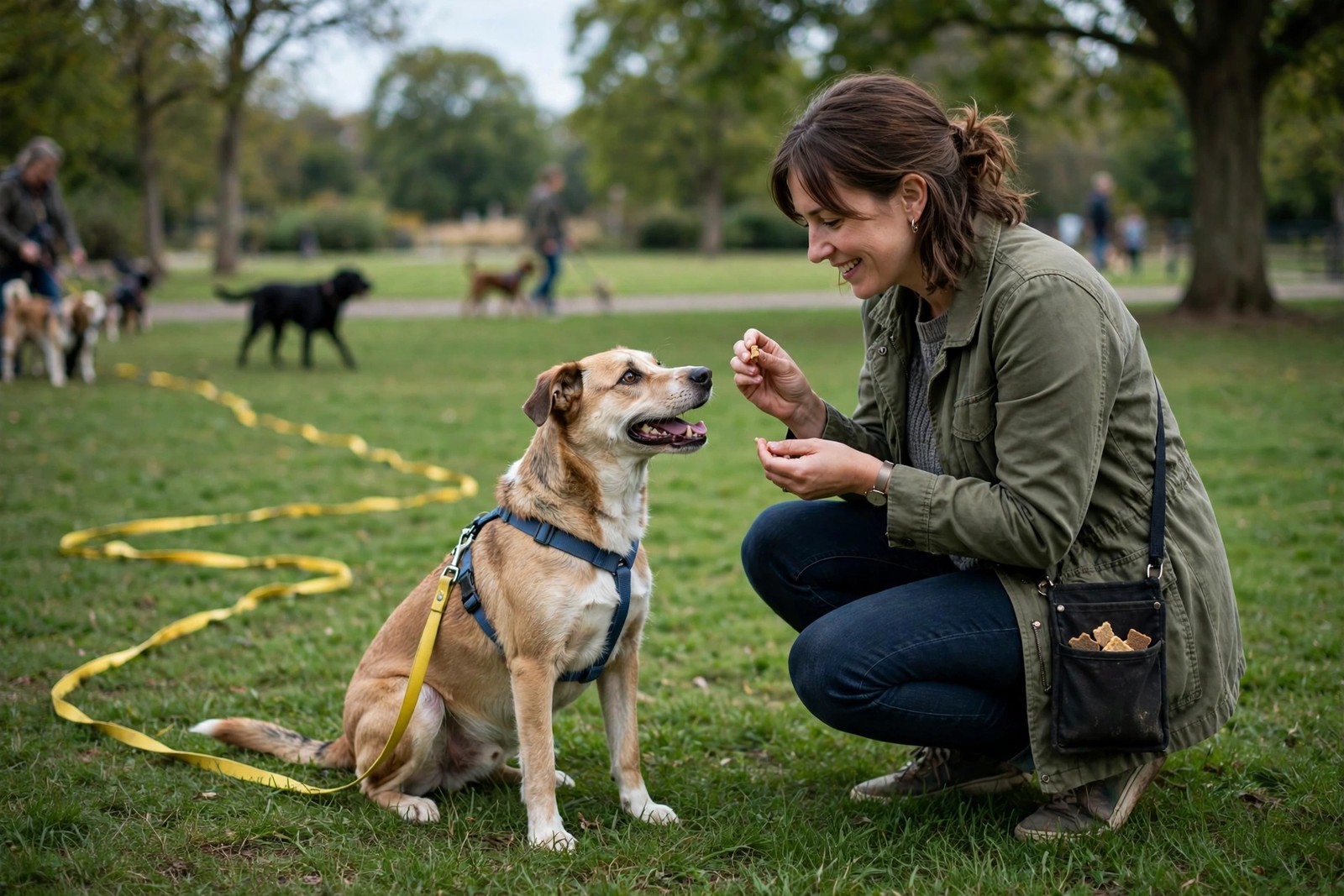
Treat park recall as a different, harder skill rather than disobedience. At home, your dog is answering in a familiar room or garden with few rivals for his attention and a short distance to cover. At the park, the same cue arrives while he is tracking smells left by dozens of dogs, watching movement, playing at full arousal and standing much farther from you. A cue learned at the easy level does not automatically transfer to the hardest level, and repeating it while he ignores it teaches him that the park version is optional.
Diagnose the gap before you drill more recall
Ask what changes at the park. Distance is usually part of it: a recall across a kitchen is not a recall across a field. Distraction is the rest: other dogs are often the highest-value distraction, followed by wildlife smells, balls and open space that invites running. Arousal matters too, because a dog deep in play hears and processes cues poorly even when he knows them well at home.
Also check your payoff history. If park recall usually means the lead goes on and the outing ends, while ignoring you means ten more minutes of play, the park itself has been training the choice you dislike. The rebuild must change both the skill and that bargain.
Stage the rebuild where success is likely
Start in the easiest outdoor setting you have, such as a quiet garden, a calm corner of a familiar field at a quiet hour, or an enclosed space with few dogs. Keep distances short, call when he is already moving loosely rather than locked onto another dog, reward with something he values highly, and release him to explore again.
Then move to the park at its quietest time and work at its edge, not in the middle of the busiest play. Use a long line in open areas where it is safe, held or trailing appropriately for the space, so he cannot rehearse running off, while taking care that he cannot sprint to the end of the line at full speed. Practise recall away from low-level distractions first, such as sniffing grass at a distance from other dogs, before you ever ask for recall away from play itself.
Pay recall like the park pays, and give the park back
Reward park recalls as if you are competing with the environment, because you are. Use high-value food he rarely gets elsewhere, praise with real enthusiasm, and, crucially, release him back to the park after many recalls. Call, reward, let him go again: that sequence turns recall into a brief interruption that predicts more freedom, not its end.
When the outing must end, make the final recall pay especially well and follow it with a last game or a scatter of food to find on the lead, so the memory of leaving is not simply loss.
Stop spending the cue on moments he cannot win
If he is in full chase, wrestling joyfully with a new friend or fixed on wildlife, do not stand calling his name on repeat. Walk toward him during a natural pause, attract his attention at closer range, clip the lead on calmly and leave without scolding. A recall spent repeatedly on impossible moments loses value, while a recall protected for winnable moments stays strong. If your cue has already been spent this way for months, consider retraining recall on a whistle or a fresh cue word, built correctly from the garden stage upward, rather than trying to repair a word he has learned to tune out at the park.
Raise difficulty one layer at a time: a busier hour, a longer distance, or a recall past a calm dog, but not all three together.
With KinsLe's Care Teams, you can assign those staged recall sessions to family members across the week, record which stage each session used, and keep everyone practising several times a week rather than testing him at the park.