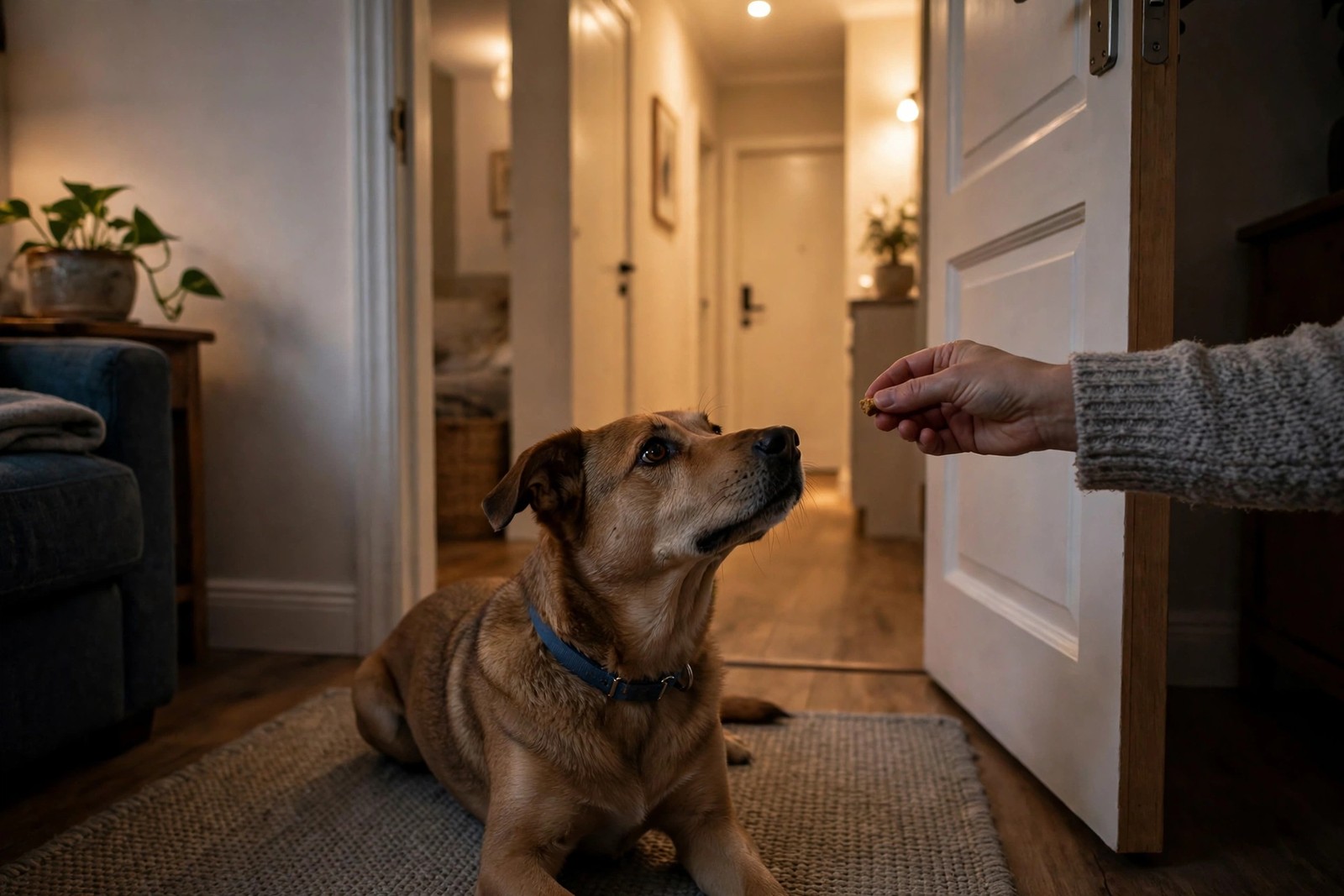
Dogs do not keep a volume league table of household sounds. They keep a prediction table, and your dog's table is well edited. The doorbell and the hallway score differently on it because, in your particular house, they have forecast very different outcomes over hundreds of repetitions. Understanding that difference explains the apparent pickiness, and it also shows you exactly how to soften the hallway barking if it is wearing the household down.
The Doorbell That Predicts Nothing
Ask what usually follows your doorbell. In many homes now, it is a parcel left on the step, a brief pause, and nobody entering at all. Even when someone does come to the door, the event often happens on the doorstep, beyond a closed door, and ends without touching your dog's world. A sound repeated that often with that little consequence undergoes a quiet demotion: the brain stops spending attention on it. Your dog has not gone deaf to the doorbell and is not being selective out of spite; the bell has simply been filed as wallpaper, the same way you no longer hear a clock tick in a room you use daily.
This is specific to your house's history, not a rule about doorbells. A dog whose bell predicts arriving guests, fuss, and a party at the door will bark at the bell forever. Meaning, not the sound itself, is doing the work.
Why Hallway Noises Stay Worth Announcing
Hallway sounds sit at the opposite end of the prediction table. Footsteps, a key in an internal door, a handle turning, or voices on the stairs all happen inside the home, close to where your dog rests, and they reliably precede real events: a family member arriving in the room, a door opening, a walk, a meal, company. They are also irregular. A sound that occurs at unpredictable times, in slightly different forms, cannot be filed away the way a daily bell can, because each new version has to be checked.
Proximity adds the rest. Hallway noise arrives with scent drifting under doors and air moving as doors open, so your dog gets a multi-sense announcement rather than a disembodied chime from the front wall. Barking at it is partly alert and partly participation: something is happening in my house, and I am part of this household.
Softening Hallway Barking Without Arguing With It
If the barking itself bothers you, train the ending rather than the alert. Let your dog give a brief alert, thank your dog calmly, then cue a settle on a mat away from the hallway door and reward the settle generously. Practice the sequence with household members deliberately walking, pausing, and opening doors in the hallway at quiet times, so the mat routine is learned on easy versions before a real late-night arrival tests it. Avoid opening the interesting door or producing the person at the peak of the barking where you can, because that timing pays the loudest moment; wait for a breath of quiet, then let life proceed.
At night, moving the bed away from the hallway door and adding low background sound in the sleeping room can take the edge off individual creaks and pipes. Mention the pattern to your vet if hallway barking is new, escalating sharply, or paired with night-time restlessness or anxiety, because sudden sound sensitivity in an older dog can ride along with pain or hearing change and deserves a hands-on check. With KinsLe Care Teams, you can assign those hallway practice sessions across the family and mark each one complete with a timestamp, so the thank-you-and-settle routine sounds identical whoever is home.