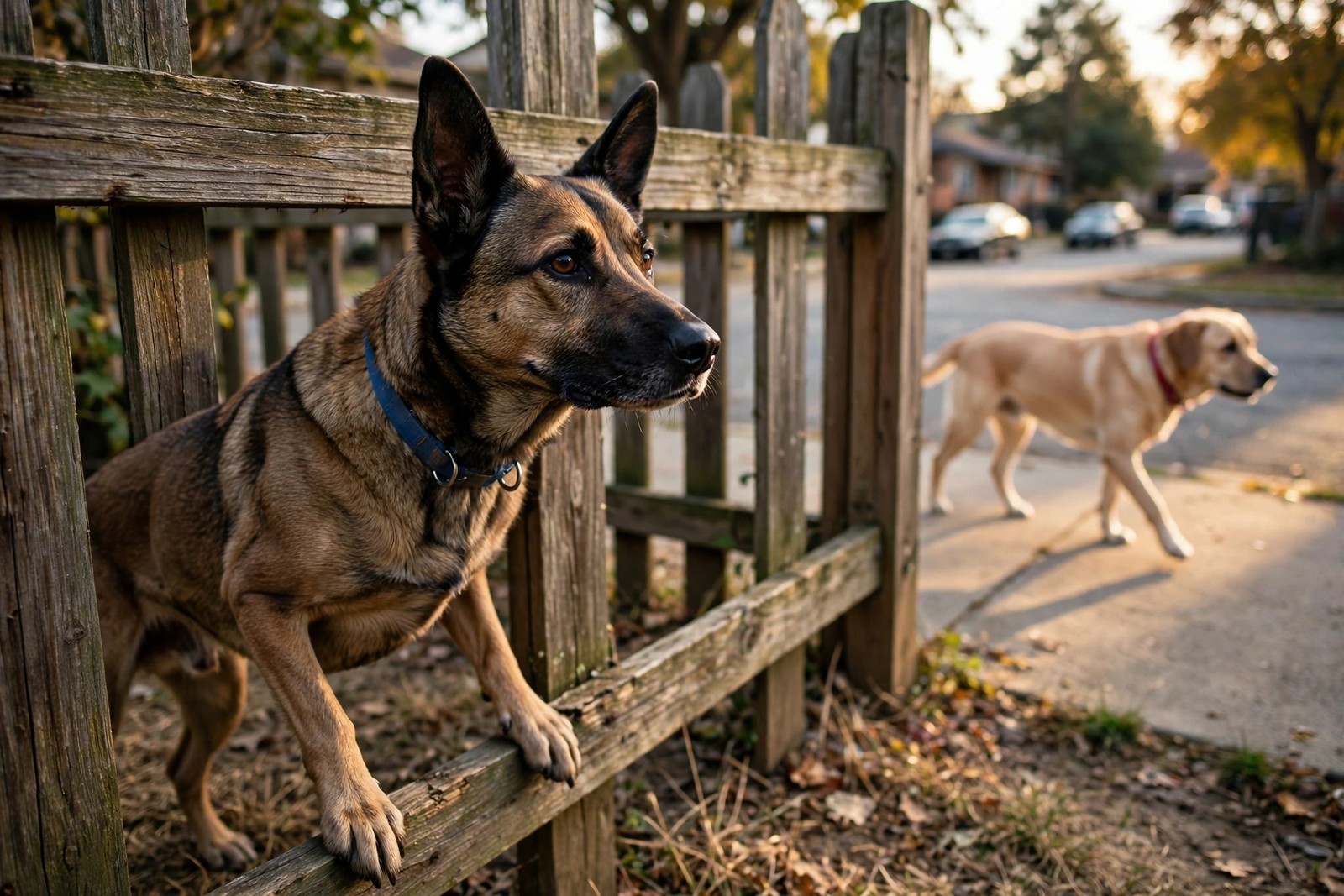
A dog that races the fence line, barking hard at every passing dog, is not being disobedient or spiteful. It is caught in a behaviour loop with three separate engines, and it will keep running until all three are addressed. Understanding each engine is what turns a daily shouting match into a solvable training problem.
Three Forces Behind Fence Barking
The first force is barrier frustration. On a walk, your dog can approach, sniff, circle, and read the other dog properly. At the fence, it can see and smell the dog but cannot complete any of that sequence, and the blocked greeting is deeply frustrating, especially for social dogs. Frustration raises arousal, and arousal comes out as barking, lunging, and racing the boundary. The second force is territorial arousal: the fence marks the edge of home ground, dogs are primed to announce and defend that edge, and a stranger walking its length reads as a challenge rather than a coincidence. The third force is accidental reinforcement, covered below, and it is the one that cements the habit.
The Lesson the Passing Dog Teaches
From your dog's point of view, every fence episode ends the same way: it barks, and the intruder leaves. The fact that the passing dog was always going to leave does not register. What registers is a perfect record of success, repeated daily, and behaviour that succeeds gets stronger. Meanwhile the rehearsal itself is self-rewarding, because high-arousal fence running is exciting, burns energy, and becomes the highlight of a bored dog's afternoon. Left alone in the yard, the dog practices the full routine unsupervised again and again, with no one there to interrupt it, which is why fence barking left to itself almost never fades and often spreads to people, bicycles, and delivery vans passing the same line.
Lowering the Pressure
Management comes before training, because training cannot outpace daily rehearsal. Block the visual trigger where you can: a solid screen, privacy slats, or a second inner barrier that keeps your dog a few steps back from the boundary all reduce the charge of a dog appearing at touching distance. Stop leaving your dog in the yard unsupervised during the hours when dog-walking traffic is heaviest, and bring it in at the first bark rather than after the full performance, before arousal peaks. Meet the underlying needs too, since a dog that has had a real walk, some sniffing time, and a training game earlier in the day reaches the fence with far less stored frustration to spend.
Teaching the Alternative
Train the recall away from the fence as its own skill. Start when the yard is quiet: call your dog from a short distance, reward generously the moment it turns toward you, and build up until the turn is instant. Only then practise with a mild distraction present, at whatever distance lets your dog still succeed, and keep paying the recall like it matters, because you are competing with one of the most exciting events of your dog's day. A look-at-that game also helps: reward your dog for calmly noticing a distant dog and looking back at you, so watching without erupting becomes a trained behaviour rather than a hope. Punishment and shouting mostly add your arousal to your dog's, so skip both. If fence behaviour comes with stiff, fixed staring, attempts to bite through the barrier, or aggression that is generalising to walks, bring in a qualified behaviour professional promptly. KinsLe's Care Teams keeps the human side of this plan consistent, because the recall practice, yard supervision, and reward rules can be shared as named duties so every family member responds to a fence episode in exactly the same way.