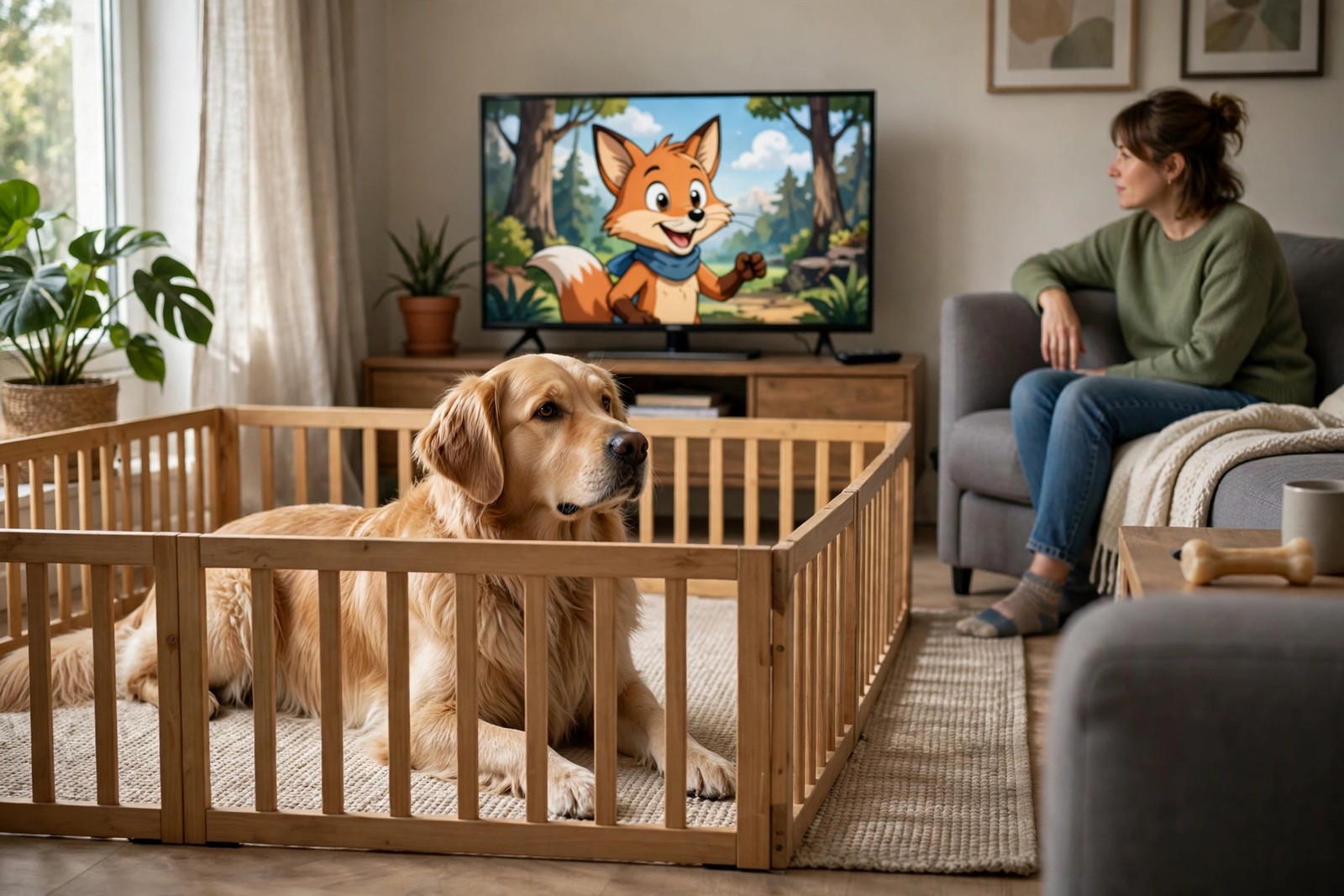
Owners often expect the cartoon case to be the give-away that a dog is being silly: surely a drawn animal, in impossible colors, with a comic voice, cannot fool a real animal. It fools the part of your dog that matters here. Your dog is not assessing whether the animal is realistic; your dog is detecting a pattern of movement its visual system evolved to flag instantly, and animation, far from removing that pattern, is built entirely out of it.
Why a Drawn Animal Still Reads as an Animal
Animators draw movement the way movement works: legs cycling in a walking or galloping rhythm, a body bobbing with each stride, turns, chases, and escapes. To a dog, whose vision prioritizes motion and shape over fine detail and color, that rhythm is the headline information. A drawn dog trotting across the screen offers moving legs, a changing outline, and a direction of travel, and many dogs respond to exactly that package whether the outline is photographic or painted. The soundtrack helps rather than corrects the impression, because cartoons frequently add barks, yelps, galloping beats, and scuffling noises timed to the action.
This also explains the selectivity owners report: the same dog may ignore a talking head, a car chase, or a football match, because none of those delivers an animal gait. The trigger is not television, excitement, or naughtiness. It is animal-shaped movement, wherever it appears.
Why Lunging Raises the Stakes
Barking at the screen is arousal; lunging adds a rehearsed charge that can never complete. Your dog accelerates toward an animal that cannot be reached, caught, or driven off, and that blocked finish is a reliable recipe for rising frustration, redirected snapping at nearby people or dogs, and frantic repetition every time an animal appears. There is hardware at stake, too: a large dog hitting a television stand can pull a screen down onto itself, crack the panel, or injure paws and teeth on the set. A dog who lunges daily is also practicing daily, so the charge gets faster and less interruptible the longer it is simply endured.
Manage the Distance First, Then Train Behind the Line
Start with physical management, not willpower. Put a barrier your dog cannot cross in the heat of the moment, such as a playpen fence or a fixed gate line, far enough from the screen that your dog can be aroused behind it without reaching the set, and set a settle mat with a chew behind that line as your dog's screen-time station. During the retraining period, avoid animal-dense viewing in your dog's presence altogether, including children's cartoons, which are wall-to-wall animal movement; watch those with your dog settled in another room rather than rehearsing the lunge nightly.
Train in short, deliberate sessions behind the barrier. Begin with brief, muted clips of slow, distant animals and reward every glance away from the screen, every sigh, and every return to the mat, ending each session while your dog is still coping. Add sound back in low before you add closer or faster animals, and step back a level whenever your dog fixes, stiffens, or barks through a reward. Progress is measured in calmer responses to the same clip over repeated sessions, not in how dramatic a program your dog can eventually endure. If lunging continues despite distance and staged work, or your dog has injured itself or redirected onto anyone, bring in a qualified behaviorist, and mention any sudden change in screen reactivity to your vet. With KinsLe Care Teams, you can assign the barrier-and-mat setup and the short training sessions as shared household duties, each marked complete with a timestamp, so no one quietly drops the barrier for a relaxed evening and undoes the work.