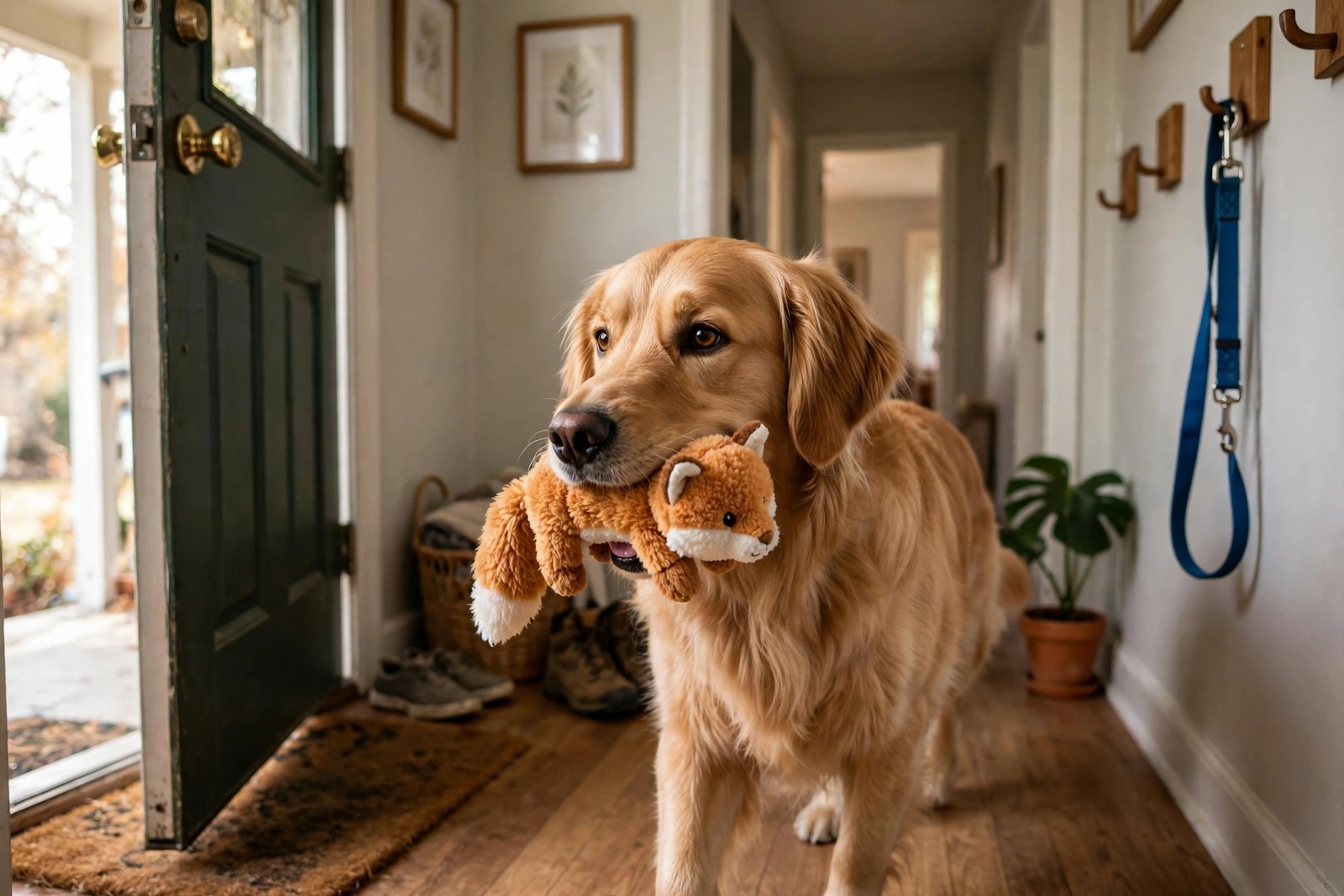
The walk ends, the lead comes off, and instead of flopping down your dog collects a toy and carries it from room to room, sometimes whining softly around a mouthful of plush. It looks purposeless, but it is one of the more useful things a dog can do for itself: a built-in decompression routine that helps a stimulated brain come back down to resting speed.
A Mouthful Helps Arousal Come Down
A walk is rarely restful exercise for a dog. Sights, scents, passing dogs, traffic, and greetings stack stimulation on top of physical effort, and the dog comes home with arousal still circulating after its legs have stopped. Holding and carrying an object gives that arousal somewhere to go. The rhythmic mouthing, the parade around familiar rooms, and the eventual choice of a spot to lie down with the toy all work like a pressure valve, and dogs that have a toy to collect typically settle faster than dogs left to pace the hallway. Breeds developed to carry things in their mouths, retrievers above all, reach for this tool most readily, but the self-soothing effect works across breeds, which is why the habit shows up in terriers, spaniels, and mixed breeds too.
A Greeting and Settling Ritual
Many dogs weld the toy to a social ritual. A dog that rushes to grab a toy when its owner comes home, or carries one straight to its bed after a walk, is often presenting: offering the household an object it values as part of greeting and reunion. Soft eyes, a loose, swinging tail, and a wiggly body around the toy are signs of a happy dog discharging excitement in a socially safe direction, far better than jumping up or mouthing hands. The after-walk version is the same ritual pointed at the house itself, a lap of honour with a prize before rest. Some dogs add quiet whining, which, paired with a relaxed body and a dog that eventually lies down, is usually overflow excitement rather than distress.
Reading the Body That Carries It
The toy is constant, so read the body around it. Contented carrying looks loose: the dog moves at an easy pace, checks in with people, and settles within a short while, often sighing down with the toy still between its paws. Over-arousal looks different: repeated circuits of the same rooms at speed, whining that escalates rather than fades, inability to lie down, panting long after the dog has cooled, and snatching at the toy or guarding it when someone passes. A dog that cannot settle after most walks may be getting too much high-intensity stimulation on them, too little sniffing time relative to marching, or may be uncomfortable somewhere in its body, all of which are worth adjusting or raising with a vet if the pattern persists.
Building a Calmer Doorway Routine
You do not need to take the toy away; you need to complete the routine it starts. Keep the dog's chosen settling toys near the door or its bed so the collection step is easy. After the lead comes off, offer water, then a few minutes of calm sniffing, scattering a small handful of treats in grass or on a mat so the nose, not the legs, does the last work of the outing. Follow with a long-lasting calm chew or simply quiet company in the dog's resting spot, and keep greetings from family members low-key for the first minutes so arousal falls instead of spiking again. Shortening a stimulating evening walk or adding distance from trigger-heavy routes can also shrink the amount of decompression the dog must do at home. KinsLe's Care Teams makes that wind-down sequence a shared habit rather than one person's idea, because the post-walk water, sniffing time, and settling steps can be assigned to whoever walked the dog and ticked off with a timestamp.