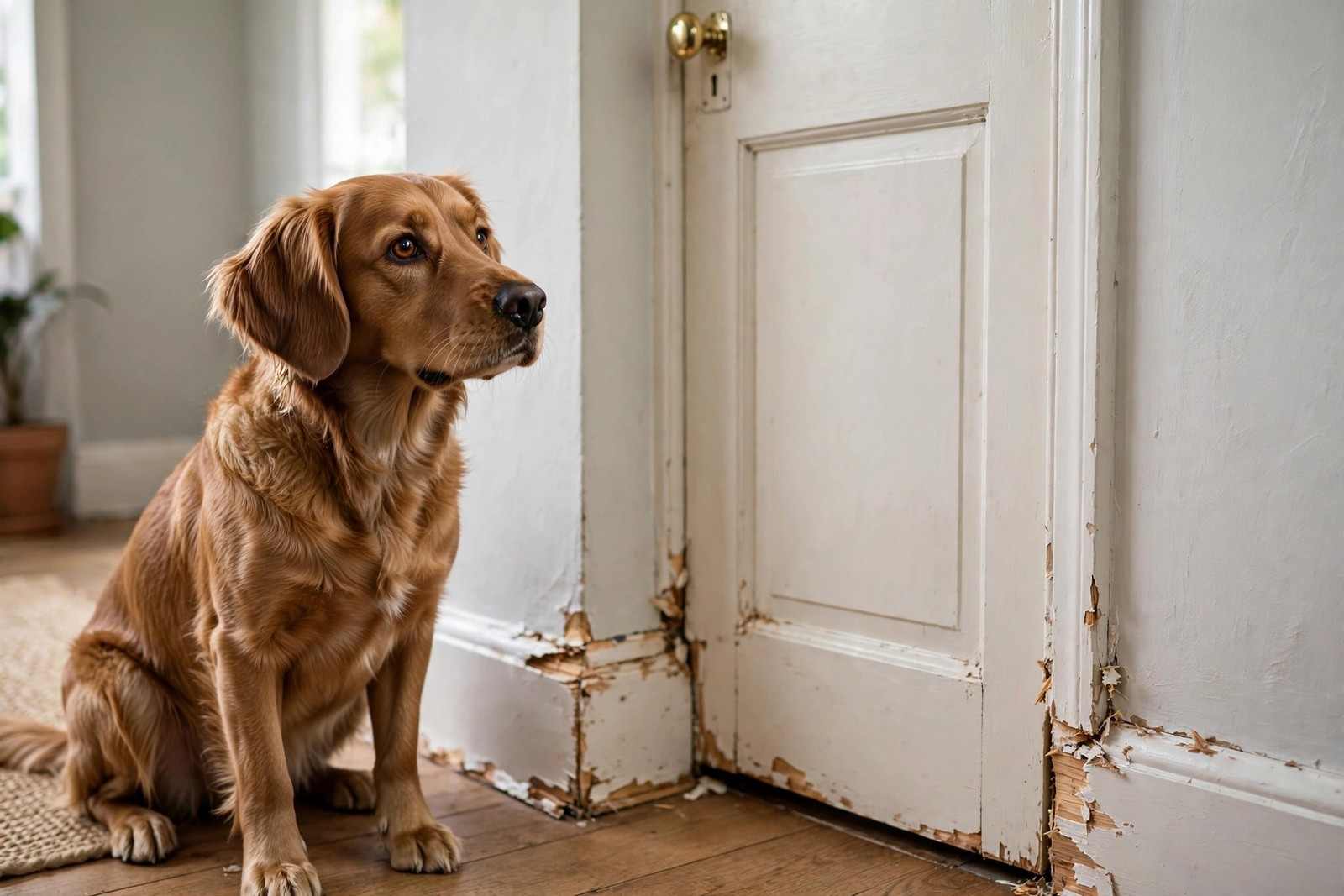
Read the damage like a map, because in this case the map is the message. Ordinary chewing lands wherever the dog happens to be resting — a table leg near her bed, a shoe left by the sofa. Her chewing sits in exactly one room, at exactly the points where that room opens: the corners of the door frame at nose height, the skirting boards running toward the door, sometimes the edge of the door itself. She is not choosing woodwork she fancies; she is working at the seam between herself and the rest of the house, and that makes it a separation pattern until proven otherwise.
Why Exits, and Why Corners?
A dog trying to get through a barrier works where the barrier is weakest and where scent and sound leak through — the gap under and around the door. Corners concentrate both: two surfaces meeting give teeth purchase that a flat board does not, and the corner by the hinge or latch is where she has scratched, nosed, and worried before, so the damaged spot smells of her own earlier efforts and draws her back. Rooms matter too. The room where she is left is the room associated with being left, so its exits carry all the significance; the same skirting in a room where the family sits together holds no charge at all.
Confirming It on Camera
Before rebuilding anything, film two or three departures on a phone or camera. Separation chewing has a recognisable timeline: it usually starts within minutes of the door closing, often alongside pacing between door and window, panting, drooling, whining or barking aimed at the exit, and repeated returns to the same corner. Contrast that with a bored chewer, who typically settles first, chews later in the absence, and works on whatever is nearby. The film also tells you her threshold — the length of absence she manages calmly before the chewing starts — and that number, not guesswork, is where training begins.
Rebuilding Alone Time Below Panic Level
- Practise absences shorter than her threshold, even if that starts at seconds: step out, return calmly before she escalates, and build duration in small increments across many repetitions.
- Flatten the departure signals — pick up keys, put on shoes, and then sit back down sometimes, so the routine stops predicting abandonment.
- Keep arrivals and departures deliberately dull; greetings happen once she is calm, not at the door in a rush of relief.
- Leave her with a food toy or chew by all means, but understand its limit: a dog who will not touch food when left is telling you the distress, not the boredom, is real.
- Where possible, avoid leaving her longer than she can handle while the work is under way — a sitter, a family member, or a day arrangement protects the training from being undone weekly.
Protecting the Woodwork Without Punishing Her
A taste deterrent on the frame or a chew-proof guard over the corner protects the house while you work, and it is legitimate as damage control — but it is not treatment, and shifting her chewing to the next unprotected corner confirms the distress is still there. Punishing damage found on your return teaches nothing useful: she cannot connect your anger with chewing done hours earlier, and she learns instead that returns are frightening, which deepens the problem. If the film shows hard panic — frantic, sustained, self-injuring efforts, drooling, or toileting from a housetrained dog — involve your vet and a qualified behaviourist rather than extending a home plan. Writing the absence schedule, her current calm threshold, and each session's result into KinsLe's Care Teams means every family member practises at the same level and logs how she did, so her alone time builds on shared facts instead of each person's guess.