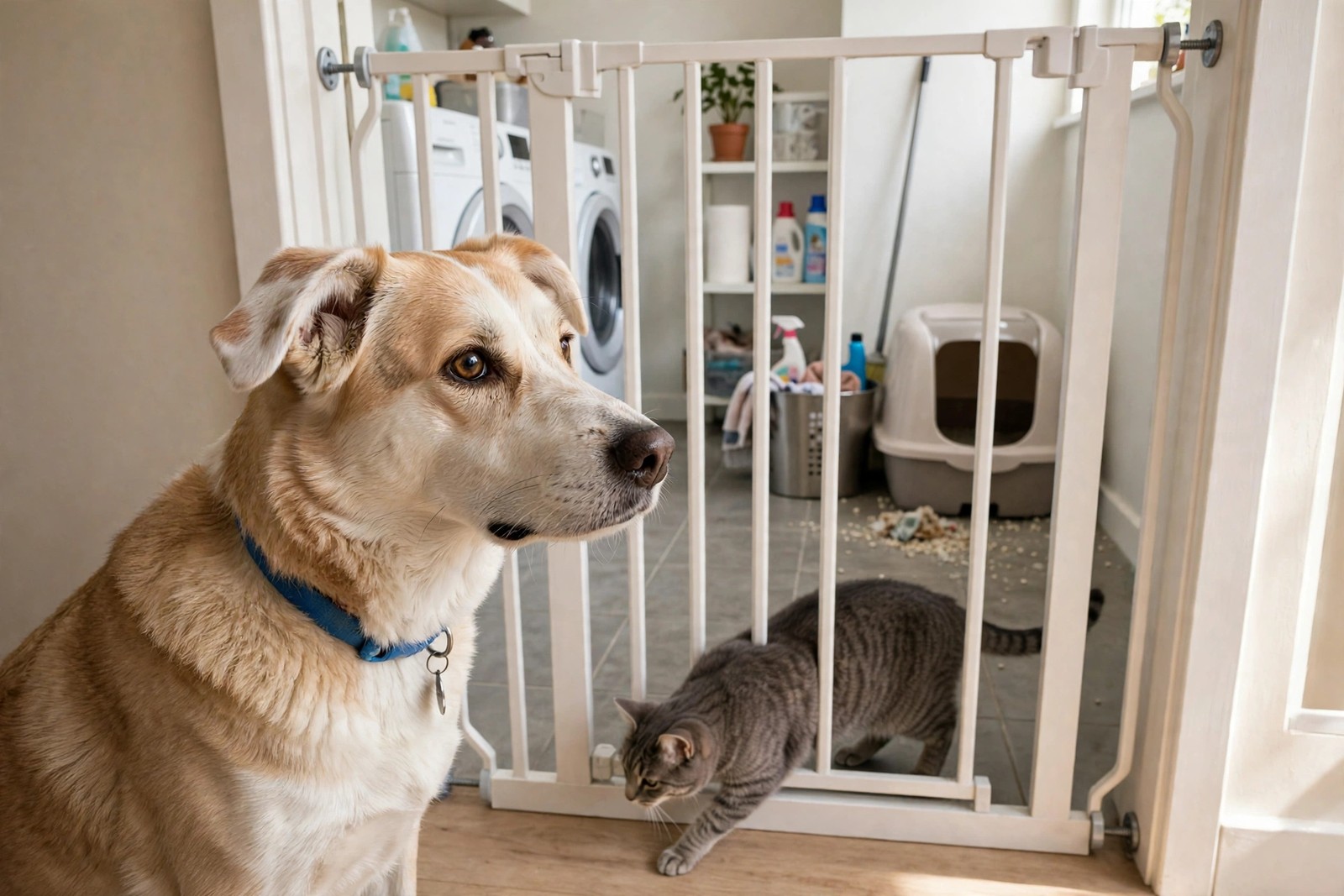
Start with the uncomfortable truth: to your dog, the litter tray is not disgusting. Dogs are scavengers by design, eating faeces is within normal dog behaviour, and cat faeces sit at the top of the menu because cat food is richer in protein and fat than dog food and passes through the cat only partly digested. What reaches the tray still smells like food to a nose far better than yours. She is not being defiant, deficient, or depraved; she is being a dog who has found an unattended delicacy that refills itself daily.
Why Training Alone Loses This Fight
Training works when you control the rewards, and here you do not. A leave-it cue pays only when you are present to give it and to deliver the alternative reward. The tray pays instantly the moment she reaches it — including at 3 a.m., while you are out, and every time a door is left ajar. Behaviour that is rewarded on an unpredictable schedule is the hardest kind to extinguish, and each successful raid rehearses the route, the timing, and the technique. Owners typically spend months winning supervised encounters while losing every unsupervised one, and the habit stands. That is not a failure of effort; it is the arithmetic of a self-rewarding behaviour, and it is why the honest answer to "can training alone fix it?" is almost always no.
Management That Actually Ends It
- Put the tray where she cannot go and the cat freely can: a room behind a baby gate raised just enough for the cat to slip under, a door held cat-width ajar with a latch strap, or a cupboard with a cat-sized entrance.
- Consider the tray itself: a covered tray or a top-entry design slows access, though a determined dog can defeat many lids, so the tray is a backup, never the barrier.
- Scoop promptly — ideally as soon after use as the household rhythm allows, and at least daily — because a clean tray holds little reward even if she does reach it once.
- Feed the cat on a schedule and clear leftovers, since the whole problem starts with rich food passing through; do not, though, change the cat's diet or add anything to either animal's food to make faeces taste bitter without veterinary advice.
- Keep her out of the tray room as a standing household rule, with doors closed, because "she usually doesn't go in there" is an invitation she will eventually accept.
Training's Real Job: The Safety Net
Train the edges, where training can win. A strong leave-it, practised with high-value payoffs, covers the moment she encounters a stray dropping on a walk or slips through a gate left open. An automatic check-in — she looks to you when passing the tray room door — turns the danger zone into a cue to earn something better from you. Reward calm behaviour around the cat's areas generally, and never chase or scold her mid-raid in a way that teaches her to raid faster and more secretly; a dog who learns to bolt the prize down is at risk of choking, and a dog whose raids are repeatedly interrupted often shifts to night raids.
The Health Angle, Briefly
Tray contents can carry litter she should not be eating in quantity — clumping litter especially is not meant to be consumed — and any faeces can carry parasites between animals. Keep the cat's worming and vet care current, mention the habit at your dog's next vet visit, and watch for vomiting, diarrhoea, or a dog who goes off her food after a raid. With access removed, the behaviour usually fades from daily life within days, even though the taste for it never entirely leaves her. Making the management stick is a household logistics problem — gates kept shut and trays kept scooped on schedule — and that is exactly what KinsLe's Care Teams is for: the scooping rota can be assigned to named family members and marked complete, so the tray is emptied by whoever is home rather than left full for the one opportunist who never forgets it.