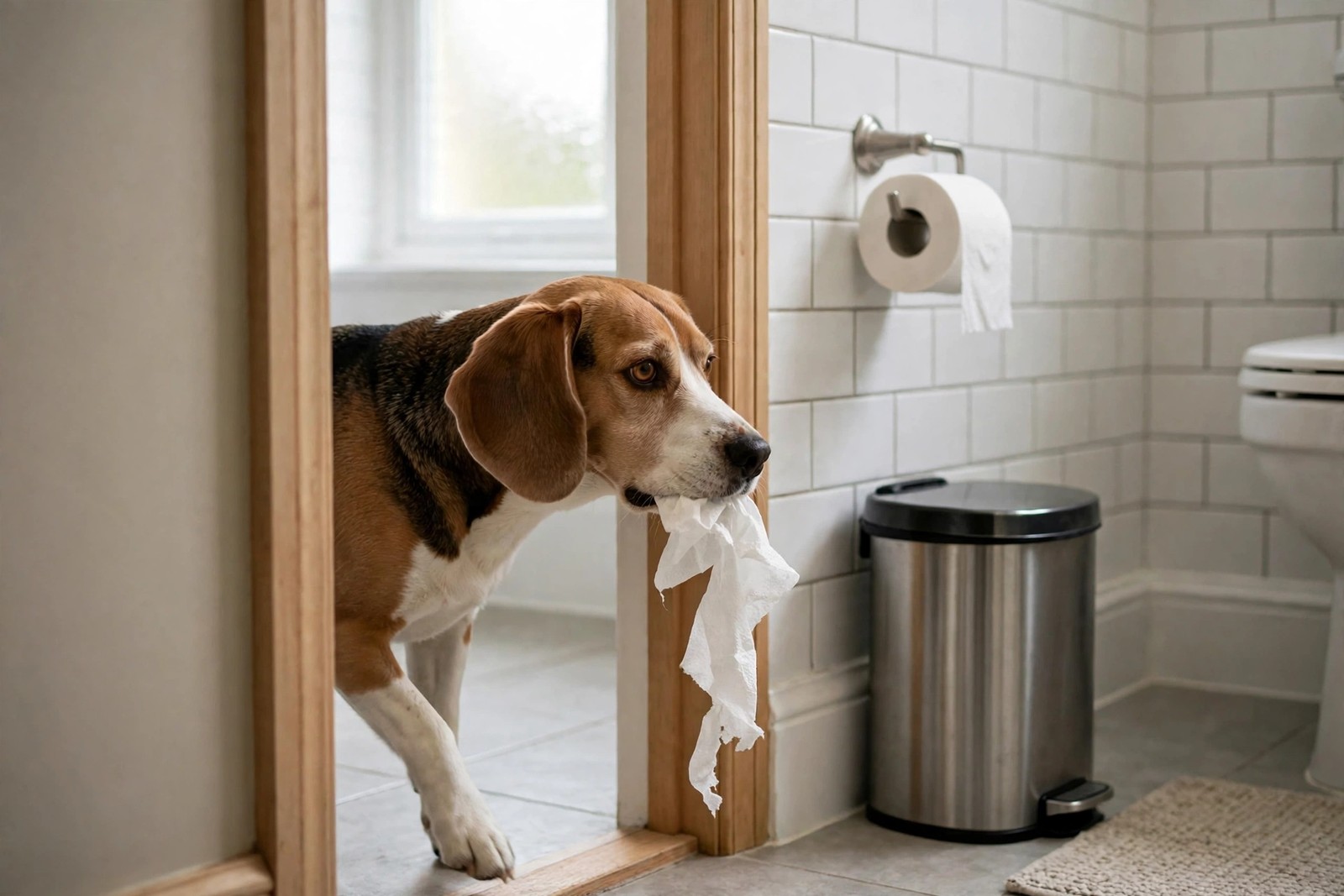
Consider the bathroom from her height. It is a small, quiet, usually empty room where the door is often left ajar, and it contains a roll of soft paper mounted at exactly nose level on a holder engineered to dispense freely, plus a bin of used tissues that smell strongly of the people she loves most. Tissues themselves are soft, faintly scented, easy to tear into satisfying pieces, and light enough to carry away for private consumption. A dog does not need a deficiency to find this attractive; she needs only opportunity and a taste for the texture, and bathrooms supply both daily.
Habit, Boredom, or Something More?
Tissue eaters are usually connoisseurs, not patients. The habit usually starts young — puppies explore the world mouth-first, and paper is a safe, shreddable discovery — and it persists because it has never stopped paying. Boredom sharpens it: a dog who raids only when home alone for long stretches, or only on days her walk was skipped, is filling empty time with the house's most available craft project. Read it differently if the behaviour is new in an adult dog, frantic rather than leisurely, or part of a wider pattern of eating non-food items — soil, stones, fabric, faeces, anything she can swallow. Eating non-food items persistently, sometimes called pica, belongs in a vet conversation, because it can accompany nutritional, digestive, or other health problems that training will not touch. A dog who gulps large quantities of anything indigestible also risks a gut blockage regardless of cause, so volume matters as well as motive.
The Fix Is Architectural
- Close the bathroom door as a household rule — not ajar, not pulled-to, closed — or fit a latch the family will actually use.
- Replace the open bathroom bin with a lidded pedal bin, and move the tissue box out of nose reach for a dog who counter-surfs the sink unit.
- Keep the spare toilet rolls in a cupboard rather than stacked beside the cistern, and let the working roll sit in a covered holder if she has learned to unroll it across the floor.
- Give guests the one-line brief — door closed, nothing paper within reach — because a visitor's ajar door is how determined raiders get their weekly opportunity.
Once access ends, dogs usually drop the habit quickly because there is nothing left to rehearse; a dog sneaking successfully once a fortnight keeps the skill alive indefinitely.
Training the Supporting Skills
With access removed, training becomes the insurance policy rather than the front line. Teach leave-it indoors with dropped tissues as the specific test item once the basic cue is solid, paying releases with food she values more than paper, so a tissue dropped in front of her becomes an earning opportunity. Practise a swap for raids in progress: call her away brightly, trade the tissue for a treat without chasing, and never pull paper from her mouth in a struggle that turns it into a contest — chasing and grabbing teach speed-swallowing, which is the genuinely dangerous version of this habit. Watch, too, for the dog who shreds but spits: she is after the game, not the meal, and a dog like that needs shredding outlets of her own — a cardboard box with treats inside to destroy legitimately usually satisfies the urge.
Keeping the Whole Household Aligned
This habit survives on inconsistency: one person closes the door religiously, another leaves it open after every shower, and the dog simply waits for her person. Paper eating is therefore a household-systems problem with a household-systems fix, where the rule is written down once and visible to everyone rather than carried in one owner's head. Sharing the bathroom rule, her leave-it progress, and the watch-for list for genuinely worrying non-food eating through KinsLe's Family Sharing means family members and regular helpers all see the same notes on her profile, so the door stays closed and the bin stays lidded whoever used the bathroom last.