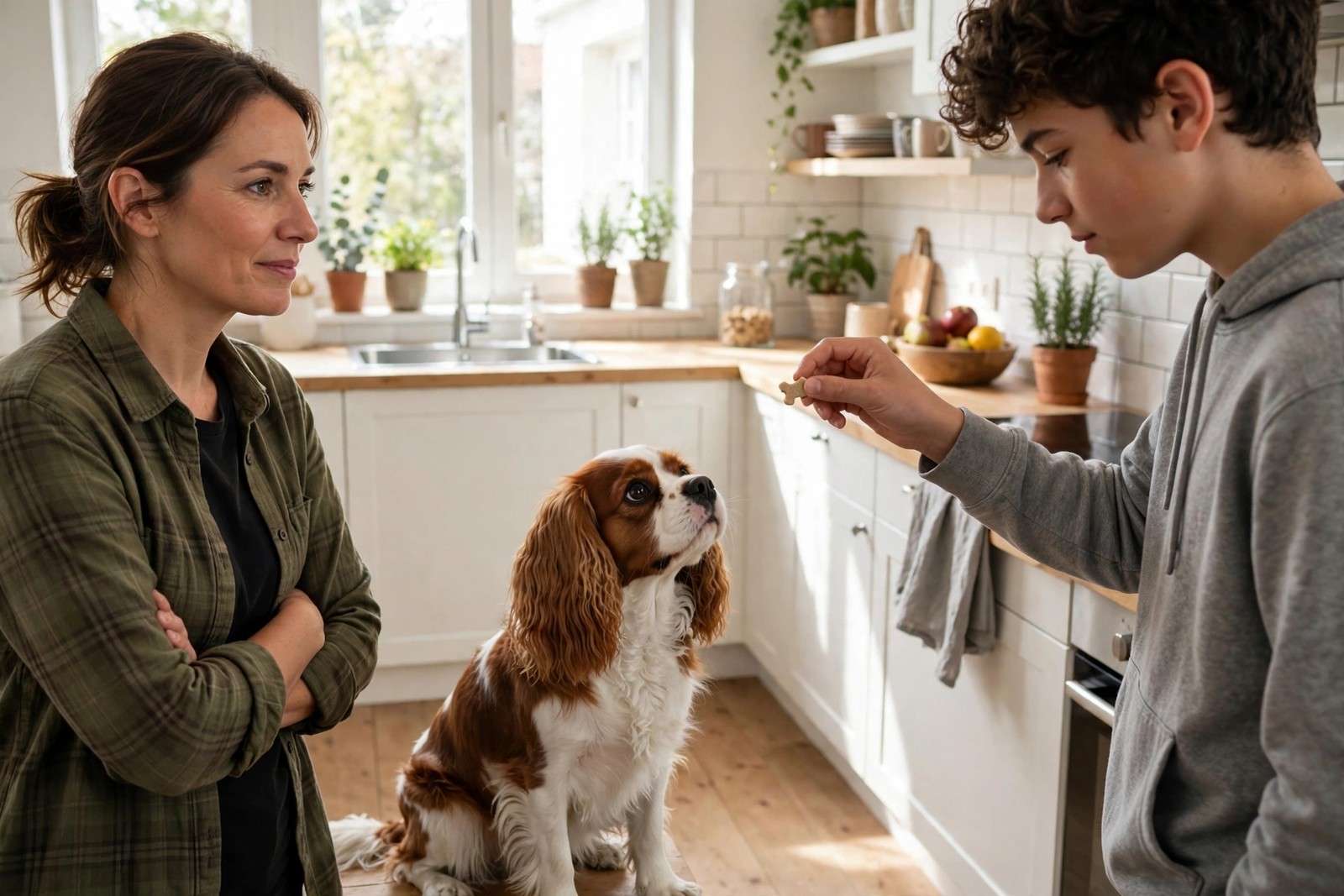
Your dog has not chosen a favourite person, and she is not ranking the household. She has learned one person's version of each cue, and to a dog that version is the cue itself. A spoken command reaches her as a package: the exact word, the pitch and volume of the voice, the hand signal that went with it, where the person was standing, and how quickly a reward arrived in earlier sessions. Change several parts of that package at once and the new version can be genuinely hard for her to recognise, even though every human in the room hears the same word.
Why One Person's Cue Lands and Another's Does Not
The person she obeys usually did the original teaching, so their delivery matches the picture she learned from. They also tend to have the deepest reward history: hundreds of sits that ended in food, praise or a game. Other family members often give the cue differently without realising it. One says sit once and waits, another repeats it three times while leaning forward, and a third says it while walking away with hands full. Each version asks her to solve a slightly different puzzle. Timing matters too. If one person rewards within a second and another fumbles in a pocket for ten seconds, the slow version teaches far less. Dogs also read confidence: a hesitant, questioning tone sounds like a different signal from a clear, cheerful one.
Rebuilding Each Cue as a Household Cue
Pick the cues that matter most, usually recall, sit, down, wait and leave it, and write down exactly how the household will give each one. Agree the single word, the hand signal, and the reward that follows a correct response. Then let the person she already obeys demonstrate while the others watch the details: same word, same signal, same pause afterwards. After that, each other person practises in short, easy sessions in a quiet room, paying generously for correct responses and asking for nothing harder than she can already do well. Keep the first sessions easy on purpose. Success at a simple sit in the kitchen builds the new person's reward history far faster than a failed test at the park.
Rotate who practises, who feeds, and who starts games and walks for a while. A dog who only ever works with one person keeps a one-person picture of the cue. Short turns with different people, all delivering the cue the agreed way, teach her that the word and signal stay the same whoever gives them. If she stalls for someone, that person should lower the difficulty, move closer, and reward smaller steps rather than repeating the cue louder. Repeating a cue she has not understood only teaches her that the first version can be ignored.
Mistakes That Keep the One-Person Pattern Alive
Avoid testing her in the hardest setting first, such as calling her away from play with a person she barely listens to. Avoid cue inflation, where sit becomes sit, sit, SIT with rising volume, because she learns to wait for the third version. Avoid different rules per person, such as one person allowing jumping up while another rewards four paws down; mixed rules blur the picture she is trying to learn. Children should practise with an adult coaching, using the same word and signal, and their sessions should stay short and heavily rewarded. If progress stalls completely, or she responds to one person but shows fear or avoidance of another, ask a qualified trainer to watch a session, and mention any sudden change in responsiveness to your veterinarian in case pain or hearing loss is part of the picture.
Household consistency is what turns a private cue into a shared language, and writing the agreed words where everyone can see them helps more than another round of reminders. KinsLe's Care Teams supports that shared routine by letting you assign practice, feeding and walking turns to each family member, with every completed task marked complete with a timestamp.