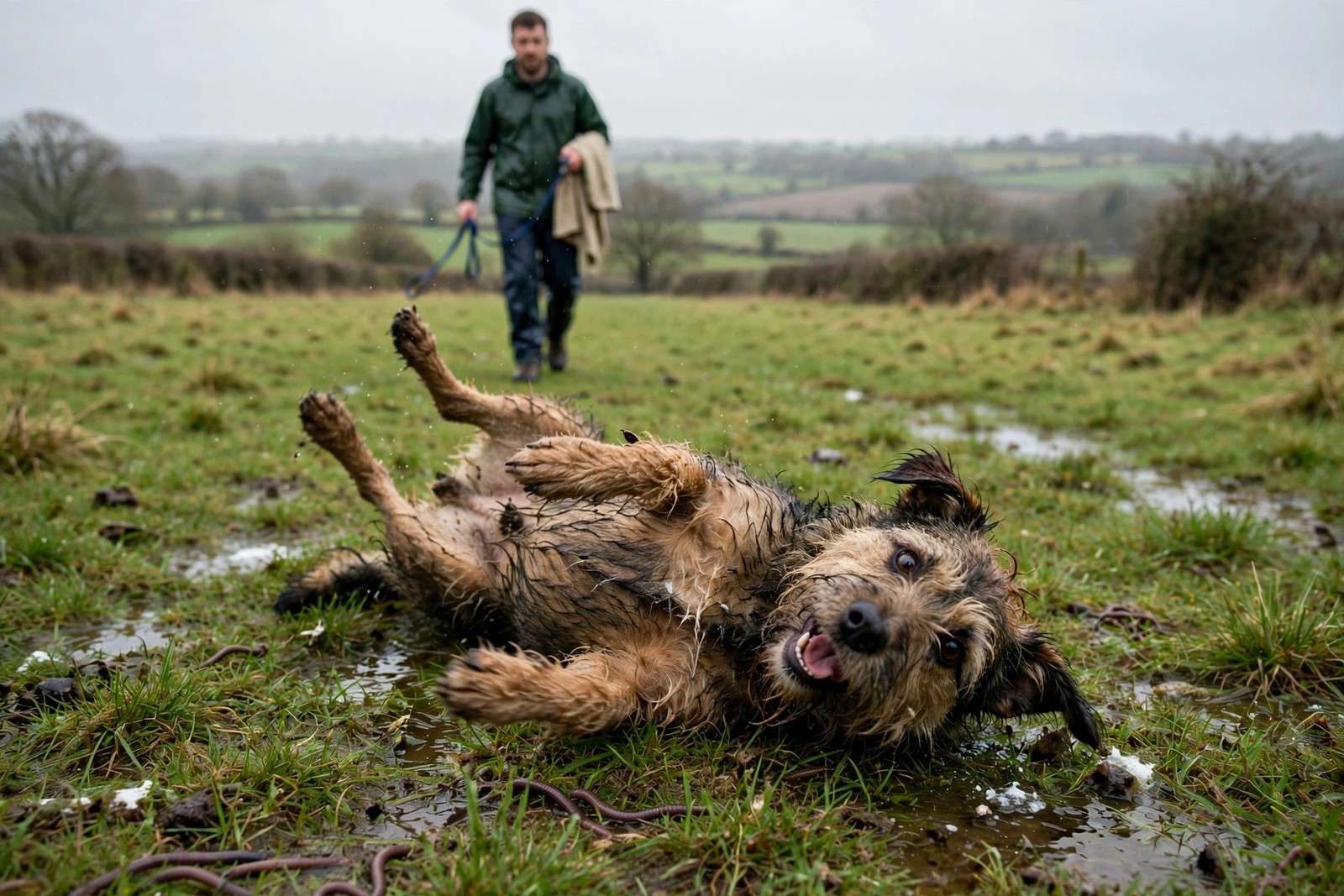
Few sights deflate a country walk like a clean dog dropping a shoulder, wriggling with obvious joy, and rising wearing dead worm and bird mess like perfume. Her delight is the point owners find baffling, because the smells that repel people are precisely the ones that interest her. Rolling of this kind is widespread in dogs and their wild relatives, and behaviourists generally explain it through scent: what she is doing with the smell, rather than any wish to be dirty or defiant.
The Likely Reasons Behind the Roll
One explanation is scent carrying. A dog who finds a strong, unusual smell may roll to pick it up and transport it, much as dogs investigate smells to gather information about who and what has been in a place. Another is scent masking, an idea drawn from hunting ancestors whose own odour would be less noticeable under the smell of the environment and its animals. A third is simpler: many dogs appear to find these odours genuinely pleasant and worth close contact, and individual favourites vary, with some dogs specialising in worm casts after rain, others in fox or bird mess, and others in anything dead near water. The rolling sequence is usually unmistakable once you know it: intense sniffing, a pause, one shoulder dropping, then a full wriggle with legs waving. That wind-up gives you a second or two to intervene, which matters more than any theory about why she does it.
The Practical Risks Worth Managing
A roll usually ends with nothing worse than a bath, but the material itself deserves respect. Bird mess and decaying animals can carry bacteria and parasites, and dogs who roll often try to eat the find as well, which is the part to prevent firmly. Keep her away from anything dead near water where rats may have been, wash the rolled patch with dog shampoo once home, and check her coat and skin for anything caught in longer fur. A dog who rolls and then scratches one spot persistently, develops a rash, or seems unwell after a country walk should be checked by a veterinarian. Rolling near livestock also needs managing for safety and courtesy, and in ground-nesting bird season a dog charging to a scented hotspot can disturb wildlife, so use a lead in sensitive areas even if her recall is usually reliable.
Reducing It Without Ruining the Walk
You will not train the interest away, and punishment is pointless for a behaviour she finds self-rewarding, but you can cut the success rate sharply. Learn her wind-up and call her away at the sniffing pause, paying the interruption with something high-value so leaving a treasure is worth it. Keep her on a lead or long line through known hotspots: gateway mud after rain, the ground under rookeries and pigeon roosts, field edges after muck spreading, and the banks of ponds. Give her sanctioned rolling instead: many dogs accept grass rolling, a sand patch or a good wriggle on a clean rug at home as partial payment, offered right after you have called her off something foul. Rinse the worst off before she gets in the car, carry water and a towel as standard kit, and accept that an occasional successful roll is the tax on walking a scent-driven animal through real countryside.
Share the less glamorous half of the routine too, so the same person is not always left holding the towel at the back door. KinsLe's Care Teams lets you assign the post-walk rinse, coat check and towel wash to whoever brought her home, with each task marked complete with a timestamp.