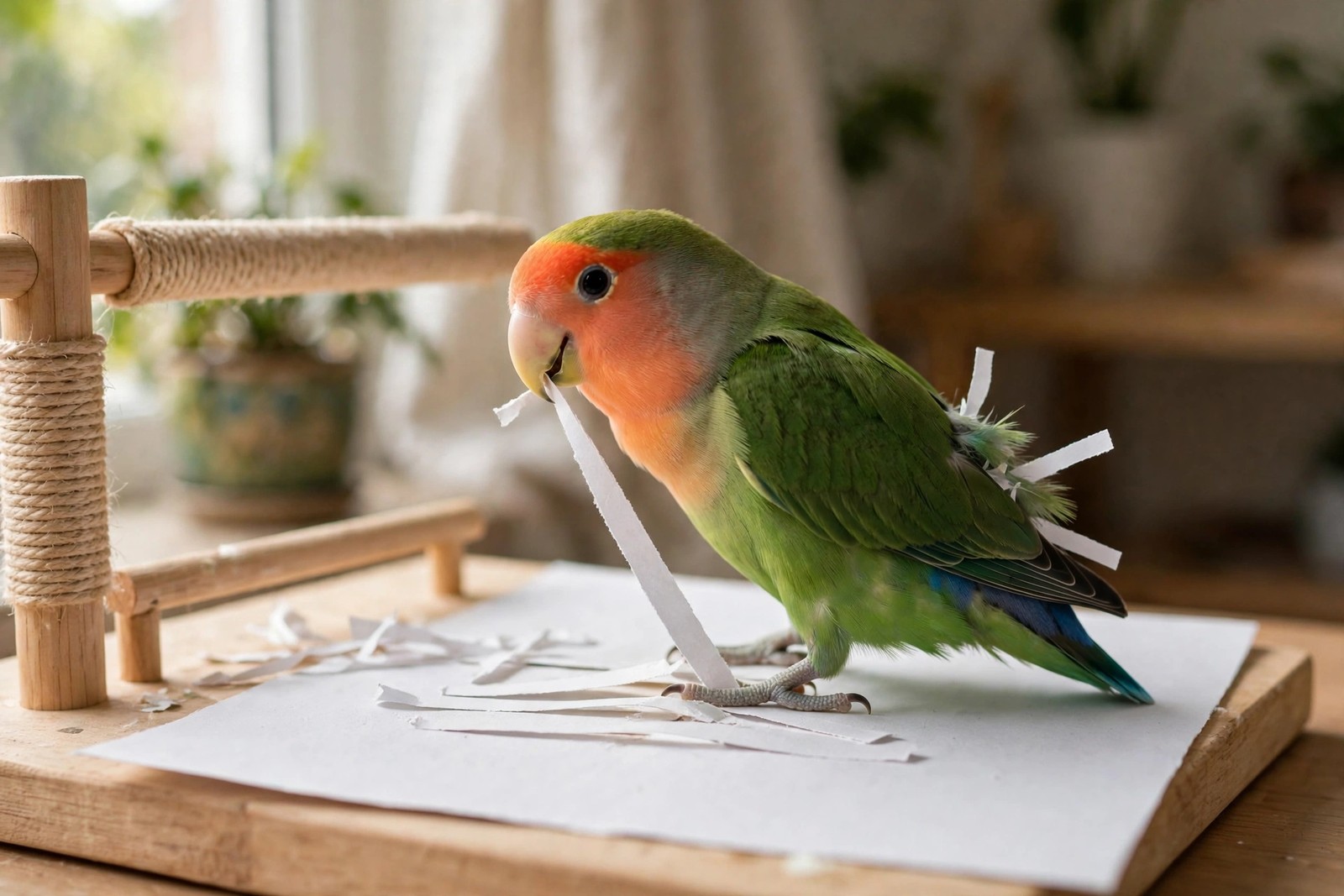
If your lovebird reduces every paper receipt, book page, and cage liner to ribbons, you are watching instinct working exactly as designed. Shredding is to a lovebird what digging is to a terrier: a hardwired occupation that fills hours, exercises the beak and jaw, and, for hens, forms part of nesting behaviour.
Why Hens Shred With Such Focus
Female peach-faced lovebirds are famous for cutting remarkably even strips from paper or leaves and tucking each strip into the feathers of the rump, so a bundle can be flown back to a chosen nest site. Males of some lovebird species carry material in the beak instead, but the strip-and-tuck display is the classic hen behaviour owners notice. A hen working through a sheet of plain paper strip by strip is practising a carrying system, not destroying things out of boredom or spite.
Shredding also serves quieter purposes. Stripping, chewing, and manipulating fibres is foraging-adjacent work that occupies a bird bred to process vegetation all day, and it gives a single pet lovebird, without a mate to preen and squabble with, something absorbing to do. A bird with nothing shreddable will often redirect the same drive onto cage covers, curtains, or its own feathers, which is why supplying the behaviour is better than suppressing it.
Safe Shreddables to Offer on Purpose
- Plain white or brown paper, paper towel, and unprinted cardboard, offered in sheets, tubes, or woven through cage bars.
- Soft natural materials sold for birds, such as balsa, yucca, cork bark, woven palm leaf, and clean pine cones from a pet supplier, rotated so novelty keeps interest up.
- Paper parcels with a prized food piece folded inside, so shredding also becomes foraging and ends with a reward.
Avoid glossy magazine pages, heavily dyed paper, receipts, and anything with glue, staples, or a strong chemical smell. Supervise the first sessions with a new material, and remove pieces that have been dragged through water or droppings.
When Shredding Tips Into Nesting Mode
There is one judgment call. Endless shredding plus a hen guarding a dark corner, a food bowl, or a paper-filled hideaway can signal full nesting mode. Persistent nesting behaviour can encourage egg laying in a hen with no mate, and chronic laying depletes calcium and carries health risks. You do not need to ban paper, but do remove enclosed nest-like spaces, keep sleep at a steady 10 to 12 hours of darkness, avoid petting down the back, and rearrange the cage furnishings if she becomes possessive over one spot. If she lays an egg or strains and seems unwell, speak to an avian veterinarian rather than experimenting at home.
Expect the floor around the cage to lose this battle; a washable mat underneath saves daily sweeping battles. Replace the view of mess with the useful measure: a lovebird shredding paper for hours is a bird whose strongest natural drive has a safe outlet. Logging toy rotations and noting any shift toward nest guarding in KinsLe Care Teams helps everyone in the household supply the shredding without accidentally supplying a nest site.