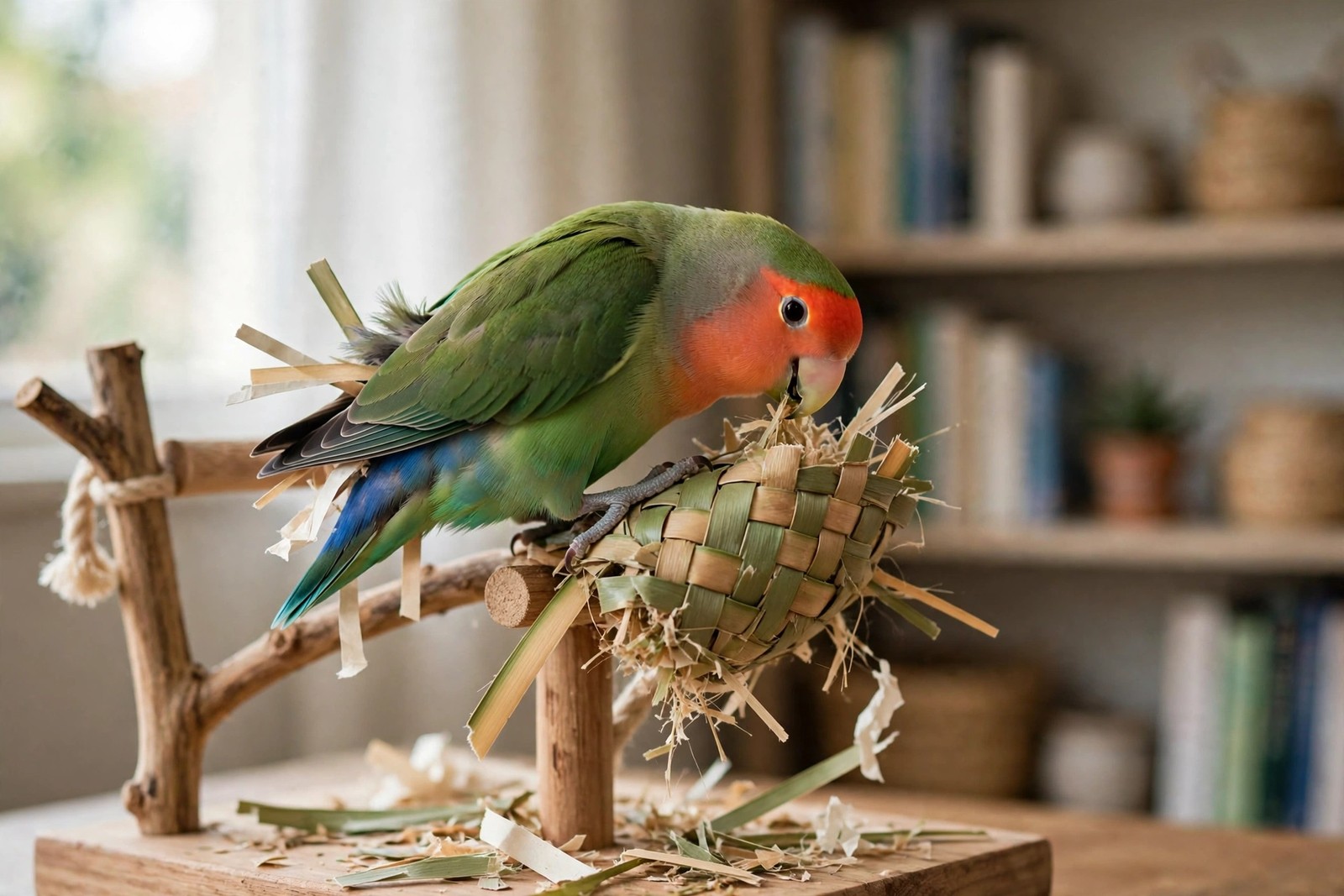
If your lovebird reduces paper, cardboard, curtains, and book spines to ribbons, you own a completely normal lovebird. Shredding is not naughtiness and it is not a habit you can train away. Female lovebirds in particular are famous for cutting neat, uniform strips from leaves and paper and tucking them into their rump feathers to transport back to a nest cavity — one of the most distinctive behaviours of the species. Males shred too, though often with less transport behaviour. That drive needs an outlet every single day; your job is to choose the outlet.
Supply Things That Are Meant to Be Destroyed
Stock the cage and any regular out-of-cage station with a rotating menu of shreddables:
- Plain, undyed paper and paper cups woven through cage bars or threaded on a skewer.
- Woven palm-leaf and seagrass strips, finger traps, and woven mats made for birds.
- Soft woods such as balsa and cork, thin pine slats, and yucca pieces that give satisfying resistance.
- Cardboard and clean egg-box pieces for ripping, plus foraging parcels with food hidden inside shredded paper.
Replace destroyed items promptly. A lovebird whose last toy is a bare string will go shopping in your living room. Rotation matters as much as quantity — a toy that has hung ignored for a fortnight becomes interesting again after a week in a drawer. Always check that materials are bird-safe and undyed, remove frayed fabric that could trap a toe, and skip anything with glue, gloss, or heavy printing.
Protect What Is Yours by Managing Access
Redirection fails if the forbidden options are easier to reach than the legal ones. Keep paperwork, books, and important documents off the surfaces where your lovebird plays, move houseplants out of range, and cover or relocate cables and wooden trim near favourite perches. Give your bird a defined play stand stocked with shredding material, and return them to it — with fresh paper — whenever they wander toward your belongings. Praise and a small treat for shredding the right thing teaches the location, not suppression of the urge.
Watch the Nesting Dial
Generous shredding material satisfies the drive, but a bird who is also given a dark, enclosed nest box, a cosy hideaway, or long daylight hours may tip into persistent egg-laying, which carries real health risks for hens. If your lovebird is laying eggs, becoming fiercely cage-territorial, or shredding obsessively around one hidden corner, remove enclosed hideaways, keep a consistent, shorter day length with uninterrupted sleep, and talk to an avian veterinarian about managing hormones. Shredding paper at a play stand is healthy; building a nest in your bookshelf with eggs in it is a conversation to have with your vet.
A steady supply chain is what makes redirection stick day after day, and KinsLe Care Teams lets you assign the daily shredding restock and weekly toy rotation to different family members, with each swap timestamped so the cage never sits empty of legal targets.