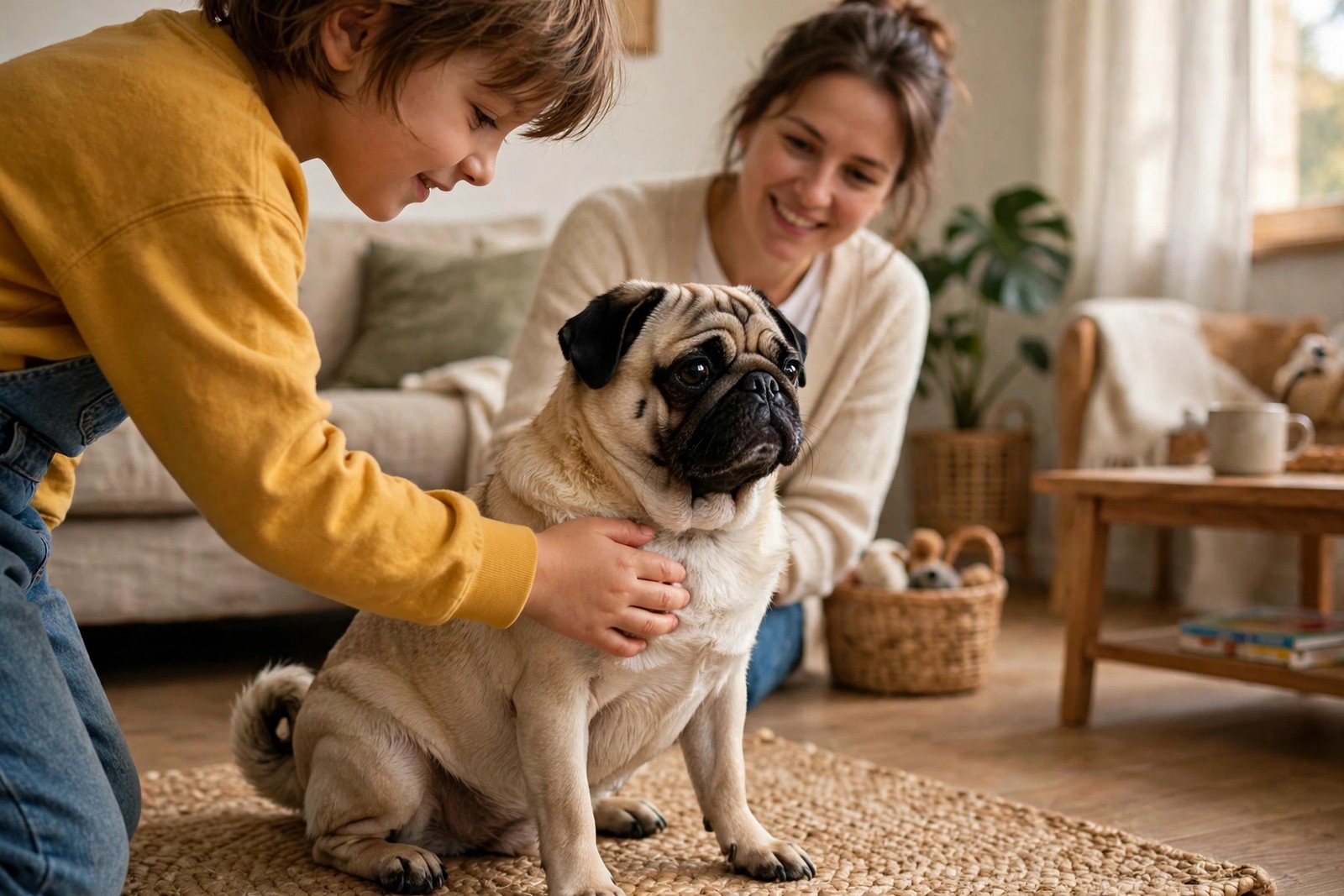
Yes, Pugs are generally good with children, and their temperament explains why. Pugs are sturdy, funny, and patient companion dogs, solidly built for their size, and they usually thrive on the noise, games, and constant company of family life. A Pug tends to follow children from room to room, clown for an audience, and forgive the ordinary clumsiness of childhood far more readily than a delicate or sharp-tempered breed would.
The supervision rule never relaxes
Good with children never means unsupervised with children. An adult should be present and paying attention whenever a young child and the Pug are together, especially while both are still learning each other. Toddlers fall, grab, and shriek without warning, and even a patient dog can be startled by a fall onto its body or a fistful of ear. Supervision lets you interrupt the moment play tips from happy to overwhelming, for either side, and it models calm behavior that children copy.
Gentle handling rules for children
Teach children a short, clear set of rules and enforce them kindly every time. Stroke the chest and shoulders instead of reaching over the head; never climb on, ride, or lie across the dog; leave the Pug alone while it sleeps, eats, or chews; and let the dog walk away whenever it chooses. Give the Pug a bed or crate in a quiet corner that is strictly off-limits to children, so retreat is always available. Children who learn these rules with a Pug usually carry respectful habits to every dog they meet afterward.
The flat-faced caution
Pugs are flat-faced dogs, and that shape limits how well they cool themselves. Excited play with children on a warm day can push a Pug into heavy, noisy breathing and overheating faster than a long-nosed dog. Keep vigorous games short, move play indoors or into shade in summer heat, offer water often, and end the game yourself if breathing gets loud or the dog slows. A Pug who is struggling to breathe comfortably, drooling heavily, or unsteady needs prompt veterinary care. Calm games, training tricks, and supervised cuddle time suit this breed better than marathon chase sessions anyway.
Play ideas that suit a Pug and a child
Choose games that keep arousal low and breathing easy. Short fetch rounds down a hallway, find-the-treat games under cups, gentle tug with a soft toy that ends before excitement spikes, and simple trick training where the child gives cues and rewards all work well. Teach the child to end a game by standing still and calling an adult if the Pug gets mouthy, jumps up repeatedly, or starts breathing hard. Rotating calm activities keeps the friendship rich without the rough wrestling that small children attempt and flat-faced dogs pay for afterward, especially in warm rooms or summer yards. End every session while both child and dog are still happy, because a good last minute is what both of them remember and bring to the next meeting.
Matching the individual dog
Breed character is a starting point, not a guarantee. Meet the individual Pug, watch how it responds to movement and noise, and ask about its history with children before deciding. Puppies need protection from being dropped or squeezed, while an older Pug may prefer older, quieter children. Clear household rules, written down where every caregiver can see them, keep expectations consistent. Through KinsLe, Transferrable Profiles holds what a Pug is like with children, how it prefers to be handled, and how its days are structured, so that knowledge travels with the dog if its household ever changes.